Why Do We Regret Some Impulse Purchases?
"Why do impulse purchases feel exciting at first but lead to regret later? Learn about buyer’s remorse, purchase regret, post-purchase rationalization, and what to do next."
Why Do We Regret Some Impulse Purchases?
You buy something on a whim and feel great about it.
Maybe you spot a jacket you never planned to buy. Maybe a new gadget catches your attention while scrolling. Maybe a limited-time sale makes you feel that waiting could mean missing out. At the moment, the purchase feels exciting. You finally have the thing you wanted.
Then the feeling changes.
A few days later, you see the item sitting unused and think, Why did I buy this? You check your bank balance and feel uncomfortable. Or you realize you already own something almost identical.
What felt like a great decision suddenly feels like a mistake.
This is impulse purchase regret, and it is not always as simple as buying something you do not like. The more interesting question is: Why can something feel exciting when you buy it but feel wrong later?
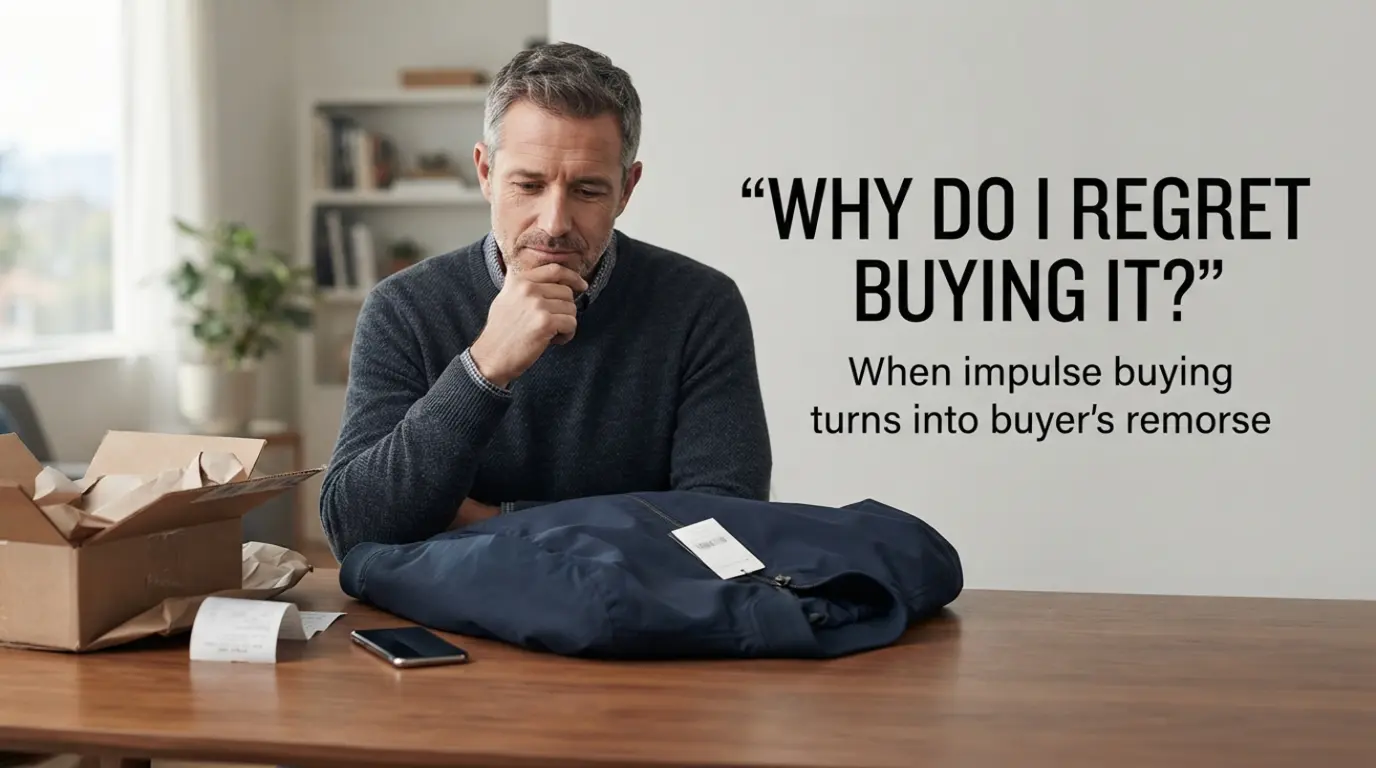
The answer often lies in the gap between the emotional experience of wanting something and the practical reality of owning it.
The Gap Between Wanting and Owning
Impulse purchase regret often begins when the emotional appeal of a purchase fades and the reality of the decision becomes easier to see.
Before buying, your attention is focused on what the purchase might give you: excitement, novelty, convenience, confidence, enjoyment, or simply the pleasure of having something new.
After buying, you have the actual product, the actual price, the actual space it takes up, and the actual opportunity cost of the money you spent.
That shift can change how the purchase feels.
This does not mean the original excitement was fake. You were simply experiencing the purchase from a different perspective. Before buying, you were imagining the experience. After buying, you were living with the result.
That difference can explain why you regret buying something even when you genuinely wanted it at the time.
Why Impulse Purchases Feel Exciting at First
An impulse purchase can create a burst of excitement because several things happen at once.
There is anticipation: I could have this.
There is novelty: This is new.
There is instant gratification: I don't have to wait.
And there is the satisfaction of turning a desire into something tangible.
The product can also become connected to an imagined future. You might picture yourself wearing the clothes, using the gadget every day, decorating your home, or finally starting the hobby you have been thinking about.
For a short time, the purchase can feel like more than an object. It can represent something you want your life to feel like.
That is why impulse spending can feel so different before and after the transaction. The excitement is often connected not only to the product, but also to the anticipation of owning it.
Why Does the Excitement Fade?
Once the purchase is complete, the item eventually becomes an ordinary possession.
The new shoes become the shoes in your closet. The gadget becomes another device on your desk. The decorative item becomes part of the room. The package that felt exciting when it arrived eventually becomes something you barely notice.
The emotional intensity naturally changes.
This does not automatically mean the purchase was bad. A useful purchase can become ordinary too.
But when novelty was a major part of the appeal, the difference can be noticeable.
The question changes from “Do I want this?” to “What am I actually doing with this?”
That is often where purchase regret begins.
The Reality Check After an Impulse Purchase
The reality of a purchase can expose things that were easy to overlook before buying.
You may notice the price more clearly once the excitement has passed. You may realize that the item does not fit easily into your routine. Or you may discover that you rarely have a reason to use it.
Sometimes the reality check is simply seeing the item sitting unused.
An impulse purchase can look attractive in an online store but feel very different when it is sitting in a drawer.
You may also notice duplication. Perhaps you already have three similar shirts, another pair of headphones, several skincare products, or a kitchen appliance that performs almost the same function.
If you want more everyday examples, see Impulse Buying Examples: 10 Everyday Purchases You Don’t Plan to Make.
The uncomfortable realization is often not “I hate this.”
It is: “I didn't really need another one.”
Buyer’s Remorse vs. Purchase Regret
Buyer’s remorse describes the uncomfortable feeling that can appear after making a purchase. You may question whether you made the right decision, feel guilty about spending money, or wish you had waited.
Purchase regret is a broader way of describing dissatisfaction or second thoughts about something you bought.
The terms overlap, and people often use them interchangeably.
Importantly, regret does not necessarily mean the product itself is bad.
You can experience buyer’s remorse after buying something useful. You might simply feel that you paid too much, bought it at the wrong time, or could have used the money elsewhere.
Likewise, you can regret buying something while still liking the item. You might love an expensive pair of shoes but regret spending that much on them.
The emotional reaction and the objective quality of the purchase are not always the same thing.
Why Some Purchases Cause Immediate Regret
Sometimes regret appears almost immediately.
You place the order and think, That was probably unnecessary.
This can happen when the purchase creates an obvious conflict. Perhaps the price is higher than expected, you realize you already own something similar, or the decision happened so quickly that you barely considered it.
You may also experience a sudden feeling of losing control: Why did I just spend that much?
In these cases, impulse buying regret can arrive before the product even reaches your door.
Why Other Purchases Become Regrettable Later
Delayed regret is different.
At first, you may be happy with the purchase. You use the product, enjoy it, and feel that the decision was worthwhile.
Then the item gradually becomes less relevant.
You stop using it. You discover that you have better alternatives. Or you realize that it does not fit your lifestyle as well as you imagined.
Sometimes the regret only appears when another expense comes up and you realize the money could have been useful elsewhere.
Delayed regret often happens because experience replaces expectation. You had to actually live with the purchase before you could understand whether it belonged in your life.
Post-Purchase Rationalization: “It Was Worth It”
After an impulse purchase, people do not always immediately admit that they may have made a poor decision.
Instead, they may look for reasons to make the purchase feel reasonable.
I'll use it all the time.
It was on sale.
I'll have it for years.
It's actually an investment.
I deserved something nice.
Sometimes these statements are completely reasonable. Other times, they are explanations we create because accepting the purchase feels easier when we can defend it.
This is post-purchase rationalization: trying to make a decision feel more reasonable after it has already been made.
The justification may temporarily reduce doubt, but it does not answer the more useful question: Does this purchase actually work for me?
For a deeper look at this pattern, see The “It’s an Investment” Trap: Why We Justify Expensive Impulse Buys.
“I Already Have Something Like This”
One of the simplest sources of regret is duplication.
You buy something and later realize you already own something that performs almost the same job.
This can happen with clothes, shoes, beauty products, electronics, home accessories, kitchen equipment, and many other everyday purchases.
Owning multiple versions of something is not automatically a problem. Sometimes having options is useful.
The problem is buying another version without realizing that what you already own meets the same need.
That realization can make an impulse purchase feel particularly pointless because it did not solve a problem. It simply added another possession.
Expectation vs. Reality
Before buying, imagination has no practical limitations.
You can picture the product fitting perfectly into your life. You might imagine wearing the clothes more often, using the equipment every day, becoming more organized, or finally getting serious about a hobby.
The imagined version of the purchase can be more exciting than the actual experience.
Then reality arrives.
The clothes do not get worn as often as expected. The gadget stays in its box. The hobby never becomes part of your routine.
This is why something can be desirable without ultimately being useful.
The better question is not only “Do I like this?”
It is also: “Do I like the reality of having this?”
Why Expensive Impulse Purchases Can Feel More Painful
An expensive impulse purchase can create stronger regret because there is more money at stake.
But price alone does not determine whether you will regret something.
A relatively inexpensive purchase can be frustrating if you never use it. A costly purchase may produce little regret if you use it constantly and genuinely value it.
The emotional pain often comes from the gap between the cost and the value you feel you received.
If you spend a significant amount and later conclude that the purchase did not improve your life, that gap can feel particularly large.
This is also why guilt about spending should not automatically be treated as proof that a purchase was wrong.
Ask yourself: Did I make a purchase I genuinely cannot afford, or am I simply uncomfortable because spending money feels difficult?
Those are different problems.
Why Does an Impulse Purchase Feel Good Then Feel Wrong?
The emotional sequence often looks like this:
Want → excitement → purchase → temporary satisfaction → reality → doubt → regret
You want something, anticipation builds, and buying it provides a quick feeling of satisfaction. Once that feeling fades, you begin evaluating the purchase differently.
You notice the price, the lack of use, the duplication, or the difference between what you imagined and what actually happened.
That creates doubt, and if the doubts become strong enough, regret follows.
The important point is that the person evaluating the purchase afterward has more information than the person making the decision.
You now know what it actually cost, how often you use it, whether you needed it, and how it fits into your life.
Changing your mind after gaining that information is not necessarily a failure.
Before You Decide You Regret It
Not every moment of doubt means you made a bad purchase.
Sometimes you like the item but feel guilty about spending money. Sometimes the purchase is expensive but affordable and genuinely useful. Sometimes you simply experience the normal emotional drop that comes after getting something new.
Before deciding what to do, ask yourself:
- Do I actually dislike the item, or do I just feel guilty about spending the money?
- Will I realistically use it?
- Can I afford it?
- Did I buy something I already own?
- Would I choose it again if I were making the decision today?
- Can I still return it?
These questions help separate emotional discomfort from practical regret.
If the item is useful, affordable, and something you would still choose today, the initial doubt may not mean you need to get rid of it.
But if you would not make the same decision again, never use it, or the purchase creates financial pressure, that is useful information too.
What to Do When You Regret an Impulse Purchase
If you realize you genuinely do not want the purchase, do not assume you have to keep it simply because you already paid for it.
First, check whether you can cancel the order. If it has not shipped, cancellation may be the simplest solution.
If you already received the item, check the return window and return conditions. Do not wait simply because you think you will decide later.
The idea that “I can always return it” can make a purchase feel safer than it actually is. Return deadlines and conditions can affect whether returning it remains possible. See The Return Window Illusion: Why “I Can Always Return It” Rarely Happens.
If returning the item is not practical or appropriate, you can also choose to accept the purchase rather than repeatedly punishing yourself for it.
The useful part is understanding what happened.
How to Learn From an Impulse Purchase You Regret
Regret becomes more useful when you treat it as information rather than proof that you are bad with money.
Look backward and ask what happened immediately before the purchase.
Was I bored?
Was I stressed?
Was I influenced by a sale?
Did I feel pressure to buy quickly?
Did I tell myself it was an investment?
Did I think I could always return it?
The goal is not to find someone to blame. It is to identify the pattern.
Looking at broader responses can also help put your own experience in context, which is what the 2026 impulse buying survey explores.
If boredom repeatedly leads to online shopping, boredom may be the trigger worth addressing. If sales repeatedly make you buy things you would not normally purchase, urgency may be changing your decisions.
If expensive purchases are repeatedly justified as “investments,” that language may deserve a closer look.
You can also use the Impulse Purchase Calculator when repeated impulse purchases make it difficult to see the bigger picture. Looking at your spending over time can make patterns easier to recognize.
The objective is not perfection. It is better awareness before the next purchase happens.
What Impulse Purchase Regret Can Teach You
A regretted purchase can reveal something that was difficult to see while you were shopping.
Maybe you value having fewer possessions. Maybe you prefer saving money for larger goals. Maybe you discover that you enjoy browsing more than owning. Or perhaps certain types of sales consistently make you buy things you do not need.
Each of these insights can improve future decisions.
The goal is not to eliminate every spontaneous purchase. Some unplanned purchases are enjoyable, useful, and completely reasonable.
The goal is to become better at recognizing the difference between wanting something right now and wanting to live with the purchase afterward.
FAQ
Why do I regret impulse purchases?You may regret an impulse purchase when the excitement of buying fades and you start evaluating the actual cost, usefulness, or fit of the item in your everyday life. You may also discover that you already own something similar or that you were more excited by the idea of owning it than actually using it.
Why does buying something feel good and then bad?Buying something can provide anticipation, novelty, and instant satisfaction. Once the purchase becomes an ordinary possession, those feelings can fade. You may then notice the price, lack of use, duplication, or the difference between what you expected and what actually happened.
Is buyer’s remorse normal?Yes. Buyer’s remorse describes doubt or discomfort after making a purchase. It does not automatically mean the purchase was objectively bad. Sometimes the feeling reflects financial guilt or uncertainty rather than a genuinely poor buying decision.
How do I stop regretting things I buy?Start by identifying what causes your regret. Look at whether you tend to buy when bored, stressed, rushed, influenced by discounts, or convinced that you can always return the item. Creating more time between wanting something and purchasing it can also help you evaluate whether you want the actual product or simply the excitement of buying it.
What should I do if I regret an impulse purchase?First, pause before trying to justify it. Check whether you can cancel the order or return the item, and pay attention to the return window. If you cannot or do not want to return it, consider what the purchase taught you about your spending pattern rather than repeatedly blaming yourself.
Sometimes the financial wake-up call is even bigger than a single small mistake. For a closer look at how accumulated habits can suddenly derail years of disciplined saving, read I Was "Good With Money" for Years, Then Blew $4,000 in One Season.
For a closer look at how expensive hobbies can fuel hidden patterns of rationalized spending, read I Spent $300 Chasing the Perfect Coffee. Here's What It Actually Taught Me.
Conclusion
Regretting an impulse purchase does not necessarily mean you made a foolish decision.
Sometimes you discover that you genuinely do not want the item. Sometimes you realize you already own something similar. Sometimes the purchase is perfectly useful, but you feel uncomfortable about the money you spent.
What matters is understanding the difference.
The most useful question is:
“What changed between wanting it and living with it?”
Maybe the excitement disappeared. Maybe reality exposed a need that was never there. Maybe the price became more important once the purchase was complete. Or maybe you simply learned something about yourself that you could not have known before owning the item.
That is the useful side of impulse purchase regret.
The goal is not to never regret a purchase. It is to understand your patterns well enough that the next decision is more deliberate.