Impulse Buying Examples: 10 Everyday Purchases
"Discover 10 everyday impulse buying examples, from online shopping and checkout add-ons to clothing, gadgets, food, and limited-time offers."
Impulse Buying Examples: 10 Everyday Purchases You Don't Plan to Make
You probably don't think of yourself as an impulse buyer.
After all, you may carefully plan your rent, groceries, subscriptions, or major purchases. You compare prices, read reviews, and wait for the right time to buy. Yet you might still come home with a shirt you never intended to purchase, add an extra item to an online order, or buy something simply because it was marked “50% off.”
That's what makes impulse buying easy to miss. It doesn't always look like reckless spending. Often, it looks like a small decision that feels reasonable in the moment.
An impulse purchase is an unplanned purchase made with little or no prior intention to buy the item. The decision can be influenced by convenience, emotion, discounts, scarcity, social pressure, or simply seeing something at the right moment.
The following impulse buying examples show how ordinary purchases can turn into unplanned spending—and why they happen.
What Is Impulse Buying?
Impulse buying happens when you decide to purchase something without having planned to buy it beforehand.
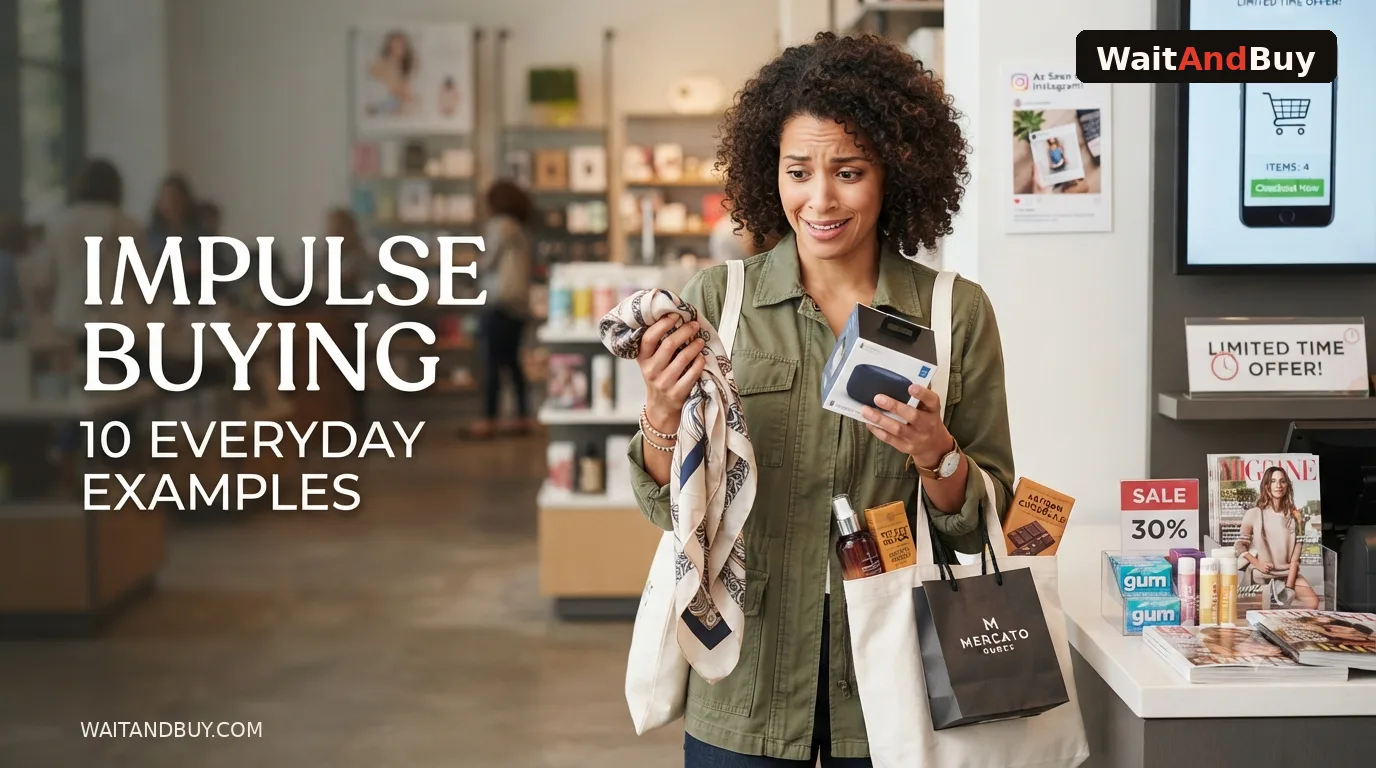
The key distinction is intention.
If you planned to buy a pair of shoes, researched your options, compared prices, and then purchased them, that is generally a planned purchase.
If you went shopping for a shirt, saw a pair of shoes on sale, and bought them because they looked great and the discount seemed too good to miss, that's an impulse purchase.
Impulse shopping can happen online or in physical stores. It can involve something inexpensive, such as a snack, or something considerably more expensive, such as a gadget.
The price isn't what makes a purchase impulsive. The lack of prior intention is.
10 Everyday Impulse Buying Examples
1. Adding an Extra Item to Your Online CartYou go online to buy a phone charger.
While checking out, you notice a cable organizer, wireless stand, or another accessory recommended underneath the product. You weren't looking for it when you opened the website, but it looks useful enough to add to your cart.
This is a common example of an impulse purchase because the additional item wasn't part of your original shopping plan.
The trigger is often convenience. Because you're already placing an order, adding another item feels easy. A recommendation such as “Customers also bought” can make the purchase feel even more natural.
The important question is: “Would I have searched for this item if it hadn't appeared in front of me?”
If the answer is no, you may be looking at an impulse purchase.
2. Buying Clothes Because They're CheapYou walk into a clothing store intending to browse. You don't need anything specific.
Then you find a shirt for a price that seems almost impossible to ignore.
You think, “It's only $500,” so you buy it.
The purchase may feel harmless because the individual amount is small. But the fact that something is inexpensive doesn't make it planned.
This is particularly common with clothing because stores constantly introduce new styles, seasonal collections, clearance sections, and discounts. A low price can reduce the mental resistance to buying something you didn't originally want.
It's one reason why cheap clothes can become expensive over time when small impulse purchases accumulate. For a deeper look at this pattern, see Cheap Clothes & Impulse Buying.
The trigger here is usually a combination of low perceived cost, novelty, and the feeling of getting a bargain.
3. Buying a Snack or Drink at the CheckoutYou have already finished your grocery shopping. Then you see chocolate, chips, chewing gum, or a cold drink near the checkout counter. You weren't planning to buy anything else, but you grab one while waiting.
This is one of the simplest impulse buying examples because the purchase happens at the final stage of a shopping trip.
The item is positioned where you're already making a purchase decision, and the cost often feels insignificant compared with the rest of your basket.
The trigger isn't necessarily hunger. It can simply be visibility and convenience. You didn't go to the store looking for that particular snack; you encountered it at exactly the moment when buying it was easy.
4. Buying a Gadget Because It Looks UsefulYou're scrolling through an online store when you see a small gadget that solves a problem you didn't realize you had.
Maybe it's a mini projector, smart light, kitchen gadget, charging accessory, or device designed to make an everyday task slightly easier.
You think, “I could actually use this.” A few minutes later, you've ordered it.
The gadget may genuinely be useful. That's not what determines whether the purchase was impulsive.
If you weren't considering buying it before you saw it and made the decision immediately, it fits the definition of an unplanned purchase.
The trigger is often novelty combined with perceived usefulness. The product introduces a new possibility, and your brain starts imagining how much better or easier life could be with it.
5. Buying a Beauty Product Because of a RecommendationYou enter a store to buy your usual shampoo or skincare product.
You notice a new serum, moisturizer, makeup product, or hair-care item recommended by an influencer or displayed prominently in the store. You weren't planning to buy it, but you become curious.
You read the packaging, see a few positive reviews, and decide to try it.
This can be an impulse purchase even when you've researched the product for several minutes. Research performed after encountering the product doesn't necessarily mean the purchase was planned.
The trigger can be social proof, curiosity, novelty, or the desire to improve your appearance. The purchase becomes especially easy to justify when the product promises a noticeable improvement to your skin, hair, appearance, or routine.
6. Buying Something Because It's “Only Available Today”You're browsing an online store when a banner appears: “Sale ends tonight.”
Or perhaps: “Only 2 left.”
Suddenly, a product you weren't planning to buy feels urgent. Instead of simply deciding whether you want the product, you start worrying that waiting could mean losing the opportunity.
That's a classic environment for impulse buying.
The trigger is scarcity and FOMO (fear of missing out). The perceived opportunity to buy something before it disappears can make immediate action feel more important than careful consideration.
Scarcity marketing can be particularly persuasive because it changes the question from “Do I need this?” to “What if I can't get it later?” For a deeper look at this pattern, see FOMO & Scarcity Marketing: The Impulse Buying Trap.
7. Buying Food Because You're Stressed, Bored, or TiredYou have had a long day.
You aren't particularly hungry, but you open a food-delivery app and start browsing. One restaurant looks appealing. Then you notice a dessert or side dish and order more than you originally intended.
Food purchases can become impulsive because emotions can influence what seems appealing in the moment. Stress, boredom, tiredness, and the desire for comfort can all make an immediate reward feel more attractive.
The important distinction is whether the food order was already part of your plan or whether the emotion of the moment pushed you toward something you hadn't intended to buy. A planned meal ordered after a busy day isn't necessarily impulse buying; adding extra items simply because they feel rewarding in the moment may be.
8. Buying Something to Reach a Free-Shipping ThresholdYour cart total is $1,850.
Free shipping starts at $2,000.
Instead of paying the shipping fee, you add a $200 item you don't particularly need.
It feels like you're saving money, but you've still spent more money than you originally intended. The extra item wasn't part of the original purchase decision; the shipping threshold created a new reason to spend.
The trigger is perceived savings. The logic sounds sensible: “I'm getting free shipping.” But if you wouldn't have bought the additional item without the threshold, the purchase was driven by the offer rather than your original need.
For a seasonal look at how temporary novelty drives spending, read Halloween Costume Shopping: Buy, Wait, Borrow, or Rent?.
9. Buying a Limited-Edition Product You Didn't Need
A brand announces a limited-edition color, collaboration, seasonal product, or special release. You weren't looking for the product, but now it feels temporary.
That changes how the decision feels. Instead of thinking, “Do I need this?”, you may start thinking, “If I don't buy it now, I might never get another chance.”
Limited-edition products can create a strong sense of urgency because scarcity can increase perceived value.
This doesn't mean every limited-edition purchase is impulsive. A collector who has been waiting months for a specific release has made a planned purchase.
But if you discover the product unexpectedly and immediately buy it because you fear missing out, it's a strong example of impulse buying.
10. Buying Something After Seeing It Repeatedly on Social MediaYou see a product on Instagram.
Then you see it again on TikTok. Later, another creator mentions it.
Eventually, you become curious enough to search for it yourself. You weren't originally shopping for the product, but repeated exposure makes it familiar and starts creating interest.
Eventually, you buy it.
This is an interesting example because the final purchase may feel like a considered decision. You might even research the product before purchasing it. But if repeated exposure created the initial desire and you had no prior intention of buying it, the purchase may have started as an impulse.
The trigger is repetition, social proof, curiosity, and familiarity. Seeing the same product repeatedly can keep it in your attention until an otherwise unnecessary purchase starts to feel like something you should consider.
What Do These Impulse Buying Examples Have in Common?
Although the purchases above look different, they share a common pattern: you weren't necessarily planning to buy the item before something changed the situation.
You saw a product at checkout. A discount made something seem like a bargain. A recommendation introduced something new. A limited-time offer created urgency. A free-shipping threshold encouraged an extra purchase. Social media repeatedly exposed you to a product. Or an emotion made an immediate reward more appealing.
In other words, impulse buying often starts with a trigger rather than a need.
That's why simply telling yourself to “spend less” isn't always enough. You also need to recognize the situations that make unplanned purchases more likely.
Impulse Buying vs. Planned Buying
Not every spontaneous-looking purchase is necessarily bad, and not every unplanned purchase is irresponsible.
The difference between planned and impulse buying is mainly about the decision process.
| Planned Purchase | Impulse Purchase |
|---|---|
| You identify a need beforehand | You discover the desire in the moment |
| You may research alternatives | You often decide quickly |
| You have considered the cost | The price may be justified afterward |
| You have time to reconsider | The purchase feels urgent |
| The item was already on your list | The item wasn't part of the plan |
The same product can therefore be either planned or impulsive depending on how and why the decision happened. Buying something after deliberately deciding you need it is different from buying that same item because an offer or emotion suddenly made it appealing.
Why Do We Make Impulse Purchases?
There isn't always one reason. Impulse purchases can result from several triggers working together.
DiscountsA discount can make an item feel cheaper than its original price, even when you weren't planning to buy it.
FOMOFear of missing a deal, product, trend, or opportunity can make waiting feel risky.
ScarcityMessages such as “limited stock” or “ending soon” can create pressure to make a decision immediately.
ConvenienceOne-click checkout, saved payment details, and personalized recommendations remove friction from the purchase process.
EmotionsStress, boredom, excitement, loneliness, and even celebration can influence spending decisions.
HabitSometimes impulse shopping isn't a dramatic decision. It becomes part of a routine: open an app, browse, find something interesting, buy it.
Recognizing these triggers is useful because you can start noticing when you're being prompted to buy rather than when you actually decided you wanted something.
How to Tell If a Purchase Is an Impulse Purchase
Before buying something, ask yourself a few simple questions:
- Was I planning to buy this before I saw it?
- Would I still want it if there were no discount?
- Would I buy it if I had to wait 24 hours?
- Am I buying it because I need it or because I don't want to miss out?
- Where will I use it, and how often?
- Do I already own something that does the same job?
You don't have to answer “no” to every question to decide against a purchase. The purpose is to create enough distance between seeing something and buying something to make the decision more deliberate.
How Much Are Your Impulse Purchases Really Costing You?
Individual impulse purchases can seem insignificant. A $300 purchase doesn't feel like a major financial decision. Neither does $500 or $800.
But repeated purchases can add up, and the cost isn't always limited to money. Buying something you didn't really want can also lead to buyer's remorse, the feeling of regret that can come after the excitement of a purchase fades.
That can create an uncomfortable cycle: you make an unplanned purchase, enjoy the immediate reward, later question whether you needed it, and then feel frustrated when you notice similar purchases accumulating.
If you're curious about how much your unplanned spending may be costing you each month or year, the Impulse Purchase Calculator can help you estimate the total and see how much you might save by reducing impulse purchases.
The goal isn't necessarily to eliminate every spontaneous purchase. It's to understand your pattern well enough to decide which purchases are actually worth making.
FAQ
What is an example of impulse buying?Buying a shirt you didn't plan to purchase because it is heavily discounted is a simple example of impulse buying. Other examples include adding unnecessary items at checkout, buying limited-edition products because they're scarce, or purchasing gadgets after unexpectedly seeing them online.
What are common impulse purchases?Common impulse purchases include clothing, snacks, beauty products, gadgets, accessories, home décor, food delivery extras, and products purchased during sales or limited-time promotions.
What triggers impulse buying?Common triggers include discounts, convenience, FOMO, scarcity, emotions, social media exposure, product recommendations, and shopping habits.
Is buying something on sale an impulse purchase?It can be. A sale doesn't automatically make a purchase impulsive. If you planned to buy the item and waited for a sale, the purchase was likely planned. If you bought it only because you unexpectedly saw the discount, it may be an impulse purchase.
What is the difference between impulse buying and planned buying?Planned buying starts with an intention to purchase something. Impulse buying generally starts when you encounter an item, offer, or situation that creates an immediate desire to buy something you hadn't planned to purchase.
Why do I keep making impulse purchases?Repeated impulse purchases can become a habit reinforced by convenience, emotional rewards, discounts, FOMO, and frequent exposure to products. Identifying the situations that trigger your purchases can help you interrupt the pattern.
Are small impulse purchases a problem?A single small purchase may not matter much. The bigger issue is repetition. Frequent small purchases can accumulate into a meaningful amount of spending over time, particularly when they happen without much consideration.
For guidance on keeping holiday grocery trips intentional and avoiding last-minute cart inflation, read 7 Thanksgiving Grocery Shopping Do's & Don'ts.
Conclusion
Impulse buying doesn't always look like an expensive shopping spree.
More often, it looks like a shirt you didn't need, an extra item added to your cart, a snack at checkout, a gadget that suddenly seemed useful, or a product you bought because a sale was ending.
That's what makes impulse purchases worth noticing. The individual decision can feel completely reasonable while the pattern remains invisible, and the regret may only appear later, when the excitement has disappeared.
The next time you're about to buy something unexpectedly, pause for a moment and ask one simple question:
“Was I planning to buy this before I saw it?”
If the answer is no, you don't necessarily have to walk away. But giving yourself a little time to think can turn an automatic purchase into a deliberate decision.