Halloween Costume Shopping: Buy, Wait, Borrow, or Rent?
"Should you buy a Halloween costume or wait? Compare buying, waiting, borrowing, renting, DIY, and reusing to make a more intentional choice."
Halloween Costume Shopping: Buy, Wait, Borrow, Rent, DIY, or Reuse?
A Halloween costume can be one of those purchases that feels completely justified in the moment. You see a costume you love, imagine wearing it to a party, picture the photos, and suddenly buying it seems like the obvious choice. But then Halloween passes, the costume goes into a closet, and you are left wondering whether that one night was really worth the price.
That does not mean buying a Halloween costume is automatically a bad decision. Sometimes buying is exactly what makes sense. You may have a specific character in mind, need something quickly, or know you will wear the costume again. The more useful question is not simply, “Do I need this?” but “What makes this purchase worth it for me?”
That is the idea behind the WaitAndBuy approach: pause before you buy, then decide with a clearer head. For a Halloween costume, that pause can reveal options you might not consider when you are focused on finding something to buy immediately.
Before buying a costume, there are several alternatives worth considering: buy it, wait, borrow it, rent it, make it yourself, or reuse something you already own. Each option has different trade-offs involving cost, convenience, time, creativity, and how often you are likely to use the result.
The goal is not to avoid Halloween shopping. It is to make the decision after the initial excitement has had a chance to settle.
Why Halloween Costumes Are Easy to Buy on Impulse
Halloween creates a particularly strong reason to shop because the purchase is connected to an event. Unlike buying another everyday item, a costume has a deadline. There is a party, a celebration, a school event, or a night out approaching, and suddenly the pressure to find something feels urgent.
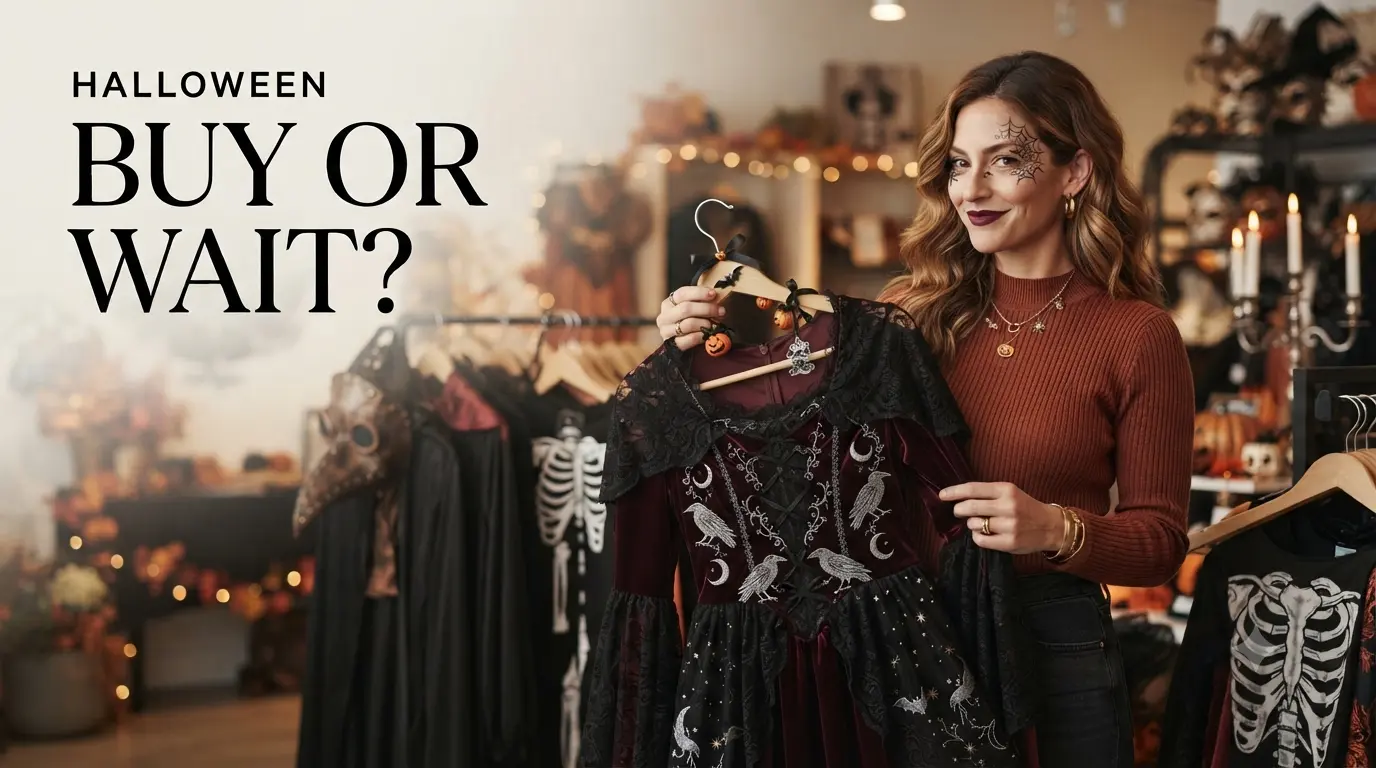
There is also an emotional component. Costumes are about more than clothing. They allow people to temporarily become a character, create a joke, participate in a theme, or simply have fun with friends. When a costume captures that idea perfectly, it can be easy to focus on how exciting it will be to wear it rather than what happens after Halloween.
Limited-time availability can make the decision even harder. A costume may appear to be selling quickly, a particular size may be unavailable later, or an online store may emphasize that Halloween is approaching. Some of that urgency may be legitimate, but urgency can also shorten the amount of time you spend deciding whether you actually want the item.
That is where pausing can be useful. You are not necessarily trying to talk yourself out of the purchase. You are giving yourself enough time to separate wanting the costume from wanting to buy the costume right now.
The Real Question: Will It Be Worth It After Halloween?
A Halloween costume does not need to be practical in the traditional sense to be worth buying. Some purchases are made primarily for enjoyment, and that is perfectly reasonable. The important part is understanding what you are actually paying for.
Suppose you find a costume for $60. If you wear it once, you might initially think that sounds expensive for a single evening. But if the costume makes the event significantly more enjoyable for you, you may decide that the experience is worth the money. On the other hand, if you are buying it mainly because it looks exciting online and you already suspect it will sit untouched afterward, waiting may be the better choice.
You can also ask whether the costume has a life beyond one Halloween. Could you wear parts of it separately? Could you use it for another themed event? Could you alter it or combine it with clothes you already own? Could someone else in your household use it later?
The point is not to turn Halloween into a spreadsheet. It is simply to look one step beyond the moment when the purchase feels exciting.
Buy: When Purchasing Makes Sense
Sometimes buying is the simplest and best option. If you have found a costume that fits your budget, you genuinely like it, and you expect to get enough use or enjoyment from it, there is nothing inherently wrong with purchasing it.
Buying can make particular sense when the costume is difficult to create yourself or when the convenience matters. A ready-made costume can save time, especially when Halloween is close and you have other things to organize. It can also provide a specific look that would be difficult to reproduce with items already in your closet.
The key is to distinguish between “I want this costume” and “I feel like I need to buy this costume immediately.” If you would make the same decision after thinking about it for a while, the purchase is more likely to be intentional rather than purely impulsive.
Wait: When the Excitement Is Doing the Selling
Waiting is useful when you are unsure. You might love the costume, but you may also be reacting to the excitement of finding it.
Instead of buying immediately, save the costume somewhere you can return to later. Give yourself some time before making the final decision. During that pause, ask yourself whether you still want the same costume, whether the price still feels reasonable, and whether you have another option that would work just as well.
Waiting can also reveal practical problems. Maybe you discover that shipping will not arrive before Halloween. Perhaps you realize you already own most of what you need for a similar outfit. Or you might simply lose interest.
None of those outcomes means the pause failed. In fact, discovering that you no longer want something is one of the useful outcomes of waiting.
Borrow: Could Someone You Know Already Have One?
Borrowing is easy to overlook because shopping makes buying feel like the default solution. But costumes are often exactly the type of item that can make sense to borrow.
A friend, sibling, partner, or family member may already have something that works. It does not necessarily have to be an exact costume, either. A jacket, hat, wig, accessory, dress, suit, or pair of boots could provide the main element of an outfit.
Borrowing can be particularly useful when you are interested in creating a costume for one specific event but do not expect to use the pieces again. It can also turn the process into part of the social experience rather than treating the costume as another product to purchase.
Of course, borrowing comes with its own considerations. You need to take care of the item, return it on time, and make sure the owner is comfortable lending it. But when those conditions work, borrowing can solve the costume problem without adding another rarely used item to your closet.
Rent: Pay for the Costume Without Keeping It
Renting sits somewhere between buying and borrowing. You get access to a costume for the event without taking permanent ownership of it.
This can be useful for costumes that are elaborate, expensive, or highly specific. If you want a particular look but have no reason to keep the costume afterward, renting can make more sense than purchasing something that will spend most of the year in storage.
There may be rental fees, deposits, deadlines, and cleaning or return requirements, so renting is not automatically the cheapest option. But price is not the only consideration. You are also paying for temporary access rather than permanent ownership.
That distinction can be valuable when the main thing you want is the experience of wearing the costume, not the costume itself.
DIY: Make the Costume Part of the Experience
A DIY costume does not have to mean building everything from scratch. It can be as simple as combining clothes you already own with a few inexpensive accessories.
The appeal of DIY is not necessarily saving the most money. It can also be about creating something more personal. A homemade costume can be deliberately imperfect, humorous, creative, or tailored to a particular person.
The trade-off is time. A costume that looks simple in your head can take much longer to assemble than expected. If you are making something because you enjoy the process, that time may be part of the fun. If you are attempting a complicated project the night before Halloween because you are trying to avoid buying anything, the result may feel very different.
DIY works best when the effort itself is something you are willing to enjoy.
Reuse: Start With What You Already Own
Before searching online or visiting a store, take a look at what you already have.
You may already own clothing and accessories that can become the foundation of a costume. A black outfit can become several different characters depending on the accessories. A suit can be transformed with makeup or props. Old clothes can sometimes be combined in ways that create an entirely different look.
Reusing what you own also changes the shopping question. Instead of asking, “Which costume should I buy?” you can ask, “What costume can I create from what I already have?”
This does not mean you should never buy anything new. You may discover that one missing accessory would complete the costume. That is a different decision from buying an entire outfit when you already have most of what you need.
A Simple Halloween Costume Decision Framework
Once you have considered the alternatives, the decision can be reduced to six straightforward choices:
- Buy when you genuinely want the costume, the price fits your budget, and the purchase feels worthwhile.
- Wait when you are uncertain or feel pressured to decide immediately.
- Borrow when someone you know has something suitable that you can use temporarily.
- Rent when you want a specific or elaborate costume without needing to own it afterward.
- DIY when you have the time and enjoy creating something yourself.
- Reuse when what you already own can become a costume with little or no additional shopping.
The point is not to choose the option that costs the least. It is to choose the option that makes the most sense for the experience you want and the trade-offs you are comfortable with.
What If You Still Want to Buy It?
Sometimes you will go through the alternatives and still want the costume. That is fine.
A pause is not successful only when it ends with you not buying something. Sometimes the pause confirms that you actually want the item. You looked at what you already owned, considered borrowing or renting, thought about the price, and decided that buying was still the option you preferred.
That is a very different experience from buying something simply because you saw it and felt an immediate need to own it.
Intentional spending is not about eliminating fun purchases. It is about making room for purchases you actually feel good about making.
The One-Night Purchase Test
Before buying a Halloween costume, ask yourself a few simple questions:
Would I still want this if I had seen it a week ago?
Do I already own something that could work?
Could I borrow or rent something instead?
Am I buying the costume because I genuinely want it, or because I feel rushed?
Will I be happy with this purchase after Halloween is over?
If I knew I would only wear it once, would I still think the price was worth it?
There are no universally correct answers. The purpose of the questions is to make the decision visible before you make it.
FAQ
Is it worth buying a Halloween costume for one night?It can be. A costume does not have to be used repeatedly to be worth buying. If the enjoyment, convenience, or experience is worth the price to you, a one-time purchase can be reasonable. The important thing is knowing that you are making that trade-off consciously.
Should I buy or rent a Halloween costume?Consider buying if you expect to use the costume again or want to keep it. Renting may make more sense if you want an elaborate or specific costume for a single event and have little interest in owning it afterward. Compare the total cost, convenience, and effort involved in both options.
Is it cheaper to make your own Halloween costume?Not necessarily. DIY can reduce spending when you already have suitable clothes and materials, but buying supplies specifically for a DIY costume can add up. Time is another consideration. DIY is most useful when you have the materials, time, and interest to make the process worthwhile.
What can I use instead of buying a Halloween costume?You can borrow a costume, rent one, create an outfit from clothes you already own, or buy only a small accessory to complete an existing outfit. Reusing existing items can sometimes produce a costume without requiring an entirely new outfit.
How can I avoid impulse buying Halloween costumes?Give yourself a pause before purchasing, especially if you are shopping because something looks exciting or you feel pressured by an approaching event. Save the item, compare alternatives, check what you already own, and return to the decision after the initial excitement has settled.
Is buying a Halloween costume an impulse purchase?It can be, but it is not automatically one. The same costume can be an impulse purchase for one person and an intentional purchase for another. The difference is often in how the decision is made rather than in the type of product being purchased.
Conclusion
Halloween costumes are supposed to be fun, and there is no need to turn every purchase into a test of perfect financial discipline. The more useful approach is to slow down just enough to decide what you actually want.
Maybe you buy the costume because it is exactly what you had in mind. Maybe you wait and decide against it. Maybe a friend has something you can borrow, a rental gives you the look without the long-term clutter, or a few things in your closet can become a costume you like even more.
Buy, wait, borrow, rent, DIY, or reuse are simply different ways to reach the same goal: enjoying Halloween without automatically assuming that buying something new is the only way to do it.
And if you do decide to buy, you can feel better about the purchase when you know you chose it after the excitement had a chance to settle.