The “It’s an Investment” Trap: Impulse Buying
"Why do we call expensive wants “investments”? Learn how this spending trap makes impulse purchases feel justified and harder to resist."
The “It’s an Investment” Trap: How Impulse Buying Justifies Expensive Purchases
“I’ll wear these shoes for years.”
“This laptop is an investment in myself.”
“It’s expensive, but I’ll use it every day.”
“A cheaper version won’t last as long.”
“I’ll save money in the long run.”
These statements can all be perfectly reasonable. Sometimes spending more on quality, durability, or functionality really is the smarter decision. The problem starts when the reasoning appears after you already want to buy something.
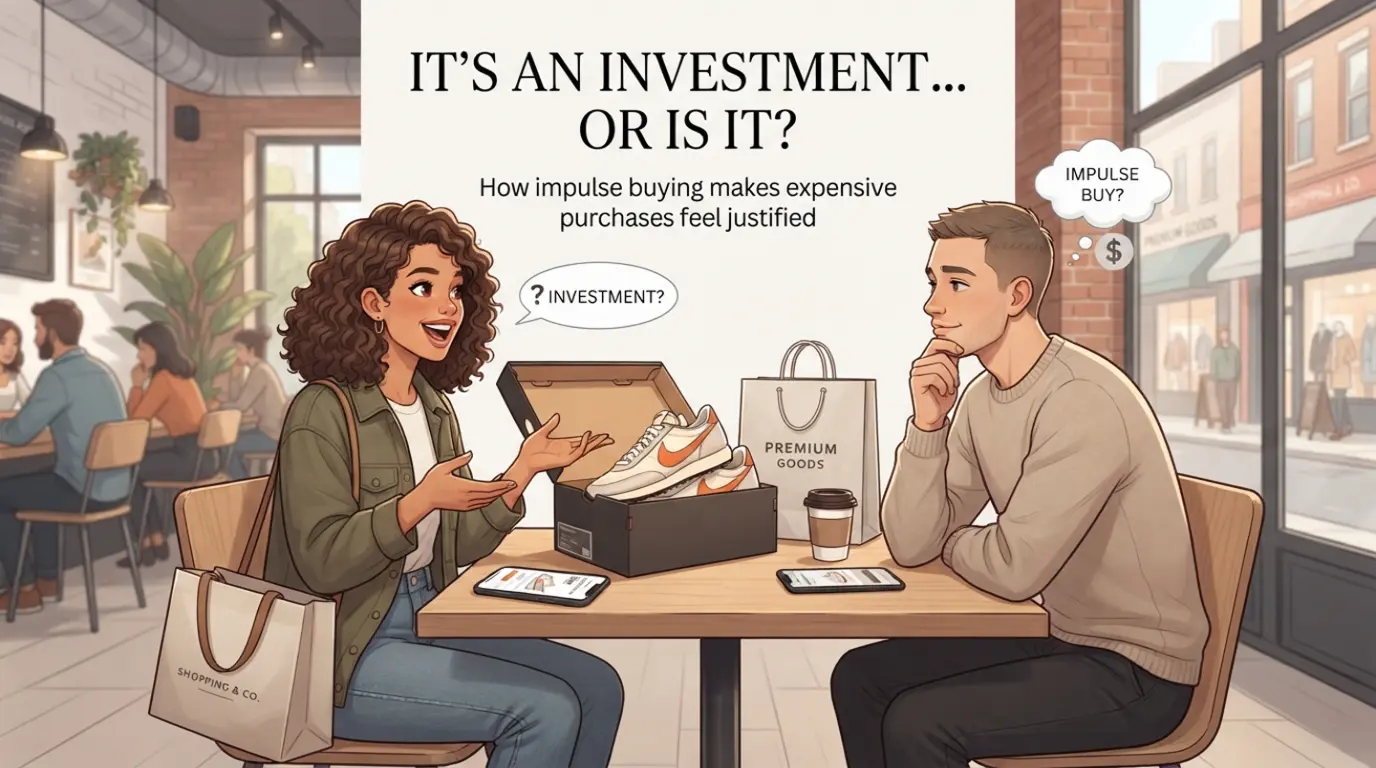
You see an expensive product you were not planning to purchase. You feel excited about it, and then your mind starts building a case for why buying it is actually sensible. Suddenly, an unplanned purchase becomes an “investment,” and impulse spending feels more like responsible financial decision-making.
That does not mean the purchase is automatically bad. An expensive purchase is not necessarily an impulse purchase, and calling something an investment is not automatically a rationalization. The important question is whether you are evaluating the item's value before deciding to buy or creating reasons to justify a decision you have already emotionally made.
What Does the “It’s an Investment” Justification Look Like?
The “it’s an investment” argument usually sounds logical because it focuses on future benefits rather than today's spending. You might tell yourself that the product will last longer, save money, improve your productivity, make your life easier, or get used for years.
Those benefits can be real. But they can also become convenient reasons for buying something you suddenly want.
Consider two different situations.
You have been using an old laptop for work, it is becoming unreliable, and you have spent several weeks comparing replacement options. You choose a more expensive model because it meets your requirements and fits comfortably within your budget. Calling that an investment may be entirely reasonable.
Now imagine seeing the same laptop unexpectedly while browsing online. You were not planning to replace your current computer, but you become excited by the features and discount. After deciding you want it, you tell yourself, “This is an investment in myself.”
The product is the same, but the decision-making process is completely different.
That distinction is important when thinking about expensive impulse buys. The price alone does not determine whether a purchase is impulsive. The timing, intention, emotional urgency, and reasoning behind the decision matter too.
Why Does Calling Something an “Investment” Make Spending Feel More Acceptable?
The word investment changes how we frame the transaction.
“I’m spending $1,000 on this” focuses attention on the money leaving your account. “I’m investing $1,000 in something I’ll use for years” shifts attention toward future benefits.
That shift can make an expensive purchase feel more responsible. It can also change the question you are asking yourself. Instead of wondering whether you actually need the item, you may start looking for evidence that the item is worth its price.
This matters because something can be worth the money without being worth buying.
A $1,500 laptop might genuinely be worth $1,500 to someone who uses it every day for work. But if you already have a perfectly functional laptop and had no intention of replacing it, the product's quality does not automatically make the purchase necessary.
This is where rationalizing purchases becomes subtle. You may not be lying to yourself. You may simply be focusing on the strongest reasons to buy while giving less attention to the reasons to wait.
Common Examples of “Investment” Purchases
The same reasoning can appear across many areas of shopping.
Clothing, Shoes, and BagsPremium clothing is easy to justify with durability and versatility. You might think, “I'll wear this jacket for years,” or “These shoes will last longer.”
Those statements may be true, but they should be evaluated against your actual habits. If your wardrobe already contains several similar items that you rarely use, expected durability does not answer whether you need another one.
Gadgets and ElectronicsTechnology often comes with a productivity argument: “This laptop is an investment in myself,” or “This tablet will make me more productive.”
That may be true when the product supports a specific need, job, education, or project. But if your current device works well and you were not planning to replace it, imagining all the productive things you could do with the new one may be more about the excitement of buying than actual need.
Furniture and Home PurchasesA better chair, mattress, desk, sofa, or appliance can genuinely provide more comfort or last longer. Spending more can make sense when the product solves a real problem and the additional quality matters to you.
The warning sign is assuming that a higher price automatically means better value. A $700 chair may be worth it if you work from home and will use it for years, but it is harder to justify if you already have a functional chair and simply fell in love with the new one.
Kitchen Appliances and SubscriptionsCoffee machines, mixers, air fryers, productivity apps, gym memberships, and similar purchases can all receive the same treatment: “I’ll use it every day,” “This will save me money,” or “This will finally make me more productive.”
A $300 coffee maker is a useful example of how an expensive purchase can feel justified by the promise of getting more value from it.
The useful question is whether that expected benefit is based on your actual behavior. If you rarely use similar products or frequently abandon subscriptions, your past habits may be a better predictor than your plans at the moment of purchase.
Three Ways We Talk Ourselves Into an Expensive Purchase
Several common arguments can make impulse purchases feel financially responsible.
“The Cost Per Use Will Be Low”Cost per use can be a useful way to evaluate a purchase. If you spend $300 on something you use hundreds of times, the cost per use may be reasonable.
The problem is that future usage is easy to overestimate. It is simple to imagine wearing expensive shoes three times a week for five years, but your actual behavior may be very different.
Before using cost per use to justify a purchase, look at how often you really use similar products. Real behavior is usually more useful than optimistic predictions.
“The Quality Will Save Me Money”Buying quality can sometimes reduce replacement costs. But “I'll save money in the long run” can also become a convenient justification for spending more today.
Instead of asking whether the expensive option is better, ask whether the difference matters for your particular needs. If a cheaper product performs everything you need and should last reasonably well, paying substantially more may not provide enough additional value.
“I Can Always Resell It”Resale value can be a legitimate consideration, particularly for products that tend to retain value. But it should not become the main reason for buying something you otherwise would not purchase.
Future resale prices are uncertain, and selling an item takes time and effort. Recovering some money later also does not change the fact that you are spending money today.
Why Do We Change the Question From “Do I Need This?” to “Is This Worth the Money?”
This is one of the easiest ways to miss an impulse purchase.
“Do I need this?” asks whether the item belongs in your life. “Is this worth the money?” assumes that buying it is already a reasonable option and asks whether the price seems acceptable.
Imagine seeing a $250 pair of shoes. Instead of asking whether you need another pair, you compare them with $350 shoes and decide that $250 is actually a good deal.
You have answered the wrong question.
A better sequence is to first ask whether you need or intentionally want the item, then consider its specific purpose, realistic usage, alternatives, and affordability. Only after those questions should you decide whether the price represents good value.
This approach does not mean choosing the cheapest option. It simply makes sure that value comes after intention, not instead of intention.
Genuine Value-Based Purchase vs. “It’s an Investment” Rationalization
Rather than asking whether an expensive product is good or bad, look at how the decision happened.
A genuine value-based purchase usually involves:
- Planning: You were considering the purchase before the buying moment.
- Need: You have a specific reason for owning it.
- Affordability: It fits comfortably within your finances.
- Research: You compared alternatives and considered the trade-offs.
- Realistic use: Your expected usage is based on your actual habits.
- Low urgency: You can wait and still feel comfortable with the decision.
- Sudden desire: You were not planning to buy it until you saw it.
- Post-hoc reasoning: The reasons appeared after you wanted it.
- Optimistic predictions: You assume you will use it far more than similar products.
- Selective research: You focus mainly on information that supports buying.
- Financial reframing: The price feels less important because you call it an investment.
- Emotional urgency: Waiting feels difficult because the excitement is strongest right now.
None of these signs automatically means you should walk away. Together, however, they are a good reason to pause before making an expensive purchase.
How Post-Purchase Rationalization Works
Sometimes the justification comes after the purchase rather than before it.
You click “Buy,” the excitement begins to fade, and you start wondering whether you made the right decision. At that point, you may look for reasons that make the purchase feel more sensible.
You might focus on the discount, quality, durability, expected usage, or potential savings. “It’s an investment” becomes a way of explaining the purchase to yourself after the emotional decision has already happened.
This is known as post-purchase rationalization. It does not mean every reason you give yourself afterward is false. You may genuinely discover benefits you had not considered.
The warning sign is when the reasons seem designed mainly to eliminate doubt rather than help you evaluate the decision honestly.
This is closely related to The “Treat Yourself” Trap: Emotional Spending & Impulse Buying, where the desire to reward yourself can make spending feel more justified than it really is.
How “Investment” Purchases Can Turn Into Buyer’s Remorse
The investment story often feels strongest at the moment you buy. You imagine wearing the shoes regularly, using the laptop for years, cooking with the appliance every day, or becoming more productive with the new gadget.
Real life eventually provides the answer.
Maybe you barely use the item. Maybe your existing product was already good enough. Maybe the money would have been more useful elsewhere. That's when the original investment argument can start to feel less convincing.
The problem may not have been the product itself. It may have been the gap between what you imagined the purchase would do for you and what it actually did.
That gap is one reason some impulse purchases eventually lead to buyer’s remorse. If you're trying to create more distance between wanting something and buying it, 5 Ways to Stop Impulse Shopping offers practical ways to build that pause into your shopping habits.
Warning Signs That “It’s an Investment” Is Actually an Impulse-Buying Justification
Pay attention when several warning signs appear together.
You weren't planning to buy it. The product appeared unexpectedly, but suddenly feels essential.
Your reasons appeared after the excitement. You wanted the item first and started building the financial argument afterward.
You're relying heavily on future behavior. “I'll use it every day” is doing more work than your actual habits.
The discount feels like the main reason to buy. A lower price can reduce the cost without creating a need.
You're comparing only products, not alternatives. You are deciding between the $300 and $500 versions without considering whether you should buy either.
You feel compelled to defend the purchase. If you immediately need a long explanation for why the purchase is sensible, that discomfort can itself be useful information.
Waiting feels unusually difficult. If the thought of waiting makes the purchase feel much less attractive, emotional urgency may be influencing the decision.
These signs do not mean “don't buy it.” They mean give yourself enough distance to decide without the pressure of the moment.
If expensive impulse purchases are becoming a pattern, it can also help to look at the bigger picture rather than judging each purchase individually. The Impulse Purchase Calculator can help you see what repeated impulse spending may add up to over time.
Is It Really an Investment?
Before making an expensive purchase, ask yourself:
- Did I plan to buy it before seeing it?
- Would I still buy it without the discount?
- Can I comfortably afford it?
- Do I have a specific use for it?
- How often will I realistically use it?
- Am I comparing alternatives?
- Would I buy it today if there were no emotional excitement?
You do not need to answer “yes” to everything for the purchase to be reasonable. The checklist is designed to slow down the decision enough to separate genuine value from emotional urgency.
If several answers make you hesitate, that is a good reason to wait rather than automatically buy.
A Practical Test Before Making an Expensive Purchase
If you are struggling to decide, try this four-step test.
1. Remove the Word “Investment”For a moment, describe the item simply as a purchase.
Ask yourself, “If this were just an expensive thing I want, would I still buy it?”
This can reveal how much of your reasoning depends on the label rather than the actual value.
2. Use Your Real HabitsDo not base the decision entirely on what you might do. Look at what you already do.
If you rarely wear similar shoes, rarely use kitchen gadgets, or rarely finish paid subscriptions, that pattern matters.
3. Include “Don't Buy” as an OptionCompare the product with cheaper alternatives, but also compare it with keeping your money.
Sometimes the best alternative is not another product. It is waiting.
4. Give the Decision Some TimeIf the purchase is not urgent, wait. The purpose is not to eliminate every desire but to find out whether the desire remains once the excitement, discount, social pressure, or fear of missing out has faded.
If you still want the item after the pause and the numbers still make sense, you may have something much more valuable than an impulse: a deliberate decision.
You Don't Have to Buy Cheap to Spend Intentionally
Intentional spending does not mean choosing the cheapest product every time.
Sometimes the higher-priced option really is better. It may last longer, perform better, feel more comfortable, or suit your needs more closely.
Frugal living is not about avoiding every expensive purchase. It is about making sure your spending reflects your priorities rather than momentary emotions.
The same applies to emotional spending and emotional shopping. The goal is not to eliminate enjoyment from shopping. It is to recognize when excitement is making the decision before your reasoning has had a chance to catch up.
A premium product can be an excellent purchase. It just does not become an investment simply because you called it one.
Conclusion
“It’s an investment” is not a bad argument. Sometimes it is exactly the right argument. A reliable laptop can support your work, a durable pair of shoes can provide years of use, and a quality appliance can genuinely be better value than repeatedly replacing cheaper versions.
The problem is when the investment story becomes a permission slip for an impulse purchase.
If you were already planning to buy the item, researched your options, can afford it, have a specific use for it, and believe the additional cost provides meaningful value, there may be nothing wrong with spending more.
But if you discovered the product unexpectedly, felt an immediate urge to buy it, and only then started thinking about durability, cost per use, resale value, productivity, or “saving money in the long run,” take a step back.
Ask the simpler question first: “Would I still want this if I gave myself time to think?”
Sometimes the answer will still be yes, and that's okay. The purpose of a pause is not to stop you from buying things you genuinely value. It is to make sure you are buying them because you decided they are worth having, not because you found a convincing story for why you should buy them.
FAQ
Why do I justify expensive purchases?Expensive purchases can create more pressure to feel that the decision was sensible. Framing an item as an “investment” can shift attention from the money being spent to the benefits you expect to receive. Sometimes that reasoning is valid; other times, it can be a way of rationalizing a purchase you already emotionally want.
Is an expensive purchase an impulse buy?Not necessarily. An expensive purchase can be intentional if you planned for it, researched it, can afford it, and have a clear reason for buying it. Impulse buying is more about how and why the decision was made than the price of the item.
How do I know if something is actually worth the money?First decide whether you genuinely need or intentionally want it. Then consider your realistic usage, affordability, alternatives, quality, durability, and the additional value provided by the higher price. Something can be worth its price without being worth buying.
What is post-purchase rationalization?Post-purchase rationalization is the process of creating or emphasizing reasons that make a purchase feel more reasonable after the decision has already been made. For example, someone may focus on quality, durability, or a discount to reduce doubts about an unplanned purchase.
How can I stop justifying purchases?Create a pause before buying. Ask whether you planned the purchase, whether you would buy it without the discount or emotional excitement, how often you will realistically use it, and whether you have considered not buying it. Giving yourself time can make it easier to distinguish genuine value from an impulse.