The “Treat Yourself” Trap: Emotional Spending & Impulse Buying
"Is “treat yourself” becoming an excuse to shop? Learn how emotional spending turns into impulse buying and how to reward yourself without overspending."
The “Treat Yourself” Trap: Emotional Spending
“I deserve a treat.”
It sounds harmless, and most of the time, it is. You finish a difficult week and order your favorite meal. You reach an important goal and buy something you've been wanting. You have a terrible day and decide that a little comfort would be nice.
There is nothing inherently wrong with rewarding yourself. Small treats can make everyday life more enjoyable. The problem begins when shopping becomes your automatic reward system, when stress leads to an online order, boredom leads to browsing, hard work leads to a purchase, and every personal milestone comes with a trip to the checkout page.
The question isn't whether you are allowed to treat yourself. You are. The more useful question is: Are you choosing the reward, or has shopping become the reward you automatically reach for?
What Does “Treat Yourself” Spending Mean?
Treat yourself spending is discretionary spending you make because you want to enjoy something, celebrate, comfort yourself, or acknowledge an accomplishment.
It might be a restaurant meal after a long week, a new pair of shoes after reaching a goal, a book you've been wanting, or a small purchase simply because you feel like you've earned it.
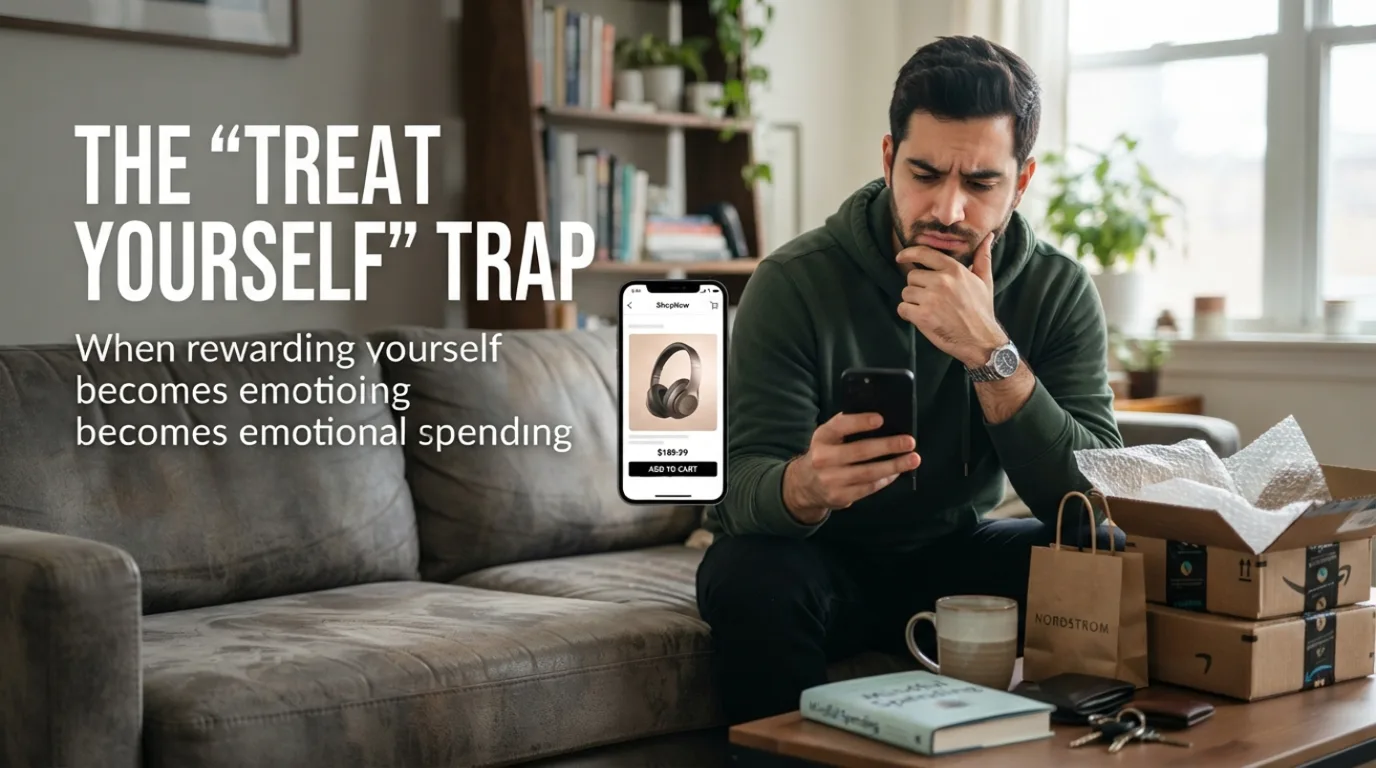
A treat doesn't have to be necessary to be worthwhile. You can intentionally spend money on something you don't need. That's part of discretionary spending. The important question is whether the purchase is intentional, affordable, and genuinely wanted.
For example, consider the difference between these two decisions. You might say, “I finished a project I've worked on for months, and I've been planning to buy these headphones with money I've set aside.” That's an intentional reward. But if you think, “Work was awful today. I feel terrible. I'm going to buy these headphones because I deserve something nice,” the emotional situation is playing a much bigger role in the decision.
The item could be exactly the same. What changes is the reason behind the purchase.
Why Does Rewarding Yourself Feel So Good?
Rewards are appealing because they can create feelings of pleasure, relief, celebration, or accomplishment. Shopping can make those feelings especially immediate because the process of finding something, imagining owning it, and completing the purchase can be exciting.
This is one reason shopping can become connected to emotions. After a stressful day, ordering something can feel like a small act of comfort. After a demanding week, buying something can feel like recognition for your effort. After reaching a goal, a purchase can make the achievement feel tangible.
The pattern can become especially powerful when the same response is repeated. Stress arrives, shopping provides a moment of relief, and the experience makes shopping feel like a reliable way to change your emotional state.
That doesn't mean every reward purchase is emotional spending. It means that when shopping repeatedly becomes the response to how you feel, it is worth paying attention to the pattern.
Christmas gift-giving can create a similar emotional spending pattern, especially when guilt, comparison, and reciprocity influence how much you feel you should spend.
For a closer look at how stress, boredom, exhaustion, and other emotional triggers can influence impulse buying, read Mood Tracking Cured My Impulse Buying Habit.
When Does Treating Yourself Turn Into Overspending?
Treating yourself becomes more concerning when the purchase is no longer an occasional, deliberate choice but a predictable response to an emotion or situation.
Imagine someone who decides to reward themselves with one small purchase after a difficult week. The next time work is stressful, they do it again. Then they start shopping when they're bored, disappointed, exhausted, or frustrated. Eventually, almost every uncomfortable feeling creates a reason to spend.
The individual purchases may not seem particularly serious. A meal here, a shirt there, or another online order might feel insignificant on its own. But when spending repeatedly becomes a way of managing emotions, the total can become much harder to ignore.
A useful test is to step away from the individual purchase and look at the decision itself. Are you buying something you genuinely wanted before the emotional moment? Can you comfortably afford it? Would you still want it after the feeling has passed? And if you didn't buy it, would you still be able to feel rewarded?
Those questions help separate intentional self-reward from automatic spending.
Is It a Treat or an Impulse Purchase?
An intentional treat and an impulse purchase can look remarkably similar from the outside. Both involve buying something you want, and neither necessarily involves buying something you need.
The difference is usually in how the decision happens.
An intentional self-reward is a conscious choice. You know what you want, you've considered the purchase, it fits comfortably within your spending plans, and you are comfortable with the decision.
Planned discretionary spending is similar. You may decide in advance that you'll spend a certain amount on entertainment, dining, clothing, or a personal reward. The purchase doesn't need to be essential to be intentional.
Emotional spending happens when your emotional state becomes a major reason for spending. You may be stressed, disappointed, lonely, bored, exhausted, or excited, and buying something becomes a way to create relief or pleasure.
Impulse buying involves acting with little planning or consideration. You may see something unexpectedly, feel an immediate desire for it, and buy it before giving yourself enough time to decide whether you actually want it.
These categories can overlap. An emotional purchase can also be an impulse purchase, while an intentional treat can be planned well in advance.
The goal isn't to label every purchase perfectly. It's to understand what is driving the decision.
The Connection Between Emotional Spending and Impulse Buying
Emotional spending and impulse buying aren't exactly the same thing, but they often reinforce each other.
Suppose you have had an exhausting day and open a shopping app because you want to feel better. You weren't planning to buy anything. Then you see a jacket you like. Within minutes, you've convinced yourself that you deserve it and placed the order.
The emotional trigger came first. The impulse purchase followed.
Another person might experience the same stressful day but already have a reward planned: “If I finish this project, I'll set aside $100 for something I've wanted.” When the time comes, they buy the item they had already chosen and budgeted for.
Both people spend money, but the decisions are very different.
This is why emotional shopping can be difficult to recognize. The purchase itself may be perfectly reasonable. The more important question is whether the emotion created the need to shop.
Common “I Deserve This” Rationalizations
The phrase “I deserve this” isn't automatically a problem. Sometimes you really have worked hard and genuinely want to celebrate. The problem occurs when the phrase becomes a convenient justification for spending.
A difficult day can become, “I had a terrible day, so I'll order something.” A productive week can become, “I worked hard this week, so I deserve this.” Reaching a goal can become, “I hit my goal, so I'll buy myself something.” And a prolonged stressful period can become, “It's been a stressful month; I need something nice.”
None of these thoughts is inherently unreasonable. The useful question is whether the purchase was something you genuinely wanted or whether the emotional situation created the desire to spend.
Try asking yourself: “Would I still want this if I already felt completely fine?”
If the answer is yes, you may simply be considering something you genuinely want. If the answer is uncertain, waiting can give you useful information.
Sometimes we also rationalize a purchase after we've already decided to make it. We focus on why the purchase makes sense rather than examining why we wanted it in the first place. For another look at how feelings can influence buying decisions, read You Don't Need It, You're Just Scared Of Missing Out.
How Small Rewards Can Quietly Add Up
One challenge with reward spending is that individual purchases can feel too small to matter.
The same pattern can make everyday small purchases seem harmless even when their combined cost becomes significant.
A small meal, a new shirt, a beauty product, an online order, or a gadget purchased after finishing a project might not seem like a major financial decision. But repeated purchases still count as spending, even when each one feels insignificant.
This is particularly easy to miss when purchases are tied to different occasions. One purchase might be a reward for working hard. Another might be compensation for a stressful day. Another might celebrate an achievement. Because each purchase has its own emotional justification, it can be difficult to see the overall pattern.
Looking at your spending as a whole can change that perspective. Instead of asking whether one purchase was affordable, ask how often you're using purchases as rewards and what those decisions add up to over a month or year.
The Impulse Purchase Calculator can help you reflect on how repeated small purchases may accumulate over time. The purpose isn't to make you feel guilty about every discretionary purchase. It's to make the pattern easier to see.
Why Shopping Can Become an Automatic Reward Habit
Habits become easier to repeat when a particular behavior consistently follows a particular trigger.
If you regularly shop after stressful days, your mind can begin to associate stress with shopping. If you browse online stores whenever you're bored, opening a shopping app can become part of your boredom routine. If you always buy something after completing a difficult task, purchasing can become part of how you mark accomplishment.
Eventually, you may stop consciously deciding whether shopping is the best reward. It simply becomes the familiar response.
This is where treat yourself culture can become complicated. The message that you deserve something nice can be encouraging, but if the easiest version of “something nice” is always something you buy, spending can become tied to almost every emotional experience.
A healthier approach isn't to remove rewards. It's to create more than one way to reward yourself.
Signs That “Treat Yourself” Spending Is Becoming a Problem
You don't need to eliminate treats to have a healthier relationship with spending. Instead, look for patterns that suggest shopping is becoming automatic.
One sign is that you regularly shop when you're stressed, upset, bored, lonely, or exhausted. If emotional discomfort reliably sends you toward shopping, the purchase may be serving as emotional relief rather than simply satisfying a genuine want.
Another sign is that almost every achievement or difficult experience creates a reason to spend. If finishing a task, receiving good news, getting through a bad week, or reaching a personal goal routinely ends with a purchase, your reward system may be becoming dependent on shopping.
Frequent buyer's remorse is another warning sign. If a purchase feels exciting in the moment but you often regret it shortly afterward, the emotional reward may be temporary while the financial commitment remains.
It is also worth paying attention if you hide purchases, minimize how much you spent, buy things you don't really want once the emotional moment has passed, or struggle to imagine rewarding yourself without spending money.
None of these signs means you have to stop buying things you enjoy. They are simply reasons to slow down and examine whether shopping is still a choice or has become a reflex.
How to Reward Yourself Without Automatically Spending Money
You don't have to remove rewards from your life. Instead, expand your definition of what a reward can be.
A reward can provide rest, enjoyment, novelty, connection, recognition, or simply a break from responsibility. It doesn't necessarily need to arrive in a shopping bag.
You could take a long walk somewhere you enjoy, watch a favorite movie, spend time on a hobby, call a friend, read a book you already own, cook a favorite meal, visit somewhere interesting, take an afternoon away from work, or simply give yourself permission to rest.
Some rewards can still involve spending. The point isn't to make every reward free. If you genuinely enjoy going out for dinner after a demanding week and it fits comfortably within your budget, that's a perfectly reasonable treat.
The important shift is making spending one possible reward rather than the automatic reward.
A Practical Pause Before Making a Reward Purchase
The next time you think, “I deserve this,” you don't have to immediately reject the purchase. Instead, give yourself a short pause before deciding.
First, identify what you're feeling. Are you stressed, exhausted, bored, disappointed, excited, proud, or simply interested in the item?
Next, ask whether you wanted the product before that emotion appeared. If the item only became appealing after a difficult moment, giving yourself more time can help separate the desire from the feeling.
Then check whether you can comfortably afford it. A reward that creates financial stress afterward may not feel much like a reward.
Finally, ask whether you would still want it tomorrow and what else could make you feel rewarded right now. You don't have to choose the alternative, but considering it prevents shopping from becoming the only available answer.
This is where a pause can be more useful than willpower. Instead of telling yourself, “I can't buy this,” try thinking, “I don't have to decide right now.”
You can save the item, take a photo, close the shopping app, or simply walk away. If you still want it after the emotion has settled, that's useful information. You may be looking at an intentional purchase rather than a passing impulse.
You Can Treat Yourself Without Making Shopping the Reward
There is an important difference between mindful spending and never spending money on yourself.
You can buy the expensive meal. You can buy the shoes. You can celebrate a promotion. You can purchase something simply because you love it.
The goal isn't to turn every purchase into a financial morality test. It's to separate “I want this” from “I need to buy this because of how I feel.”
An intentional treat might sound like, “I've thought about this, I can afford it, and I'm happy with the choice.” Automatic reward spending sounds more like, “I feel something, so I need to buy something.”
Those statements can lead to the same purchase, but they represent very different relationships with money.
The goal is not to stop treating yourself. It's to make sure shopping doesn't become your automatic reward system.
FAQ
Is treating yourself a form of impulse buying?Not necessarily. An intentional treat can be planned, affordable, and consciously chosen. It becomes more like impulse buying when the purchase happens suddenly with little consideration, particularly when an emotional trigger is driving the decision.
Why do I feel like I deserve to buy something?Buying something can become associated with accomplishment, comfort, celebration, or relief. If you've repeatedly rewarded yourself with purchases, you may begin connecting certain emotions or situations with shopping. The feeling of deserving something isn't the problem; the useful question is whether buying something is actually the reward you want.
Why does shopping feel like a reward?Shopping can provide anticipation, novelty, excitement, comfort, or a sense of accomplishment. When those feelings repeatedly follow a purchase, shopping can become associated with emotional reward and eventually become an automatic response to certain situations.
How do I stop spending money as a reward?Start by creating a pause between the feeling and the purchase. Identify what you're feeling, ask whether you genuinely wanted the item beforehand, check whether you can afford it, and consider other forms of reward. You don't need to stop treating yourself; you want to make shopping a choice rather than an automatic response.
What are healthier alternatives to retail therapy?Try rewards that provide rest, enjoyment, connection, or novelty without requiring a purchase. A walk, hobby, favorite movie, time with friends, reading, cooking, or simply taking time off can all serve as meaningful rewards. The best alternative is one that actually addresses what you need in that moment.
Is retail therapy healthy?Occasionally buying something you enjoy isn't automatically unhealthy. The concern is when shopping becomes your primary way of coping with difficult emotions or when purchases create financial stress, regret, or other problems. If shopping is repeatedly being used to change how you feel, it may be worth exploring other ways to cope and reward yourself.
Conclusion
Treating yourself isn't the problem.
You deserve enjoyment, celebration, and rest after hard work. You can spend money on something you genuinely want and feel good about the decision.
The problem begins when shopping becomes the default way you deliver those rewards. If every stressful day ends at checkout, every achievement requires a purchase, and every bout of boredom becomes an excuse to browse, it may be worth creating some distance between the emotion and the spending decision.
The next time you think, “I deserve this,” don't automatically say yes or no. Ask yourself whether you actually want the item, whether you can comfortably afford it, and whether you would still choose it once the moment has passed.
Sometimes the answer will be yes. Buy it and enjoy it. Sometimes the answer will be no. Let it go.
And sometimes the best reward is realizing that you can treat yourself without automatically spending money.
That's the heart of intentional spending: not taking the joy out of buying things, but making sure the things you buy are choices you actually want to live with.
A Simple Next Step
If small impulse purchases tend to disappear into your monthly spending, take a closer look at the pattern. Use the Impulse Purchase Calculator to see how repeated purchases can add up over time, then give your next “treat yourself” purchase a little more time before deciding.