I Can Always Return It: The Impulse Buying Trap
"Why does “I can always return it” make impulse buying feel safe? Learn how return windows can encourage impulse purchases and overspending."
The Return Window Illusion: How “I Can Always Return It” Fuels Impulse Buying
“I can always return it.”
It is one of the easiest ways to make an uncertain purchase feel reasonable.
You are looking at an expensive jacket, a pair of shoes in two sizes, or a gadget you are not completely sure you need. The price makes you hesitate, but then you notice the retailer offers free returns for 30 days.
Suddenly, the purchase feels safer.
Instead of asking, “Do I really want this enough to buy it?” you start thinking, “Why not try it? I can always return it.”
That small change can matter. A return policy may genuinely reduce the financial risk of buying something that turns out to be unsuitable. But it can also lower the mental barrier to an impulse purchase by allowing you to postpone the decision.
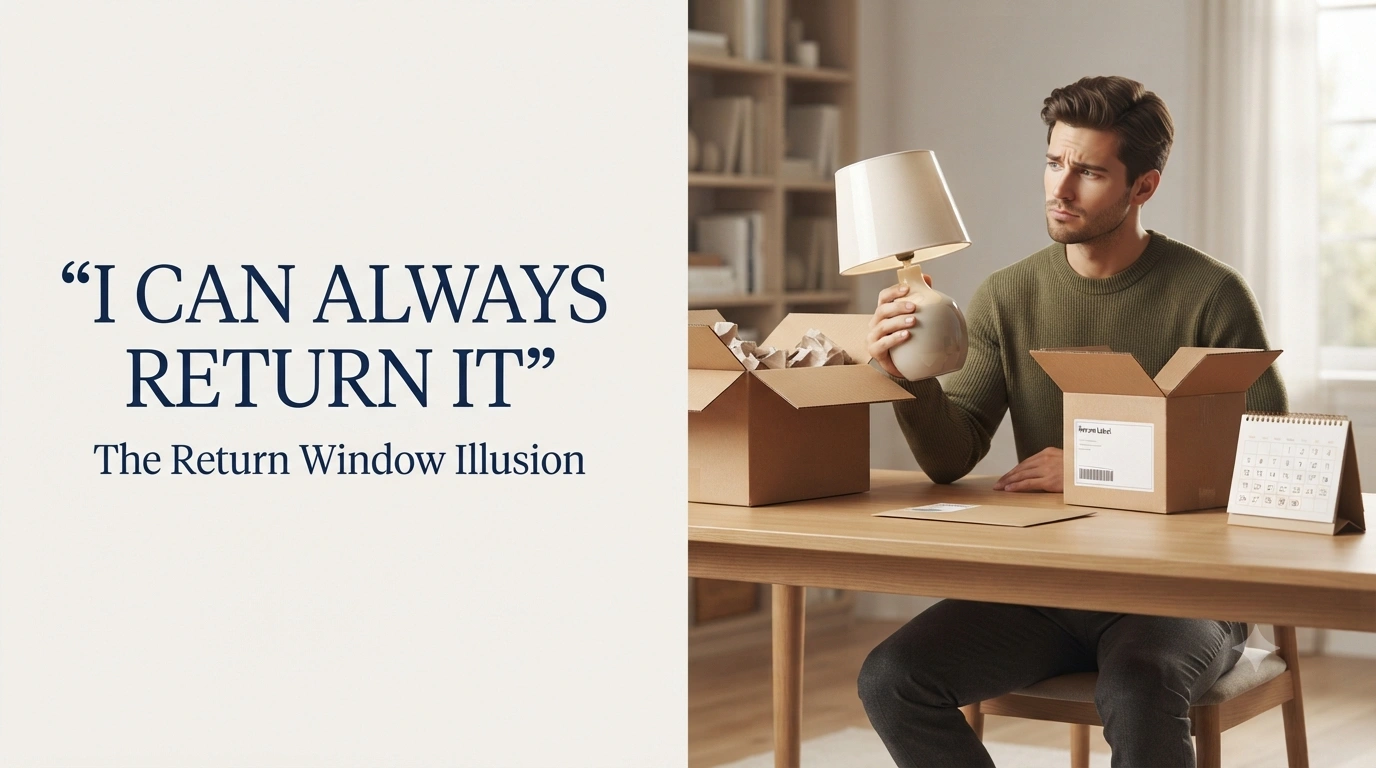
The problem is that intending to return something and actually returning it are two different things.
Once the package arrives, returning it may require finding the packaging, checking the return deadline, printing a label, arranging a drop-off, or simply remembering that you bought it. Sometimes the item goes back. Sometimes you decide it is easier to keep.
That is the return window illusion: the belief that because you can reverse a purchase later, you do not need to make a careful decision now.
What the “I Can Always Return It” Mindset Means
The “I can always return it” mindset happens when the possibility of returning a purchase makes the decision to buy feel less permanent.
Consider a $150 pair of shoes. You are interested, but you are not convinced you need them.
Without an easy return policy, you might think:
“Do I really want to spend $150 on these?”
With free returns, the thought can become:
“I'll try them. If I don't like them, I'll just send them back.”
The product has not become cheaper, and your uncertainty has not disappeared. What changed is how reversible the purchase feels.
This is particularly relevant to impulse buying because the purchase starts to feel temporary. Instead of deciding whether you want the product before buying it, you can tell yourself that you will make the real decision later.
Common versions of this thinking include:
- “I'll order both sizes and return one.”
- “If I don't like it, I'll just send it back.”
- “It's expensive, but there's free returns.”
- “I'll try it at home and decide later.”
- “The return window is 30 days, so I don't need to decide now.”
These thoughts are not automatically bad. Sometimes ordering multiple sizes or trying a product at home is a sensible response to genuine uncertainty.
The issue is whether the return option is helping you manage uncertainty or simply helping you justify buying something you would otherwise skip.
Why “I Can Return It” Changes the Buying Decision
When you believe there is an easy way out, the downside of buying can feel smaller.
Without an easy return, you may think, “I need to decide before I buy.” The purchase feels more permanent, so uncertainty can make you pause or walk away.
With an easy return, the thought can become, “I can decide after it arrives.” The purchase feels more temporary, perceived risk feels lower, and you may become more willing to buy despite uncertainty.
The product itself has not necessarily changed. What has changed is how comfortable you feel saying yes to it.
This is why returnability can become part of an impulse-shopping decision. The return policy may be genuinely useful, but it can also make an uncertain purchase feel safer than it otherwise would.
Without an Easy Return- The purchase feels more permanent.
- You have more reason to evaluate it before checkout.
- Uncertainty may stop you from buying.
- You are more likely to focus on whether you actually want the item.
- The purchase can feel temporary.
- Uncertainty may seem easier to tolerate.
- You may feel more comfortable buying quickly.
- You can convince yourself that the real decision can happen later.
The key difference is simple: an easy return can reduce the perceived risk of buying, but it does not necessarily increase the value of what you are buying.
How Returnability Can Delay the Decision
Normally, buying requires you to answer a fairly direct question:
Do I want this enough to spend money on it?
An easy return policy can quietly change that question to:
Do I want to find out whether I want this?
The second question is much easier to answer with “yes.”
This is the core problem with the “I'll decide later” approach. The decision has not disappeared. It has simply moved from before checkout to sometime after delivery.
That can be useful when you genuinely need information that only becomes available after purchase. But when the uncertainty is about whether you actually want the item, postponing the decision can work against you.
The purchase arrives. You try it once. It seems fine. You put it away.
A few days pass.
You remember that you were supposed to decide whether to return it, but keeping it requires no additional effort. Returning it requires action.
The longer the decision is postponed, the easier it can become to keep the purchase by default.
Why People Intend to Return Something but Keep It
The intention to return an item is made before you own it. The actual return decision happens after the product has arrived.
Those situations feel different.
Before buying:
“I'll return it if I don't love it.”
After buying:
“It's actually not that bad. Maybe I'll keep it.”
Several things can contribute to that shift.
You may discover that the product is useful enough, even if it is not exactly what you expected. You may become accustomed to having it. You may decide the return is not worth the effort. Or you may simply forget about it until the deadline is close.
This is why a return policy should not be treated as if it guarantees that an uncertain purchase will eventually be undone.
The purchase still requires a decision.
Common Return Friction Points
Even generous return policies can involve small tasks. Those tasks can be enough to turn “I'll return it” into “I'll just keep it.”
Return deadlinesA return window creates a deadline. If you have 30 days, you still need to remember that those 30 days are passing.
An item sitting in a closet can become an easy thing to forget.
PackagingYou may need the original box, tags, accessories, or packaging materials. If you have already thrown them away or misplaced them, returning the item can become more complicated.
Return labelsSome returns require you to generate, print, attach, or otherwise manage a return label. Even a simple process requires you to take action.
ShippingYou may need to package the item and hand it to a carrier. If the return requires a special shipping method, that creates another step.
Restocking fees and conditionsSome retailers or products may have restocking fees or specific return conditions. “Returnable” does not always mean “returnable under every circumstance with no cost.”
Inconvenient drop-offsA return might require a trip to a store, carrier, locker, or other location. If the item is only slightly disappointing, that extra effort can make keeping it seem easier.
ForgettingSometimes there is no complicated reason at all.
You simply forget.
The item arrives, other things become more important, and the return deadline quietly gets closer.
How Online Shopping Makes the Illusion Easier
Online shopping removes much of the friction traditionally associated with making a purchase.
You can browse from your sofa, compare products, save payment details, click checkout, and have the item delivered without leaving home.
When easy returns are added to that experience, both sides of the decision become convenient:
Buying is easy. Returning is supposedly easy.
That can make the purchase itself feel almost consequence-free.
This is part of the broader reason online shopping can make impulse buying so easy. One-click checkout, saved payment information, personalized recommendations, and other low-friction features can reduce the time available to reconsider a purchase.
For more on that pattern, see Why Online Shopping Makes Impulse Buying So Easy.
The concern is not that online returns are bad. They can be extremely useful, especially when you need to test a product, check the fit, or discover whether it works for you.
The problem is using the convenience of returns as a reason to stop evaluating the purchase before checkout. A return policy should give you flexibility when you need it, not become the reason you say yes to an impulse purchase.
Responsible Returns vs. Impulse Buying
There is an important difference between using a return policy responsibly and using it as permission to impulse buy.
Responsible use might sound like:
“I want this, but I cannot tell whether the size will work until I try it.”
Impulse justification might sound like:
“I'm not sure I want this, but I can return it.”
The first involves a purchase you already have a reasonable basis for wanting, with a specific uncertainty that the return policy helps solve.
The second uses the return policy to avoid making the buying decision.
That distinction is useful because it does not require you to stop using returns. It simply asks you to understand why the return option is influencing your decision.
The Hidden Cost of Repeated Returns
Returns can also create costs that are not immediately visible at checkout.
There may be time spent checking orders, preparing packages, arranging shipping, tracking refunds, or making drop-offs. Even when a retailer provides free returns, your time and attention are not necessarily free.
Repeatedly ordering several alternatives can also create decision clutter.
For example:
“I'll order both sizes and return one.”
That can be perfectly reasonable when you genuinely cannot predict which size will fit.
But if you regularly buy several versions of products with the intention of returning most of them, you may be creating a cycle of purchases and unfinished decisions.
The financial cost is only part of the picture. There is also the cost of managing everything you bought.
When Buyer’s Remorse Starts After the Excitement
The reason the return window can feel so reassuring is that it protects you from the possibility of regret.
But the possibility of returning something does not eliminate buyer's remorse. You can still experience that uncomfortable feeling when the excitement of an impulse purchase fades and you start questioning whether you actually wanted the item.
You might ask:
- Why did I buy this?
- Did I need it?
- Do I already own something similar?
- Was I influenced by the discount?
- Am I keeping it because I want it or because returning it is inconvenient?
That shift from excitement to doubt is an important part of the impulse-purchase cycle. What felt like an exciting purchase at checkout can look very different once the initial excitement fades.
A return policy can give you a way to correct a purchase that genuinely does not work for you. But it should not become the system you depend on to fix purchases you never felt confident about making.
If you want practical strategies for breaking this cycle, see How to Avoid Impulse Buying: 7 Practical Ways to Pause.
The Return Test
Before buying something because you are telling yourself “I can always return it,” pause and ask:
If this were final sale, would I still buy it?Removing the return option can reveal whether you actually want the product or whether the return policy is doing some of the persuading.
Would I make this purchase if returning it were difficult?Imagine that returning the item required extra packaging, a shipping trip, and more effort than usual.
Would you still buy it?
Do I already know where and how I would return it?Know the actual process. Check the return deadline, packaging requirements, shipping method, and any conditions that apply.
Am I buying it because I genuinely want it or because I feel I can change my mind later?This gets directly to the heart of the return window illusion.
If the main reason you feel comfortable buying is that you can undo the decision, pause.
Will I actually remember to revisit the decision before the return deadline?A return window only helps if you use it.
Do not assume that future-you will automatically handle the return.
How to Pause Before Buying Even When Returns Are Easy
You do not need to avoid stores with generous return policies. Instead, separate the decision to buy from the option to return.
1. Decide whether you want the item firstAsk whether the purchase solves a real problem, fills a genuine need, or is something you have consciously decided you want.
2. Identify the uncertaintyWhat are you unsure about?
Is it the price, fit, quality, usefulness, or whether you need it at all?
If you can answer the question without buying, do that first.
3. Add a pauseSave the product instead of checking out immediately.
A pause creates space between the desire and the transaction, which is exactly the habit WaitAndBuy is designed to encourage: pause before buying, then decide with more clarity.
The goal is not to tell yourself that you can never buy something you want. It is to make sure the purchase survives a moment of reflection.
4. Look at what you already ownIf you already have similar products sitting unused, another purchase may be less useful than it feels in the moment.
5. Treat the return deadline as a deadline, not permissionA 30-day return window does not mean you have 30 days to decide whether you want something.
If possible, make the buying decision before relying on the return window to resolve your uncertainty.
6. Use returns when they solve genuine uncertaintyIf you genuinely need to try, test, or inspect a product, use the return policy.
The goal is not fewer returns at all costs.
The goal is fewer purchases that only happen because you believe you can return them later.
See What Your Impulse Purchases Add Up To
Individual impulse purchases can be easy to overlook because each one feels manageable.
But if you regularly buy things because they seem easy to return, useful to have “just in case,” or harmless because they were discounted, it can be useful to look at the bigger picture.
The Impulse Purchase Calculator can help you estimate how your unplanned purchases add up over time.
The point is not to feel guilty about spending money. It is to make the pattern visible so you can decide whether it reflects how you actually want to spend.
Conclusion
“I can always return it” is not necessarily bad reasoning.
Sometimes a return policy gives you valuable protection when you cannot fully evaluate a product before buying it.
The problem begins when the return option becomes the reason you feel comfortable making the purchase in the first place.
A return policy can reduce the risk of buying, but it does not make the purchase itself a good decision.
Before checkout, ask yourself whether you would still buy the item if it were final sale. Ask whether you genuinely want it or whether the ability to change your mind is what makes the purchase feel acceptable.
And when you are unsure, give yourself a pause.
You do not have to decide immediately just because the checkout button is ready. Sometimes the most useful question is not “Can I return it?”
It is:
“Would I buy this if I had to decide right now?”
That small distinction can help turn impulse shopping into more intentional spending.
FAQ
Why do I buy things thinking I'll return them?An easy return policy can make a purchase feel less permanent and less risky. When you are uncertain, “I can always return it” can make buying feel easier than deciding whether you genuinely want the product before checkout.
Does an easy return policy encourage impulse buying?An easy return policy can lower the perceived downside of buying. That may make it easier to purchase something quickly, especially when the shopper uses the return option as reassurance rather than as protection against genuine uncertainty.
Why do people keep things they planned to return?Returning an item requires action. Deadlines, packaging, labels, shipping, inconvenient drop-offs, and simple forgetfulness can make keeping an item easier than completing the return.
How can I stop using returns to justify impulse purchases?Before buying, ask whether you would still want the item if it were final sale or difficult to return. Then pause before checkout and focus on whether you genuinely want or need the product rather than whether you can undo the purchase later.
Should I buy something if I know I can return it?You can, particularly when the return policy helps manage genuine uncertainty about fit, quality, or suitability. But the return option should be a safety net, not the primary reason you decide to buy.