Why Online Shopping Makes Impulse Buying So Easy
"Learn why online shopping makes impulse buying so easy and how frictionless checkout, recommendations, discounts, and a simple pause can help you shop more intentionally."
Why Online Shopping Makes Impulse Buying So Easy
You open an online store looking for one thing. A few minutes later, you're looking at a product you never planned to buy. You add it to your cart, notice you're just short of free shipping, add something else, and complete the purchase before you've really asked yourself whether you need any of it.
Later, you might wonder: Why did I buy that?
The answer isn't necessarily a lack of self-control. Online shopping has made the journey from seeing something to buying it remarkably easy. Recommendations keep new products in front of you, saved payment details remove checkout friction, notifications create new shopping opportunities, and limited-time offers make waiting feel risky.
None of these features is inherently bad. Convenience is one of the biggest benefits of online shopping. But when the steps between seeing something, wanting it, and buying it become almost effortless, there are fewer natural opportunities to stop and reconsider.
The result can be a familiar behavioral journey:
See → Want → Click → Checkout → Regret
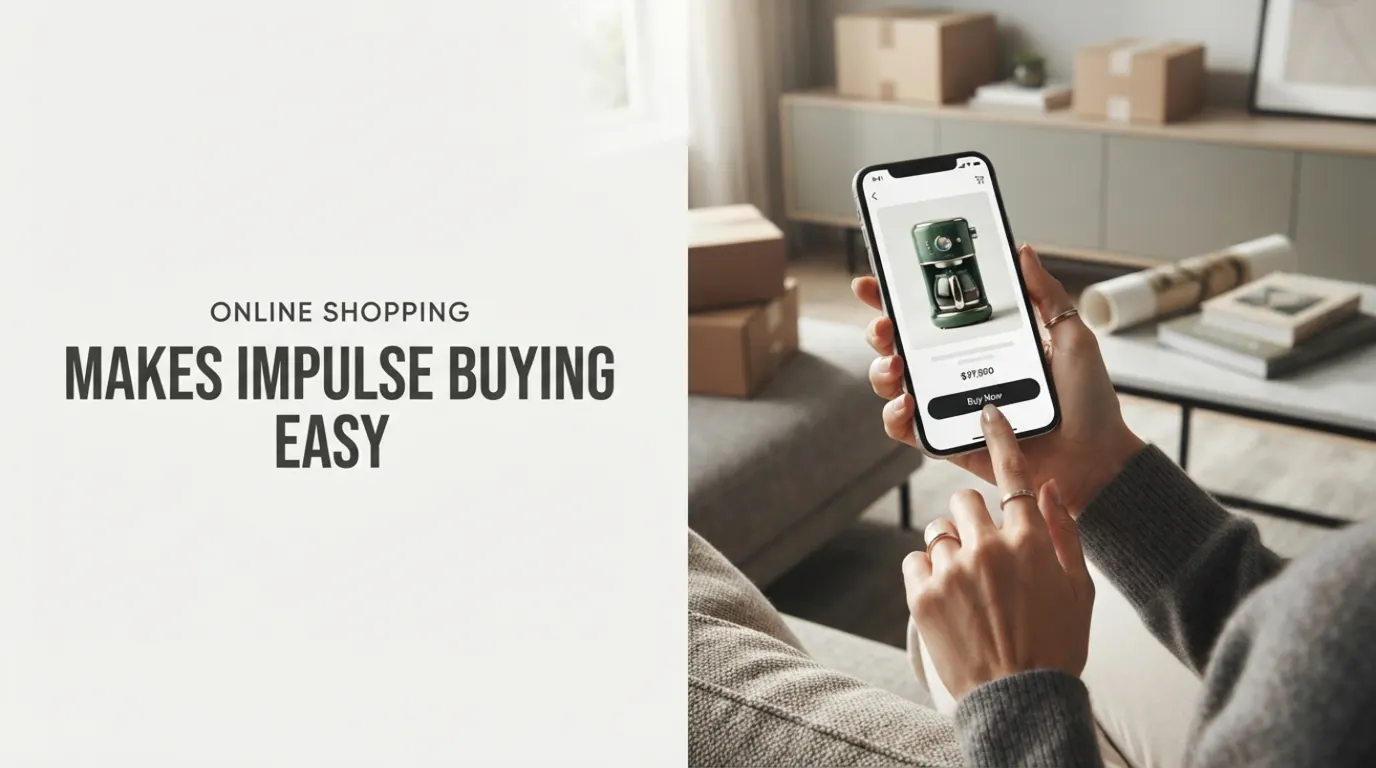
The key to breaking that cycle isn't necessarily shopping less. It's understanding where the pause disappeared, and deliberately putting it back.
Why Online Shopping Can Encourage Impulse Buying
Impulse buying happens when a purchase wasn't fully planned beforehand and is made with limited consideration. Online shopping can make this easier because many of the obstacles that once slowed purchasing have disappeared.
In a physical store, you might pick up a product, compare alternatives, walk around with it, and eventually decide whether it's worth buying. Those steps create natural opportunities to reconsider.
Online, you can discover a product, read about it, add it to your cart, and pay within minutes. If your payment and delivery details are already saved, even more effort disappears.
This is the psychology of frictionless shopping: reducing the effort required to complete a purchase. That's useful when you've already made a considered decision, but it can work differently when the desire itself is spontaneous.
The Psychology of Frictionless Shopping
Friction is anything that makes a purchase take more effort. Entering payment information, searching for your card, leaving a store, or having to return later can all create additional steps.
E-commerce has removed many of them. Saved addresses, stored payment methods, digital wallets, one-click checkout, persistent carts, and personalized recommendations make buying faster and easier.
For a planned purchase, that's a feature. For an impulse purchase, it can remove the very moments when you might have reconsidered.
A useful test is:
"If buying this required five more minutes of effort, would I still buy it?"
If you're unsure, the desire may be stronger than the actual need.
1. One-Click Checkout Makes the Final Decision EasyImagine seeing a product you like. In a physical store, there may be several steps between wanting it and owning it. Online, the process can be as simple as adding it to your cart and tapping "Buy."
When checkout requires almost no effort, the purchase can feel like a continuation of browsing rather than a separate financial decision.
That's particularly important for unplanned purchases. The easier it is to act on a momentary desire, the less opportunity there is to question it.
2. Saved Payment Details Remove a Natural PauseEntering your card number and delivery information takes time. Saved payment details and digital wallets eliminate much of that process.
That convenience is valuable, but it also makes spending less visible in the moment. You may experience the excitement of getting something new without spending much time thinking about the money leaving your account.
A purchase can happen with a tap before the thought "Do I really want to spend this?" has fully registered.
3. Recommendations Keep Creating New WantsYou finish looking at one product and immediately see another:
- "You may also like..."
- "Customers also bought..."
- "Similar items..."
- "Recommended for you..."
Recommendations can be genuinely helpful, but they also keep potential purchases in front of you after you've found what you originally came for.
You might enter an online store looking for shoes and end up browsing jackets, headphones, home accessories, and dozens of other products.
The more products you encounter, the more opportunities there are for an unplanned purchase to become appealing.
4. Endless Scrolling Removes a Natural Stopping PointPhysical stores have boundaries. Eventually, you reach the end of an aisle or leave the shop.
Online stores can keep presenting products indefinitely.
This turns shopping from a task with a natural endpoint into an activity that can continue as long as you keep scrolling. You may even start browsing without intending to buy anything, simply because you're bored or looking for something interesting.
The longer the browsing session continues, the more opportunities there are for something to trigger a purchase impulse.
5. Limited-Time Offers Create UrgencyA message such as "Sale ends tonight" or "Only a few left" can change the question you're asking yourself.
Instead of:
"Do I actually want this?"
you start thinking:
"What if I miss this?"
That shift matters. Urgency can make delaying a purchase feel like losing an opportunity, even when the product wasn't part of your original plans.
A genuine discount can provide real value. The important thing is to separate the value of the product from the pressure of the offer.
Ask yourself:
"Would I still want this if the offer were available tomorrow?"
6. Free-Shipping Thresholds Can Encourage Extra PurchasesSuppose your cart contains a $35 product, but free shipping starts at $50. You might decide to add another $15 item rather than pay for shipping.
The shipping may be free, but you've still spent more money than originally planned.
The useful question is:
"Would I have bought this additional item if I wasn't trying to reach the free-shipping threshold?"
The same principle can apply to bundles and promotions that require you to spend more to unlock a benefit.
7. Notifications Bring Shopping Into Everyday LifeOnline shopping doesn't have to wait for you to visit a store.
Apps can send notifications about sales, new products, price changes, recommendations, and abandoned carts. A notification can turn an ordinary moment into a shopping opportunity.
You might be working or relaxing when your phone suddenly presents you with a product you hadn't been thinking about.
The product wasn't part of your plans a moment earlier. Now you're considering buying it.
Reducing unnecessary shopping notifications can therefore be a simple way to reduce the number of impulse triggers you encounter.
Why an Impulse Purchase Can Feel Good Until It Doesn't
Impulse purchases aren't only about the product. They're often connected to the emotion surrounding the purchase.
Finding something exciting can create anticipation. Adding it to a cart can feel satisfying. Completing the purchase provides an immediate sense of reward, while the financial consequences arrive later.
That timing can make the decision feel better in the moment than it does afterward.
The excitement may disappear by the time the package arrives. You may then realize that you already owned something similar, didn't really need the item, or were more attracted to the discount than the product itself.
This is where buyer's remorse can enter the picture: the emotional state that influenced the purchase has changed, but the purchase remains.
The Missing Step: Pause
Look again at the original cycle:
See → Want → Click → Checkout → Regret
The missing step is pause.
A pause doesn't mean you have to reject the purchase. It simply separates the initial desire from the final decision.
That separation gives you time to discover whether the desire survives.
After waiting, you may realize that:
- You already own something similar.
- You don't have a real use for it.
- The price isn't worth it.
- You were mainly attracted by the discount.
- You were bored or emotional when you started shopping.
- You don't want the item anymore.
The goal isn't to eliminate desire. It's to stop treating every desire as an instruction to buy.
How to Reintroduce Friction Into Online Shopping
You don't need to make online shopping difficult. You only need to create a deliberate gap between "I want this" and "I'm buying this."
Save It Instead of Buying ItWhen something catches your attention, save the product instead of checking out immediately. Record the item, price, store, and date, then come back later.
You're not saying no. You're saying not yet.
Create a Waiting PeriodChoose a waiting rule that works for you. You might wait until the next day for smaller purchases and several days for more expensive ones.
The exact period matters less than having a consistent rule that prevents an immediate impulse from becoming an immediate purchase.
When you return to the item later, ask:
"Do I still want this?"
If you're curious about how much impulse spending may be adding up over time, try our Impulse Purchase Cost Calculator. It can help you estimate how much those unplanned purchases could cost you each month and year.
Ask Three QuestionsBefore buying, ask yourself:
Do I still want it? Has the desire survived the initial excitement?
Do I need it? What problem does this purchase actually solve?
Would I buy it without the discount? If the promotion disappeared, would the product still feel worth owning?
These questions don't mean every purchase has to be justified as a necessity. They simply help distinguish a considered decision from a temporary impulse.
Impulse Buying vs. Planned Buying
The difference between impulse buying and planned buying isn't whether you enjoy the purchase. It's how the decision was made.
Planned buying starts with an intention. You identify something you want or need, consider the cost, and decide to purchase it.
Impulse buying starts with an unexpected desire. The product catches your attention, the desire develops quickly, and the purchase follows without much prior planning.
A planned purchase can still be enjoyable, and an impulse purchase isn't automatically a bad purchase. The important distinction is whether the decision reflects what you actually wanted—or simply what you happened to feel in that moment.
How WaitAndBuy Fits Into the Pause
Online shopping has become very good at shortening the distance between seeing something and buying it.
WaitAndBuy takes the opposite approach: instead of purchasing immediately, you save the item and give yourself time to reconsider.
The idea is simple:
See it. Save it. Wait. Decide.
After the waiting period, you can decide whether to buy it, skip it, or wait longer.
The goal isn't to tell you what to buy. It's to make sure you have a chance to decide when the initial impulse has passed.
When online shopping removes the pause, WaitAndBuy helps put it back.
Online Shopping Isn't the Problem
It's tempting to conclude that online shopping itself causes impulse buying, but that's too simple.
Online shopping provides real benefits. It saves time, makes comparison easier, expands access to products, and makes routine purchases more convenient.
The issue is what happens when convenience meets an unplanned desire.
A fast checkout is useful when you've already made a considered decision. A recommendation can be useful when it helps you find something relevant. A discount can be useful when it reduces the price of something you genuinely wanted.
The problem begins when these features encourage you to act before you've had a chance to decide.
The goal isn't necessarily to shop less. It's to make sure your purchases reflect your decisions rather than your impulses.
FAQ
Why does online shopping make impulse buying easier?Online shopping removes many of the steps that can naturally slow down a purchase. Saved payment details, fast checkout, recommendations, notifications, and continuous browsing can make it easy to move from seeing a product to buying it without much time for reflection.
What is frictionless shopping?Frictionless shopping means reducing obstacles in the purchasing process. Features such as saved payment information, digital wallets, and streamlined checkout make it faster and easier to complete a purchase.
How do online stores encourage impulse purchases?Online stores can expose shoppers to recommendations, promotions, limited-time offers, notifications, free-shipping thresholds, and continuously available products. These features can increase opportunities for unplanned purchases while making those purchases easier to complete.
Why do I buy things online that I don't need?Online purchases can be driven by excitement, curiosity, boredom, discounts, urgency, or repeated exposure to products. Because purchasing is so convenient, the decision can happen before you've considered whether the item is genuinely useful or necessary.
Does waiting before buying reduce impulse purchases?Waiting gives the initial excitement or urgency time to fade. A waiting period doesn't guarantee that you'll decide against a purchase, but it creates an opportunity to reconsider whether you still want the item.
How long should I wait before buying something online?There is no universal waiting period. You can use a shorter period for inexpensive purchases and a longer one for expensive or nonessential items. The important part is having a consistent pause before buying.
How can I stop impulse buying online?Create friction between wanting and buying. Save products instead of purchasing immediately, reduce unnecessary shopping notifications, avoid browsing without a purpose, use a waiting period, and review saved items before deciding.
What is the difference between impulse buying and planned buying?Planned buying involves deciding beforehand that you intend to purchase something. Impulse buying happens when the desire and purchase develop unexpectedly, with little prior planning or consideration.
For a closer look at how major online sales events amplify digital purchasing pressure, read 5 Reasons Cyber Monday Makes Impulse Buying Hard to Resist.
Conclusion
Online shopping has made buying incredibly convenient. You can discover a product, decide you want it, and complete the purchase in minutes or even seconds.
That convenience is valuable when you've already made a considered decision. But when the purchase starts with an unexpected desire, removing every obstacle can also remove the opportunity to reconsider.
The answer isn't necessarily to stop shopping online. It's to restore the part of the process that's increasingly easy to skip: the pause.
The next time something catches your attention, save it instead of buying it immediately. Step away. Come back later. Then ask yourself whether you still want it.
Sometimes the difference between an impulse purchase and an intentional purchase isn't saying no.
It's simply giving yourself enough time to make sure your yes is actually yours.