5 Reasons Cyber Monday Makes Impulse Buying Hard to Resist
"Discover 5 reasons Cyber Monday triggers impulse buying, from limited-time deals and scarcity to discounts, FOMO, and easy checkout."
5 Reasons Cyber Monday Makes Impulse Buying So Hard to Resist
You open your laptop on Cyber Monday with one simple intention: take a look at the deals. Maybe you have something specific in mind, or maybe you're just curious about what is on sale. You tell yourself you'll browse for a few minutes and decide later.
Then you see it. The price has been reduced, a countdown is ticking, a message says only a few are left, and the website recommends something that goes perfectly with it. Your payment information is already saved, so buying takes only a couple of clicks. Suddenly, you're no longer simply browsing. You're making a purchase.
Cyber Monday is built around discounts, but the environment surrounding those discounts can make impulse buying particularly difficult to resist. Urgency, scarcity, perceived savings, personalized recommendations, and effortless checkout can shorten the distance between wanting something and actually buying it.
Understanding these triggers doesn't mean you have to avoid Cyber Monday. It means you can recognize when a shopping decision is being driven more by the sale environment than by something you genuinely intended to buy.
Here are five reasons Cyber Monday can make impulse purchases so tempting and what you can do when you notice yourself getting pulled into the cycle.
1. Fear of Missing a Deal Creates Urgency
One of the strongest forces behind impulse buying is the feeling that you might miss an opportunity. Cyber Monday naturally creates that feeling because deals are presented as special, temporary opportunities. A product that costs one amount normally may suddenly appear significantly cheaper, making the decision feel time-sensitive.
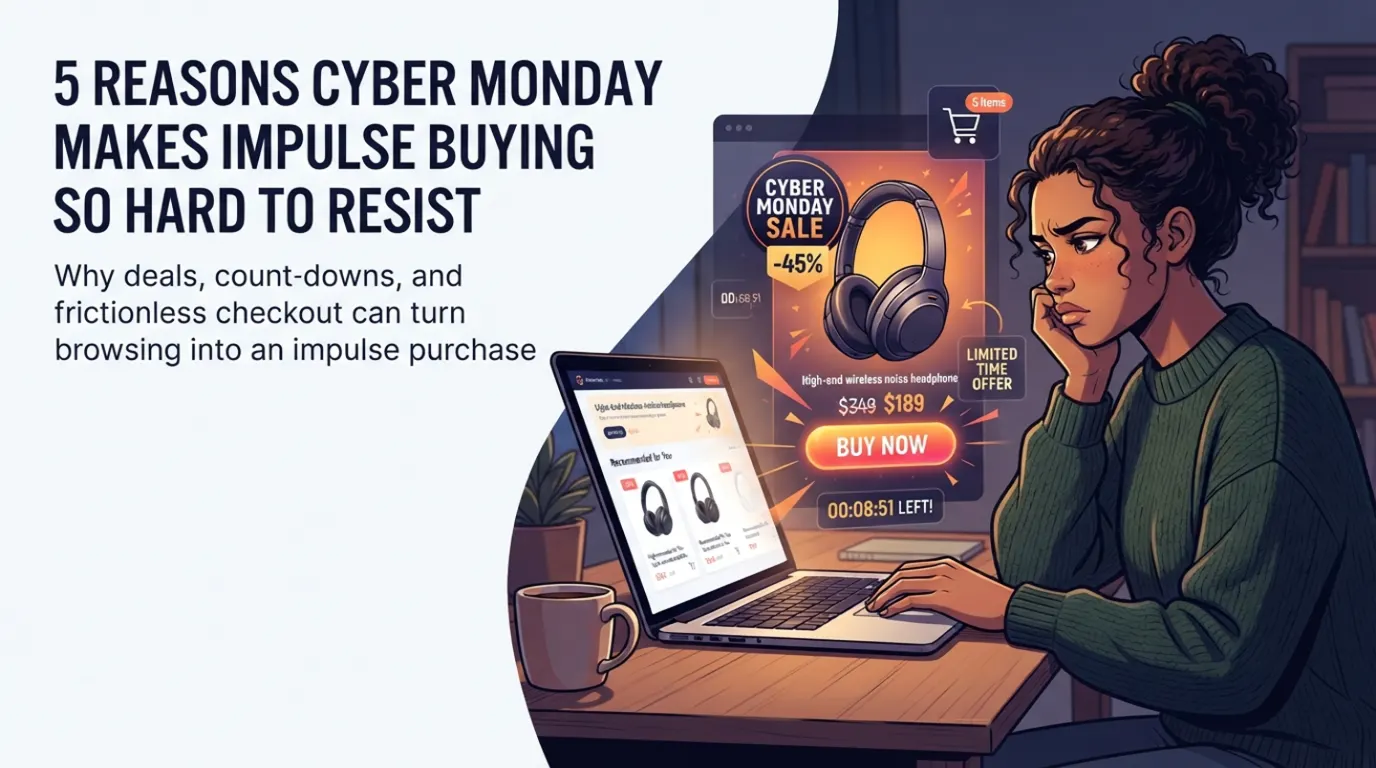
The psychological shift is subtle. Instead of asking, "Do I actually want this?", you start asking, "What if I don't buy this now?" The first question focuses on the value of the product to you. The second focuses on the possibility of losing the deal.
That fear of missing out can make a purchase feel more urgent than it actually is. You may have had no intention of buying the product before seeing the discount, yet the existence of the discount suddenly becomes a reason to buy.
The "deal" becomes the reason for the purchase
Imagine you see a pair of headphones discounted from $150 to $90. If you needed new headphones, the discount might be genuinely useful. But if your existing headphones work perfectly and you weren't planning to replace them, you're not really saving $60 by spending $90. You're spending $90 on something you weren't planning to purchase.
This is one of the easiest ways an impulse purchase can disguise itself as a smart financial decision. When you feel that Cyber Monday urgency, ask yourself: "Would I still want this if it weren't on sale?" If the answer is no, the discount may be creating the desire rather than simply reducing the price of something you already wanted.
2. Countdowns and Scarcity Make Waiting Feel Risky
Cyber Monday shopping often comes with another powerful trigger: scarcity. You might see messages such as "Deal ends soon," "Limited-time offer," "Almost gone," or "Sale ending tonight." These messages change how waiting feels because they make the opportunity appear temporary.
Normally, waiting gives you an opportunity to think. You can compare alternatives, check your budget, reconsider whether you need the product, or simply decide that you don't want it after all. Scarcity messaging makes that pause feel dangerous: instead of thinking, "I'll decide tomorrow," you start thinking, "If I wait until tomorrow, I might lose the opportunity."
This creates a conflict between reflection and urgency. For a deeper look at this effect, see Why Countdown Timers Make Flash Sales So Hard to Resist. The same psychological pressure that makes flash sales compelling can turn an ordinary Cyber Monday deal into an impulse purchase.
Scarcity can make an ordinary product feel more valuable
A product doesn't necessarily become more useful because fewer units are available. But when availability appears limited, it can feel more important to secure it. Combine that with a discount, and you're no longer simply looking at a product, you're looking at something that is cheaper than usual and might supposedly disappear if you wait.
The pressure builds, and the pause that would normally help you reconsider starts to feel like a risk. Before buying, ask yourself whether you'd still choose the product if the urgency disappeared. If losing the discount feels worse than losing the product, that's an important signal.
3. Discounts Create the Illusion That You're Saving Money
One of the most common traps in impulse spending is confusing spending less with saving money. Cyber Monday makes this particularly easy because your attention is drawn toward the amount you're supposedly saving rather than the amount leaving your bank account.
A product marked down from $100 to $60 immediately communicates a $40 saving. But that $40 only becomes meaningful if you actually needed or intended to buy the product. Otherwise, the transaction still costs you $60.
The mental calculation can become backwards
Consider these two statements: "I spent $60" and "I saved $40." They describe the same transaction, but they feel completely different. The second makes the purchase sound financially positive, which is why sale shopping can lead to impulse purchases that feel responsible in the moment.
The problem becomes even clearer when you make several purchases. Five products that weren't part of your original plan can each look like a bargain when viewed separately. Together, they can turn into a significant amount of impulse spending.
A sale doesn't automatically make something affordable. Instead of asking, "How much am I saving?", ask, "How much am I spending, and was this spending already part of my plan?" That small change can make the actual decision much clearer.
4. Endless Browsing and Recommendations Keep Creating New Reasons to Buy
You may visit an online store looking for one item and leave with several. That's partly because modern shopping experiences don't end when you find what you came for. After viewing a product, you may encounter recommendations, similar products, complementary items, customer favorites, and more Cyber Monday deals.
One shopping decision can therefore create several more opportunities to spend. This is part of the broader reason Why Online Shopping Makes Impulse Buying So Easy: digital shopping environments can keep presenting new products while removing many of the natural stopping points found in physical shopping.
Browsing can become a feedback loop
Imagine you're shopping for a winter jacket. You find one you like, and the website shows boots that go with it. You look at the boots and are shown a sweater. The sweater leads to jeans, and the jeans lead to accessories. None of these purchases were part of your original plan, yet after enough browsing, each new product can feel like a logical continuation of the previous decision.
This is where "I'm just browsing" can quietly become "I might as well buy it." You weren't thinking about buying a new kitchen appliance five minutes ago, but after seeing it repeatedly, reading reviews, noticing the discount, and imagining how useful it could be, the product can start feeling familiar and necessary.
The longer you remain in a shopping environment, the more opportunities you have to encounter products you didn't know you wanted. Before opening a shopping site during Cyber Monday, decide what you're actually looking for. If you find something outside that list, save it somewhere and come back later rather than automatically adding it to your cart.
5. Frictionless Checkout Removes the Opportunity to Reconsider
Even after all the psychological pressure of Cyber Monday, there is still one final moment when you can change your mind: checkout. But online shopping has made that moment remarkably easy to pass through. Saved payment details, stored addresses, digital wallets, and fast checkout processes reduce the number of decisions between "I want this" and "I own this."
Convenience is useful, but when you're making an impulse purchase, a little friction can be valuable. Every additional step can create another opportunity to reconsider the purchase, check the total, or ask whether the item is actually worth the money.
Checkout is where intention and impulse meet
By the time you reach checkout, several triggers may already have influenced you. You saw the discount, worried about missing it, noticed the countdown, browsed related products, and convinced yourself you were saving money. Then checkout removes the final obstacle.
That's why the pause before payment can be particularly valuable. Ask yourself: "Do I want this product, or do I want the feeling of getting this deal?" If you're uncertain, leave the cart and come back later. A product that is genuinely useful is likely to remain useful after you've had time to think, while an impulse purchase often loses some of its appeal once the urgency disappears.
How to Stop an Impulse Purchase on Cyber Monday
You don't need to avoid every Cyber Monday deal to avoid impulse spending. The goal is to create a small gap between wanting something and buying something.
Make a Cyber Monday Shopping List Before You Browse
Decide what you are actually looking for before opening shopping websites. A list gives you a reference point when recommendations and promotions start pulling your attention in different directions.
If something isn't on the list, treat it as a product to consider not a product you automatically need to buy. This simple distinction can prevent an unexpected product from becoming an unexpected expense.
Use a Waiting Period for Unplanned Purchases
If you discover something unexpectedly, don't make the purchase immediately. Take a screenshot, save the product, or add it to a separate list and come back later.
The purpose isn't to make the decision unnecessarily difficult. It's to find out whether the desire survives after the initial excitement fades. This is the basic idea behind WaitAndBuy: pause first, then decide.
Calculate the Real Cost
Don't focus only on the discount. Look at the actual amount you'll spend and consider whether the purchase was planned, whether you already own something that serves the same purpose, how often you'll use it, and whether you'd rather spend the money somewhere else.
A discount is only one part of the decision. If the sale is the only reason you want the product, the "saving" may be encouraging you to spend rather than helping you save.
Close the Shopping Tab
Sometimes the simplest way to stop impulse shopping is to leave the shopping environment. Close the browser, put down your phone, and go do something else.
You don't need to win an argument with a countdown timer. You can simply stop participating in the countdown. When you return later, the decision may feel very different.
The Most Important Cyber Monday Question
The biggest question isn't "Is this a good deal?" It's "Is this a good purchase for me?"
Those questions sound similar, but they lead to very different decisions. A good deal can still be a bad purchase if you don't need the item. A smaller discount can still be worthwhile if the product was already on your list and fits your budget. And sometimes the best purchase is no purchase at all.
Cyber Monday doesn't force you to buy anything. The sale environment simply gives you many reasons to believe that you should buy something now. Recognizing those reasons gives you back some control.
Before clicking "Buy Now," step outside the urgency of the sale for a moment. Check whether the purchase fits something you genuinely need, whether it fits your budget, and whether you'd make the same decision after giving yourself time to think.
If you're trying to make that pause part of your shopping routine, WaitAndBuy gives you a simple way to save an item, step away, and come back to make the decision later.
Sometimes the best Cyber Monday decision isn't finding a better deal. It's realizing you don't need the deal at all.
FAQ
Why does Cyber Monday make people buy more impulsively?
Cyber Monday combines several triggers that can encourage impulse buying, including discounts, urgency, scarcity messaging, personalized recommendations, continuous browsing, and fast checkout. Together, these can make immediate purchasing feel more attractive than taking time to reconsider.
What is impulse buying?
Impulse buying is making a purchase without planning or without giving yourself enough time to consider whether you actually want or need the item. The decision is often driven by an immediate desire, emotion, opportunity, or shopping environment.
How can I stop impulse buying on Cyber Monday?
Start with a shopping list and decide what you genuinely intend to purchase. For anything unexpected, create a waiting period before buying. Compare the actual cost with your budget and ask whether the purchase still makes sense after the initial excitement has passed.
Does a discount actually save money?
A discount reduces the price of a product, but it doesn't necessarily mean you saved money. If you buy something you didn't need or plan to purchase simply because it is discounted, you still spent money that you otherwise would have kept.
Why do limited-time deals encourage impulse purchases?
Limited-time offers can make waiting feel risky because shoppers worry that the opportunity will disappear. That sense of urgency can shift attention away from whether the product is genuinely needed and toward whether the deal might be lost.
How can I avoid emotional shopping?
Create distance between the emotion and the purchase. Save the item instead of buying immediately, leave the shopping website, and return after the initial excitement has passed. A waiting period can help you determine whether the desire is temporary or genuine.
Is Cyber Monday bad for intentional spending?
Not necessarily. Cyber Monday can be useful when you use it to purchase items you already need or planned to buy. The problem occurs when the sale itself becomes the reason for purchasing products that weren't part of your original plan.
What is a simple rule for avoiding impulse purchases?
Try this: If you weren't planning to buy it before you saw the deal, pause before buying it. Save it, wait, and reconsider once the urgency has faded.
Conclusion
Cyber Monday can make impulse buying feel less like impulse buying. A countdown can make waiting seem like a mistake. A discount can make spending feel like saving. Recommendations can turn one purchase into several. Scarcity can make an ordinary product feel unusually important, while frictionless checkout can take away the final opportunity to reconsider.
The goal isn't to avoid every Cyber Monday deal. It's to recognize when the shopping environment is influencing your decision more than your actual needs.
When a deal catches your attention, give yourself permission to pause. Step away, review the purchase, and come back later if it still makes sense. That small gap between wanting and buying can turn an automatic purchase into an intentional decision.