Why Flash Sales Trigger Impulse Buying
"Learn why countdown timers, urgency, FOMO, and scarcity make flash sales harder to resist—and how to pause before making an impulse purchase."
Why Flash Sales Trigger Impulse Buying
A countdown timer can turn an ordinary discount into something that feels impossible to ignore.
You may have seen it while shopping online: “Sale ends in 02:14:37.” The product has not suddenly become better, and the discount may not even be unusually large. But the ticking clock changes the situation. Instead of simply asking, “Do I want this?” you may start thinking, “What if I miss the deal?”
That shift is at the heart of countdown timer psychology.
Countdowns create a visible deadline. Combined with limited-time offers, limited-stock messages, notifications, and fast checkout, they can create an environment where shoppers feel pressure to decide before they have fully considered the purchase.
That does not mean countdown timers automatically cause impulse purchases. People respond differently to urgency. Product involvement, self-control, skepticism, and whether the deadline feels credible can all affect what happens next.
Understanding flash sale psychology can help explain why these promotions are effective and how to give yourself enough time to make a deliberate decision.
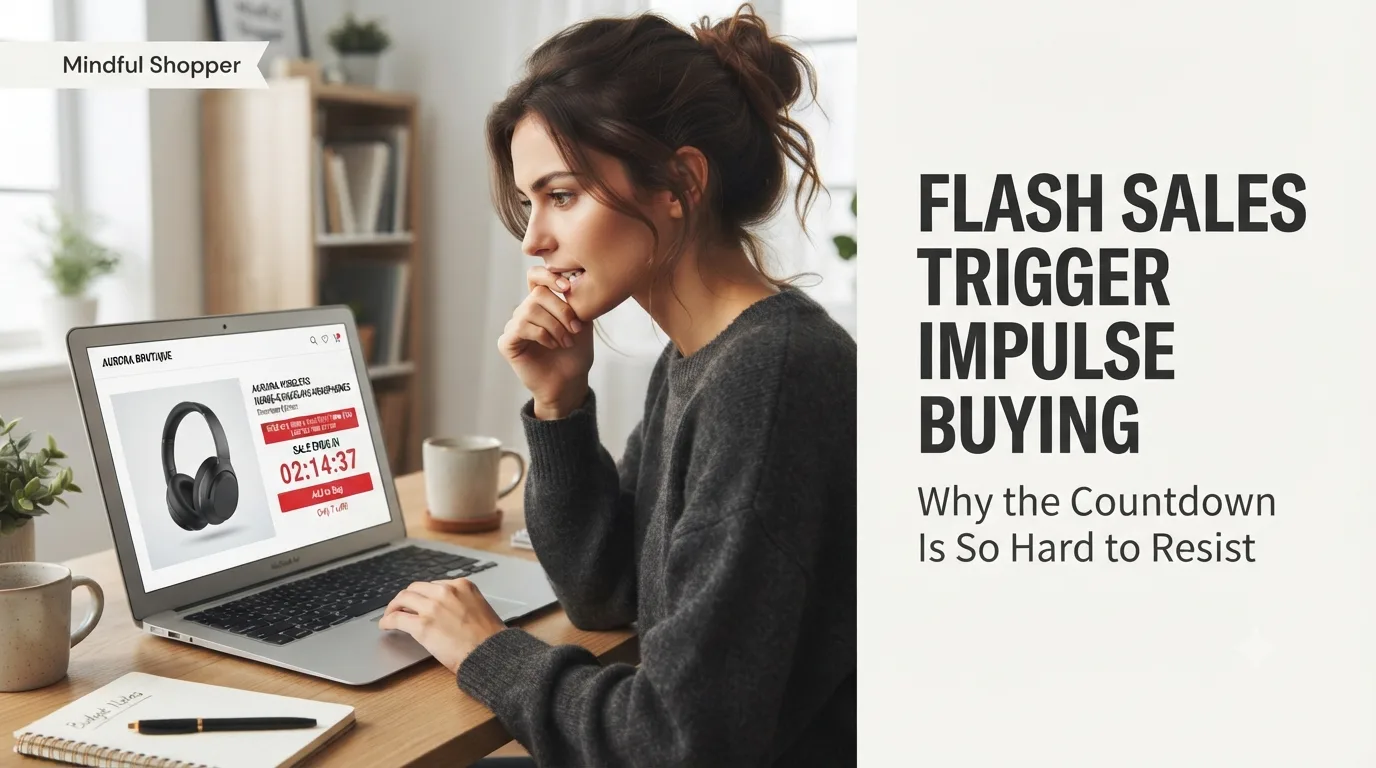
What Is the Countdown Timer Actually Doing to Your Decision?
Consider this sequence:
“Sale ends in 02:14:37” → “I might miss the deal” → “I need to decide now” → “I buy before thinking it through.”
The timer has not necessarily changed your need for the product. It has changed the decision-making environment.
Without a deadline, you can browse, compare prices, read reviews, leave the page, and come back later. With a countdown running beside the product, waiting can suddenly feel costly because it appears to mean losing the opportunity.
This is one reason countdown timer marketing is powerful: the timer makes time itself part of the sales message.
The Psychology of a Ticking Clock
A visible deadline gives a purchase a sense of immediacy.
Normally, you can see something, consider it, compare alternatives, and decide whether it deserves your money. A countdown changes that structure. Instead of asking, “Should I buy this?” you may start asking, “Should I buy this before time runs out?”
That distinction matters because the deadline can become the focus of the decision. You may pay more attention to how much time remains and less attention to whether the purchase actually makes sense.
The ticking clock can make an otherwise ordinary product feel like a special opportunity.
Urgency Encourages Faster Decisions
Urgency is one of the central mechanisms behind flash sale impulse buying.
A normal discount might say “20% off.” A flash sale might say “20% off — only 2 hours left.” The financial offer has not necessarily changed. The second version adds a constraint: you have less time to decide.
That shrinking window can encourage faster action. There is nothing inherently wrong with making a quick purchase when you already know what you want, have compared the options, and are simply taking advantage of a legitimate offer.
The problem occurs when speed replaces evaluation. The less time you give yourself, the easier it becomes to skip questions such as:
- Did I actually want this before seeing the sale?
- Do I need it right now?
- Is this the best price available?
- Do I already own something similar?
- What else could I do with this money?
Urgency does not guarantee an impulsive decision. It simply makes deliberate decision-making harder to maintain.
FOMO: When You Start Focusing on What You Might Lose
Countdown timers are closely connected to FOMO shopping, or the fear of missing out.
Once a deadline appears, your attention can shift from the product itself to the opportunity. Instead of thinking, “Is this product worth ₹2,000 to me?” you may start thinking, “If I don't buy it now, I'll lose the ₹500 discount.”
The difference is subtle but important. You are no longer evaluating only what you gain by buying. You are also imagining what you might lose by waiting.
This is where time-based scarcity overlaps with the broader psychological effects of scarcity marketing.
For a deeper look at how scarcity and FOMO can influence shopping decisions, read FOMO & Scarcity Marketing: The Impulse Buying Trap.
One useful question is: Would I still want this product if the timer were not there?
If the answer is uncertain, the timer may be influencing the decision more than the product itself.
Scarcity Can Make an Opportunity Feel More Valuable
Scarcity is another important part of flash sale psychology.
When access to something appears limited, it can feel more valuable. That does not necessarily mean the product has objectively become more valuable. Its price, usefulness, quality, and features may be exactly the same.
What has changed is your perception of availability.
A message such as “Only 3 left” or “Offer ends tonight” can communicate that you may not get another chance. This is why countdown timers often appear alongside other forms of scarcity marketing.
The product is not simply being presented as something you can buy. It is being presented as an opportunity that may disappear.
And when an opportunity feels temporary, delaying can feel like making the wrong choice, even when waiting would actually help you evaluate the purchase.
Less Time Can Mean Less Deliberation
Good purchasing decisions often benefit from a little distance. You might compare several products, check independent reviews, look at your budget, or simply sleep on the decision.
A countdown timer introduces pressure in the opposite direction: think later, decide now.
This is especially relevant for purchases that are not urgent. If your phone is broken, you may genuinely need a replacement today. But if you are considering a new pair of shoes, kitchen gadget, decorative item, or electronic accessory, the product does not become necessary because a timer appeared beside it.
Time pressure can make it easier to skip the reflection stage. Even a short pause can help separate “I want this” from “I need to buy this before I lose the deal.”
Emotional Arousal Can Change the Shopping Experience
Flash sales are not purely rational calculations.
A ticking timer can create excitement, tension, anticipation, or anxiety. You may feel a small rush when you see that an offer is disappearing, making the shopping experience more emotionally engaging.
The sequence can look something like this: discount → countdown → excitement → fear of missing out → faster decision.
Research on limited-time scarcity suggests that scarcity cues can increase perceived arousal and can influence impulse-purchase behavior. But individual responses vary, and a timer is not a guaranteed trigger for everyone.
Some shoppers become more motivated by the challenge. Others become skeptical. Some simply ignore the timer.
The important point is that an emotionally charged shopping environment can make it harder to distinguish wanting the product from wanting the feeling of getting the deal.
Why Flash Sales Are Particularly Effective Online
Online shopping makes it easy to combine several pressure mechanisms in one place.
A retailer might show a countdown timer, “only 4 left” messaging, a limited-time discount, a push notification, personalized recommendations, a prominent “Buy Now” button, saved payment information, and one-click checkout.
Each element removes a different form of friction.
The countdown creates urgency. The stock message creates scarcity. The notification brings the offer to your attention. The discount creates a perceived financial opportunity. Fast checkout makes acting on the impulse easy.
This is part of the broader strategy behind Impulse Buying in Marketing: How Brands Encourage Unplanned Purchases.
The timer usually does not work in isolation. It can be one component of an entire shopping environment designed to move you from attention → emotion → action quickly.
Why Some People Resist Countdown Timers
Not everyone sees a countdown and immediately reaches for their wallet.
People respond differently to urgency. Self-control, product involvement, skepticism, personal circumstances, and the credibility of the deadline can all affect the response.
Someone who has spent weeks researching a laptop may see a countdown as a reason to finally make a decision about something they already wanted. That is very different from suddenly buying a product they had never considered.
Likewise, experienced shoppers may question whether a promotion is actually temporary. If they recognize common urgency tactics, they may investigate before buying.
So, do countdown timers cause impulse buying?
Not automatically. They can contribute to an environment that encourages faster or more emotionally driven decisions, but the outcome depends on the person and the situation.
Fake Urgency vs. Genuine Deadlines
There is an important difference between real urgency and manufactured urgency.
A genuine flash sale might have a legitimate end time because a retailer has decided to offer a discount for a specific promotional period.
But imagine seeing “Sale ends in 00:10:00.” The timer reaches zero, and then immediately becomes “Sale ends in 24:00:00.”
If this happens repeatedly, the timer may stop feeling like useful information and start undermining trust.
The same applies to endlessly repeated “last chance” messages, permanent markdowns, or stock warnings that appear unchanged for weeks.
For consumers, the lesson is simple: a countdown is a claim, not proof that you need to buy immediately.
You can question whether the deadline is genuine before letting it influence your decision.
How to Pause When You See a Countdown Timer
You do not need to avoid every flash sale. Instead, create your own pause.
Save the item instead of buying it. If the store allows wishlists or saved items, use them. Saving something gives you a way to acknowledge that you are interested without immediately spending money.
Ask whether you wanted it before seeing the timer. One of the most useful questions is: “Would I have considered buying this if there were no countdown?” If you discovered the product only because the timer created urgency, take a step back.
Compare alternatives. Check whether another retailer sells the same product and whether similar products are available elsewhere. A “limited-time” discount is less compelling if a comparable product is available at the same or a lower price.
Check the actual price. A percentage discount can make a deal look more impressive than it really is. Focus on what you would actually pay and whether that price fits your budget.
Ask, “Do I actually need this?” What problem does it solve? How often will you use it? Do you already own something that does the same thing? Would you buy it without the promotion?
Give yourself a waiting period. If the purchase is not genuinely urgent, create your own rule. You might wait 10 minutes for a small purchase, 24 hours for a larger one, or several days for something expensive or non-essential.
The goal is not to make every purchase difficult. It is to restore enough time for deliberate thinking to catch up with your emotional reaction.
The same approach can help with post-Christmas sales, when discounts can make it tempting to buy simply because the price feels unusually low.
For another perspective on recognizing the difference between genuine desire and FOMO-driven buying, read You Don't Need It, You're Just Scared Of Missing Out.
A Simple Rule for Countdown Sales
When you see “SALE ENDS IN 01:32:48,” don't automatically translate it into “BUY NOW.”
Translate it into “PAUSE NOW.”
The timer is telling you that the seller wants a decision before a certain point. It is not telling you that the product belongs in your life.
That distinction gives you back some control.
Final Thought: The Timer Is Part of the Sale
A countdown timer is more than decoration on a product page. It changes the context in which you make a decision.
It can introduce urgency, highlight scarcity, increase emotional arousal, and make waiting feel more costly. When combined with notifications, limited-stock messages, discounts, and frictionless checkout, these techniques can create a powerful environment for fast purchasing decisions.
But the timer does not decide for you.
You can still stop, save the product, compare alternatives, question the deadline, and ask whether you wanted the item before the countdown appeared.
And sometimes, the best response to “Sale ends in 02:14:37” is simply:
“I'll decide when I'm ready.”
If you want to understand your own spending patterns, the Impulse Purchase Calculator can help you estimate how much your unplanned purchases may be costing you over time.
FAQ
Why do countdown timers work?Countdown timers make a deadline visible. A shrinking time window can increase urgency and make waiting feel more costly, which may encourage faster decisions. Their effect varies from person to person.
Why are flash sales so tempting?Flash sales combine several persuasive elements: discounts, urgency, scarcity, FOMO, and easy purchasing. Together, they can make an ordinary purchase feel like a temporary opportunity that should not be missed.
Do countdown timers cause impulse buying?Not automatically. Countdown timers can contribute to urgency and emotional arousal, which may influence impulse-purchase behavior, but individual responses differ. Self-control, product involvement, skepticism, and the credibility of the deadline all matter.
What is the psychology behind flash sales?Flash sale psychology often relies on urgency and perceived scarcity. A limited-time offer can shift attention from “Do I need this?” toward “Will I miss this opportunity?” That can encourage faster decision-making.
How can I avoid impulse buying during a flash sale?Pause before checkout. Save the item, ask whether you wanted it before seeing the promotion, compare alternatives, check the actual price, and wait when the purchase is not urgent. The goal is not to reject every sale, it is to make sure the timer is not making the decision for you.