After-Christmas Sales: How They Trigger Impulse Buying
"After-Christmas sales can turn “I'm done shopping” into an impulse purchase. Learn how discounts, scarcity, and urgency lure shoppers back into buying."
After-Christmas Sales: How They Lure You Into Impulse Buying
You thought you were done shopping.
The gifts are bought, the wrapping paper is in the trash, and Christmas is finally over. You're ready to stop spending and move on.
Then an email arrives: “UP TO 70% OFF — LAST CHANCE.”
A retailer has marked down the item you've never searched for. There's a countdown. Stock is running low. The price looks almost too good to ignore.
You weren't planning to buy anything.
But now you're thinking about it.
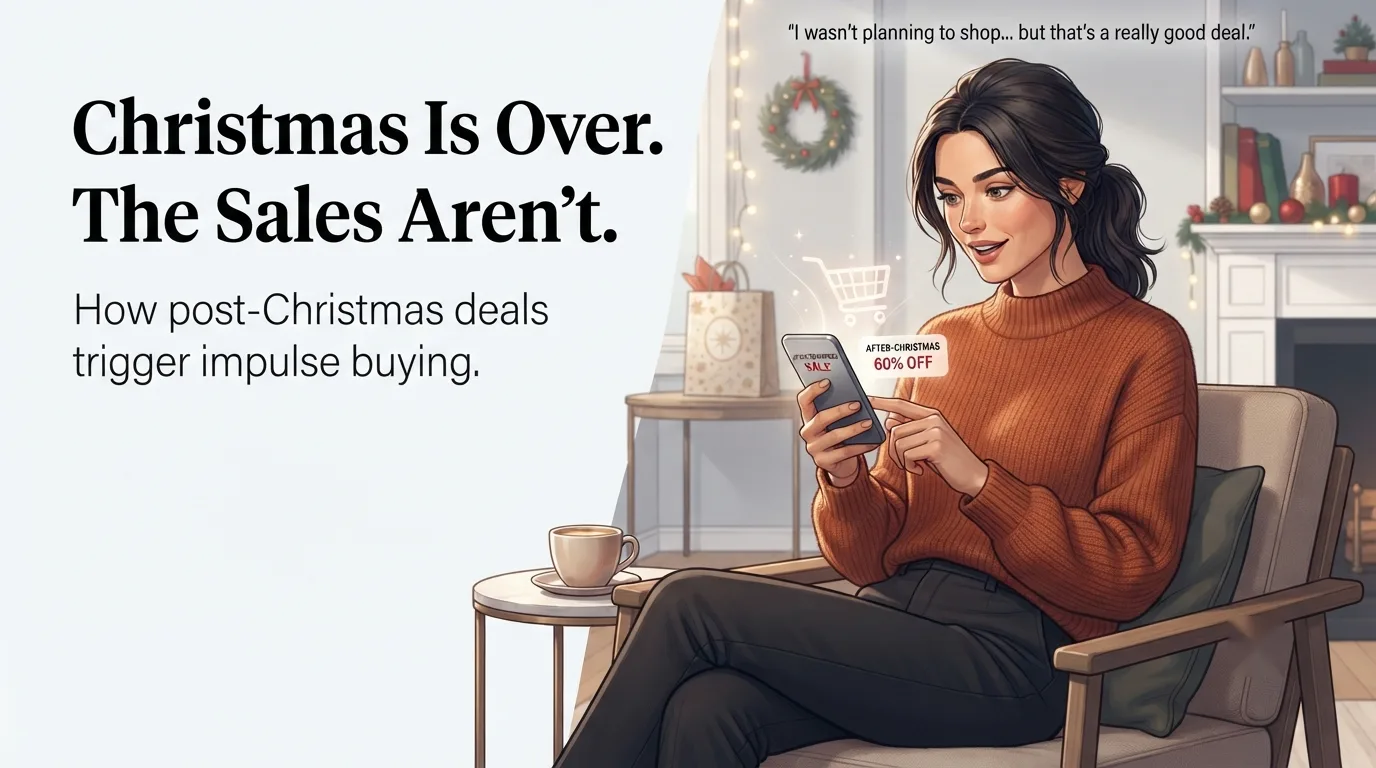
Maybe it's worth getting. Maybe you'll use it next year. Maybe you won't see a price this low again.
And just like that, you can go from “I'm done shopping” to “I should grab this before it's gone.”
That's what makes after-Christmas sales interesting. The shopping pressure doesn't necessarily disappear when Christmas ends. It can simply change its message.
Before Christmas, you may have been shopping because someone needed a gift. After Christmas, you can find yourself shopping because an opportunity seems too good to miss.
The sale hasn't necessarily created a need. It may have created the feeling that not buying would be a mistake.
And that's where an ordinary discount can become an impulse purchase.
Christmas Is Over, But the Shopping Doesn't Necessarily End
For many shoppers, Christmas creates a natural stopping point. You have a list of people to buy for, a budget to work within, and a reason for every purchase. Once the gifts are bought, it feels like the shopping should be finished.
Then the calendar changes, but the promotions continue.
Retailers can use post-holiday clearance, markdowns, limited availability, and “last chance” messaging to encourage another round of purchases. The message is simply different.
Before Christmas, it might be:
“Find the perfect gift.”
After Christmas, it becomes:
“Don't miss this deal.”
That shift matters because the reason for buying has changed. You may no longer be purchasing something for a specific person or occasion. Instead, you're being encouraged to act because the opportunity itself appears temporary.
You thought you had finished shopping.
The sale gives you a reason to start again.
Why After-Christmas Sales Feel So Hard to Ignore
A discount can change how you evaluate a product.
Imagine seeing a jacket for $120 before Christmas. You look at it, decide you don't need it, and move on. A week later, the same jacket is marked down to $60.
The jacket hasn't changed. Your need for it hasn't changed either.
But suddenly, the purchase can feel different.
Instead of thinking, “I don't need a $120 jacket,” you might think, “It's only $60 now.” You may start imagining when you'll wear it, telling yourself you'll use it next winter, or convincing yourself that passing up a 50% discount would be wasteful.
This is partly an example of anchoring: the original price can become a reference point that makes the discounted price appear especially attractive.
The important question, however, isn't simply whether the item is discounted.
It's:
Would you still want the item if there were no sale?
If the answer is no, the discount may be doing more work than you realize.
The “I'm Saving Money” Illusion
One of the easiest ways to justify an impulse purchase is to focus on what you're supposedly saving.
If something costs $50 instead of $100, your attention naturally goes toward the $50 difference. The purchase starts to feel like a financial win rather than an expense.
But spending $50 is still spending $50.
The fact that the original price was higher doesn't automatically make the purchase worthwhile.
This is where the language you use in your own head can matter. Instead of asking, “Do I want to spend $50 on this?”, you may start asking, “Do I want to save $50?”
The second question quietly assumes that buying the product is already a good decision.
Once the purchase is framed as saving money, an unnecessary item can start to feel financially responsible.
The discount may be real.
The need for the product may not be.
“Last Chance” Makes Waiting Feel Risky
After-Christmas sales often come with urgency.
You might see messages such as:
- “Last chance”
- “Final markdown”
- “Ends tonight”
- “Limited stock”
- “Final sale”
- “Once it's gone, it's gone”
These messages can make waiting feel like a mistake.
Normally, if you're unsure about buying something, you can close the browser and think about it. But urgency changes the decision. You're no longer deciding only whether you want the product; you're also deciding whether you're willing to risk losing the opportunity.
That can make the fear of missing the deal more important than the usefulness of the product itself.
And if the item disappears tomorrow, what have you actually lost?
If you never needed it, perhaps you've only lost the opportunity to buy something you hadn't planned to buy in the first place.
Missing a discount isn't necessarily losing money.
Sometimes not spending the money is the better outcome.
The “I'll Use It Next Christmas” Trap
Seasonal clearance creates another tempting justification.
You find Christmas decorations, wrapping supplies, entertaining items, clothing, or gifts at a huge discount. You don't need them right now, but you tell yourself:
“I'll use it next year.”
Maybe you will.
But buying something for future use still means spending money today on something you don't currently need. Because the purchase is connected to a future occasion, it can feel more like planning ahead than impulse shopping.
Sometimes that is exactly what it is.
Other times, “I'll use it later” is simply a convenient explanation for buying something that looks too cheap to leave behind.
A useful question is:
“Would I have put this on my shopping list for next Christmas if I hadn't seen the sale?”
If the answer is no, the discount may be creating the need rather than fulfilling one.
When a Bargain Becomes an Impulse Purchase
Not every spontaneous purchase is a bad purchase. You might discover something you genuinely need while shopping and happen to find it at a good price.
The more important distinction is what came first: the need or the sale?
If you already wanted the product, compared prices, and found it discounted, the sale may simply have made a planned purchase more affordable.
But if you weren't looking for the product, saw a dramatic markdown, and then started inventing reasons why you should own it, the situation is different.
The sale came first.
The desire followed.
That's much closer to an impulse purchase.
The product didn't solve a problem you were already trying to solve.
The sale created the problem and then offered the product as the solution.
Why “I Should Buy It” Can Be a Warning Sign
There's a subtle difference between wanting something and feeling like you should buy it.
“I want this” is a preference.
“I should buy this before it's gone” contains pressure.
That pressure can come from the discount, the countdown, limited stock, or the simple feeling that a good bargain shouldn't be left behind.
None of those things tells you whether you actually need the product. They simply make buying now feel more attractive.
That's why the phrase “I should buy this” is worth noticing.
Sometimes it means you've found something genuinely useful. Other times, it means the sale has successfully changed the question from “Do I need this?” to “Can I afford to miss this deal?”
Those questions can lead to very different spending decisions.
A Sale Can Make an Unplanned Purchase Feel Rational
Impulse buying doesn't always feel impulsive.
That's one reason it's so easy to fall into.
We often associate impulse purchases with obvious emotions such as excitement, boredom, stress, or frustration. But a discounted purchase can feel much more rational because you can build a logical explanation around it.
“It's 50% off.”
“I'll probably need one eventually.”
“It's a good brand.”
“I'll save money compared with buying it later.”
“It's basically an investment.”
This is where the purchase can become particularly difficult to recognize as impulsive. Instead of admitting that you simply want the item, you construct a reason that makes the decision feel financially sensible.
For a related example of how shoppers rationalize expensive purchases, see The “It’s an Investment” Trap: Why We Justify Expensive Impulse Buys.
The broader lesson is simple: we can become very good at explaining a purchase after we've already decided we want it.
The Online Shopping Version Can Be Even Easier
After-Christmas impulse buying isn't limited to physical stores.
Online shopping can put the same triggers directly in front of you while you're sitting at home. An email announces a clearance sale. A shopping app sends a notification. A product page displays a limited-stock message. A countdown appears next to the checkout button.
You don't need to leave the house or deliberately go shopping.
The sale can come looking for you.
That makes it especially important to recognize the difference between shopping with a purpose and simply responding to whatever promotion appears on your screen.
If you weren't looking for anything before the notification arrived, give yourself permission to do nothing.
You don't have to turn every shopping alert into a shopping session.
A Simple Way to Decide Before You Buy
Instead of immediately asking whether the discount is good, start with the purchase itself.
Imagine you see an item marked down by 60%. You feel the familiar urge to grab it before the sale ends.
Now remove the discount from the situation.
Would you still search for this product? Would you still put it on your shopping list? Would you still consider spending the money on it?
If the answer is no, you've learned something important.
The product may not be the reason you're shopping.
The promotion may be.
From there, ask yourself:
- Was I looking for this before I saw the sale?
- What specific problem does it solve?
- Where and when will I actually use it?
- Am I buying the product or the feeling of getting a bargain?
- Would I still want it tomorrow?
- If it weren't on sale, would I walk away?
You don't need to answer these questions perfectly. The point is to interrupt the automatic reaction between seeing the deal and making the purchase.
Give Yourself Permission to Walk Away
One of the most useful changes you can make is to stop treating every discount as an opportunity you must take.
You don't have to buy something because it's cheap. You don't have to use a coupon simply because you have one. You don't have to take advantage of a clearance price just because the retailer tells you it won't last.
A retailer's urgency doesn't have to become your urgency.
If you're genuinely interested in something, save it and come back later. Take a photo. Add it to a list. Give yourself time to decide.
That pause doesn't automatically mean you'll decide not to buy.
It simply gives you a chance to make sure the decision is actually yours.
That's the idea behind WaitAndBuy: create space between seeing something and buying it.
The goal isn't to eliminate shopping.
It's to make sure you are choosing what to buy rather than automatically responding to what you're being shown.
The Best After-Christmas Deal Might Be the One You Don't Buy
After-Christmas sales aren't inherently bad.
If you've been looking for a particular item and find it at a meaningful discount, buying it may be a perfectly sensible decision. The problem starts when the sale becomes the reason you want something.
That's when a $100 product marked down to $50 can become more dangerous than a $50 product you genuinely needed.
The cost isn't only the money. An unnecessary purchase can also create clutter, reinforce impulsive shopping habits, and eventually contribute to buyer's remorse when the excitement of getting the deal disappears.
Christmas may be over, but the shopping pressure doesn't necessarily end.
It can simply change its message.
Before Christmas, the pressure might have been “Buy the perfect gift.”
After Christmas, it can become “Don't miss this deal.”
Recognizing that shift is the first step toward making a different choice.
Sometimes the smartest response to an after-Christmas sale isn't:
“How much can I save?”
It's:
“Would I have bought this if there were no sale?”
If the answer is no, you may already have your answer.
FAQ
Are after-Christmas sales designed to encourage impulse buying?
After-Christmas promotions can use common sales techniques such as discounts, clearance messaging, limited availability, and urgency. These can encourage shoppers to make purchases they weren't originally planning to make.
Why do I want something more when it goes on sale?
A discount can change how you perceive the value of a product. Instead of focusing on whether you need the item, you may start focusing on the opportunity to get it for less. The original price can also serve as an anchor that makes the discounted price seem especially attractive.
How can I tell if a sale purchase is an impulse purchase?
Ask whether you wanted or needed the item before seeing the sale. If the discount created the desire to buy, rather than simply making an existing purchase more affordable, it may be an impulse purchase.
Is buying something on clearance always bad?
No. A clearance purchase can make sense if you genuinely need or want the item. The important question is whether the low price is influencing you to buy something you otherwise wouldn't have considered.
Why do “last chance” sales make me want to buy immediately?
“Last chance” messaging creates urgency and makes waiting feel risky. You may become more concerned about losing the deal than deciding whether the product is actually worth buying.
How can I stop impulse buying during after-Christmas sales?
Pause before purchasing and ask whether you wanted the item before seeing the discount, whether you would buy it without the sale, and what specific purpose the item serves. Giving yourself time before buying can reduce the pressure of the moment and help prevent unnecessary purchases.
Can online shopping make after-Christmas impulse buying worse?
Online shopping can make impulse buying easier because promotions, notifications, countdowns, and limited-stock messages can reach shoppers wherever they are. If you weren't shopping for anything before seeing the promotion, taking a deliberate pause can help you decide whether the purchase is actually worthwhile.
Conclusion
After-Christmas sales can be tempting precisely because they arrive when you think you're finished shopping.
You've already spent money. You've already made buying decisions. Then suddenly, another opportunity appears: a huge discount, a limited-stock warning, a final markdown, or a message telling you that now is the time to act.
But you don't have to act.
The next time an after-Christmas sale makes you think “I should grab this before it's gone,” pause and ask a simpler question:
“Did I want this before I saw the sale?”
That small pause can be enough to separate a genuine bargain from an impulse purchase.
Because sometimes the best deal isn't getting something for 50% off.
It's keeping 100% of your money because you never needed it in the first place.