How Marketing Triggers Impulse Buying
"Discover how discounts, FOMO, scarcity, and other marketing tactics make impulse buying harder to resist."
Impulse Buying in Marketing: How Brands Get You to Buy Without Planning To
You open an online store to buy one thing. A few minutes later, your cart contains two or three products you never planned to purchase.
The purchase may have started with a discount, a countdown timer, a "low stock" message, a product recommendation, or simply an item placed where you could not miss it. None of these techniques can force someone to buy, but they can change how a purchase feels in the moment. A product can suddenly seem more valuable, more urgent, or harder to ignore.
This is where impulse buying in marketing becomes important. Marketers can shape the shopping environment in ways that increase attention, perceived value, urgency, or emotional involvement. These factors can make an unplanned purchase more likely, particularly when there is little time or motivation to deliberate.
That does not mean every promotion causes impulse buying. A discount may help someone buy something they already planned to purchase, while a product recommendation may simply help a shopper discover something useful. The important distinction is between marketing that helps consumers make informed choices and techniques that encourage them to decide faster or feel that waiting could mean missing an opportunity.
Understanding these mechanisms can help consumers recognize when a shopping decision is being influenced. If you want to see how seemingly small purchases can add up over time, the Impulse Purchase Calculator can also help you estimate the cumulative cost of unplanned spending.
What Is Impulse Buying in Marketing?
Impulse buying in marketing refers to marketing techniques and shopping environments that can encourage consumers to make spontaneous, unplanned purchases. The purchase itself is considered impulsive when it happens without being part of the consumer's original buying plan.
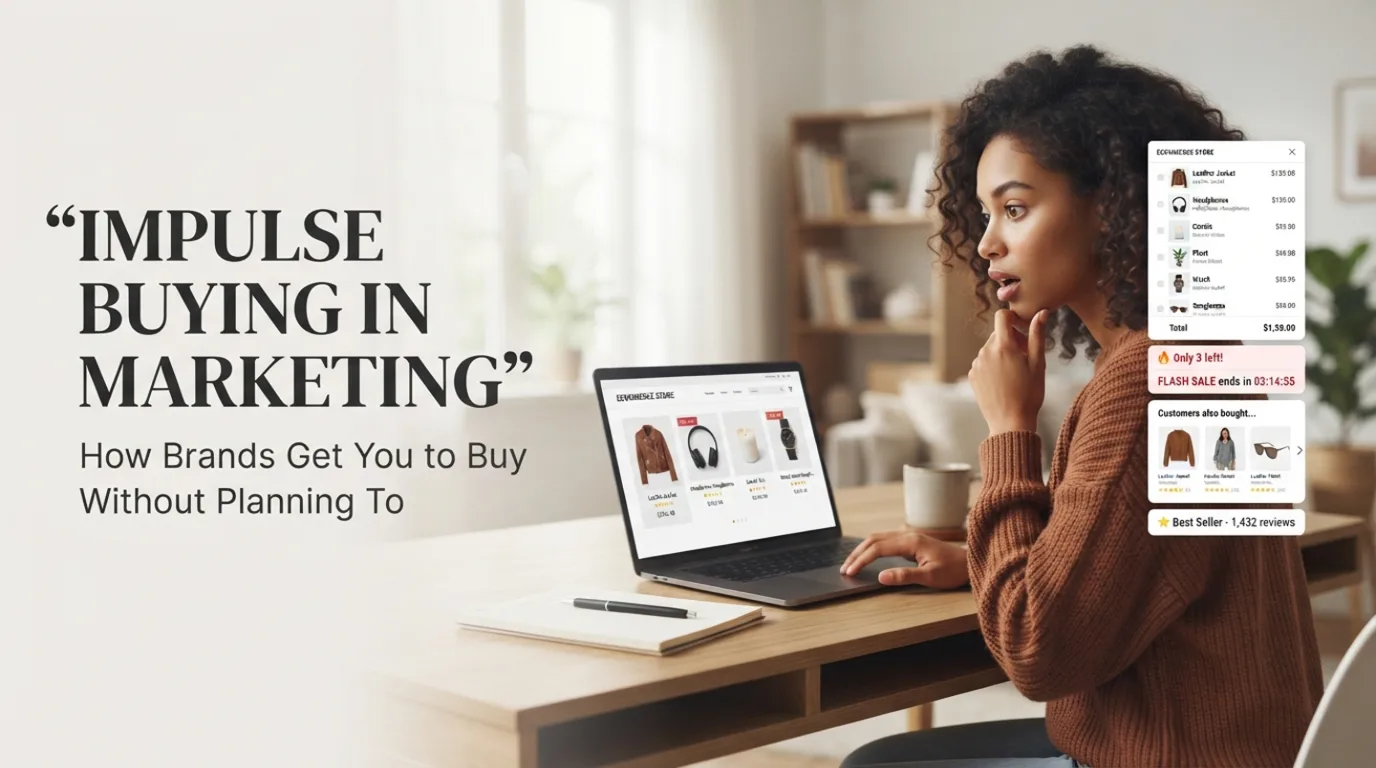
Marketing can contribute by making a product more noticeable, increasing its perceived value, creating urgency, reducing uncertainty, or making the purchase easier to complete.
For example, someone may visit a clothing website intending to replace a pair of jeans. A discounted jacket appears as a recommendation beside the jeans. The jacket was not part of the original plan, but the combination of personalization and a promotional price makes it attractive enough to consider immediately.
The marketing did not necessarily cause the purchase on its own. The consumer's preferences, mood, budget, previous experiences, and shopping context all matter. Marketing influences the environment in which that decision takes place.
1. Discounts and Price Promotions
The tacticOne of the most familiar impulse buying techniques is a price promotion. Brands may use percentage discounts, coupons, temporary price reductions, or sale prices to make a product appear more attractive.
Why it can encourage an unplanned purchaseA discount can shift the consumer's attention from whether they need a product to whether they are getting a good deal. Something that seemed unnecessary at its original price may suddenly feel affordable or like an opportunity that should not be missed.
For example, someone browsing a clothing store may not have planned to buy another shirt. Seeing "30% off today" can make the purchase feel more worthwhile, particularly if the shopper believes the price will soon return to normal.
A promotion does not automatically create an impulse purchase. If someone has been waiting to buy that shirt and purchases it during a sale, the discount simply helped them buy something they already intended to purchase.
Your move: Before buying, ask yourself whether you would still want the product if it were offered at its regular price.
For more context on how low prices and clothing purchases can contribute to spontaneous shopping, see Cheap Clothes & Impulse Buying.
2. Limited-Time Offers and Countdown Timers
The tacticBrands can attach a deadline to an offer or display a countdown showing exactly how long a promotion will remain available. Messages such as "Sale ends tonight," "Last few hours," and "Offer expires in 20 minutes" are designed to make the timing of the decision more prominent.
Why it can encourage an unplanned purchaseA time limit introduces urgency. Instead of asking only, "Do I want this?", the shopper may start asking, "Do I need to decide right now?"
That change matters because delaying a purchase normally gives consumers more time to compare alternatives, reconsider their need, or simply lose interest. A countdown can make delay feel like a missed opportunity.
For example, someone browsing headphones might initially decide to think about the purchase. A countdown showing that a promotional price expires soon can make waiting feel riskier, increasing the temptation to buy immediately.
Your move: If the product was not on your original shopping list, pause before responding to the timer. Ask whether the product is worth buying without the deadline.
3. Limited-Stock and Scarcity Messages
The tacticRetailers may highlight limited availability with messages such as "Only 3 left," "Low stock," "Selling fast," or "Limited edition."
Why it can encourage an unplanned purchaseScarcity can make a product seem more valuable or difficult to obtain while creating pressure to act before it disappears. Instead of evaluating only whether the product is worth buying, the consumer may also start worrying about losing the opportunity to buy it.
Scarcity is therefore closely connected with urgency. When shoppers believe that waiting could mean missing out, they may spend less time deliberating.
For example, someone browsing shoes might see that only two pairs remain in their size. Even though buying another pair was not part of the original plan, the possibility of losing the product can make purchasing immediately feel more appealing.
Scarcity can also be useful information when availability really is limited. The issue is not the existence of a low-stock message itself, but how scarcity changes the consumer's decision.
Your move: Ask, "Would I still want this if I knew it would be available tomorrow?"
See FOMO & Scarcity Marketing: The Impulse Buying Trap for a closer look at scarcity and FOMO.
4. Buy-One-Get-One and Bundle Offers
The tacticBrands can increase the perceived value of a purchase by offering additional products through promotions such as "Buy one, get one free," "Buy two, save 20%," or product bundles.
Why it can encourage an unplanned purchaseThese offers can change how consumers think about value. Instead of asking whether they need another product, shoppers may focus on what they are receiving for the money.
For example, someone planning to buy one bottle of shampoo might see a "buy two, get one free" offer and decide to purchase three. The promotion may make sense if those bottles will eventually be used, but the additional purchases were not part of the original plan.
Bundles can work in a similar way. A shopper looking for a laptop may add accessories to a bundle because the combined price appears better than buying each item separately, even though some of the accessories were not initially needed.
Your move: Separate the product from the deal. Ask whether you actually want every item in the bundle.
5. Free Shipping Thresholds
The tacticOnline retailers often offer free shipping when an order reaches a certain value, such as "Free shipping on orders over $50."
Why it can encourage an unplanned purchaseA shopper who has already decided to spend $40 may begin looking for another $10 product to avoid a shipping fee. The extra item was not part of the original plan, but the shipping threshold changes how its cost is perceived.
Instead of thinking, "Do I need this $12 product?", the shopper may think, "I'm only $10 away from free shipping."
This can be a sensible decision if the additional product is genuinely useful. But if the shopper spends more simply to avoid paying a smaller shipping charge, the promotion has effectively expanded the original purchase.
Your move: Compare the cost of buying the extra item with the cost of simply paying for shipping. Then decide which option actually makes sense.
6. Product Placement and Checkout Displays
The tacticPhysical retailers carefully decide where products appear. Items can be placed near checkout counters, at aisle ends, beside complementary products, or in other high-visibility areas.
Online stores use similar merchandising principles through recommendations such as "Frequently bought together" and "You may also like."
Why it can encourage an unplanned purchaseProduct placement primarily influences attention. A shopper cannot consider a product they never notice, but a strategically positioned product can interrupt an otherwise routine shopping trip.
Checkout displays are especially relevant because the shopper has already decided to make a purchase and is close to completing the transaction. Small, relatively inexpensive items are easy to notice and add at the last moment.
For example, someone buying groceries may reach the checkout and notice a snack or small household item they had not planned to purchase. Because the item is immediately visible and the transaction is already underway, adding it requires little additional effort.
Your move: Before adding a checkout item, ask whether you noticed it because you needed it or simply because it was placed in front of you.
7. Eye-Catching Packaging and Product Presentation
The tacticBrands use packaging, displays, imagery, typography, colors, and other visual elements to make products noticeable and appealing.
Why it can encourage an unplanned purchaseVisual presentation can capture attention before a consumer has consciously decided to evaluate a product. This is especially important in environments where shoppers encounter hundreds of products competing for attention.
For example, someone shopping for groceries may notice a snack with distinctive packaging displayed prominently at the end of an aisle. The item was not on the shopping list, but the presentation creates enough interest for the shopper to stop and consider it.
At the same time, attractive packaging is not inherently a tactic for encouraging impulse purchases. Good presentation can help consumers identify products, understand their features, and distinguish between alternatives. Its effect depends on the broader shopping context.
Your move: Notice the difference between "This caught my attention" and "I actually need this." Those are not necessarily the same thing.
8. Social Proof, Reviews, and Popularity Signals
The tacticBrands can show signals that other consumers have purchased or liked a product. Common examples include star ratings, reviews, "Best seller" labels, purchase counts, trending badges, and customer photos.
Why it can encourage an unplanned purchaseSocial proof can reduce uncertainty. When shoppers see that other people have purchased and positively evaluated something, the product may seem more trustworthy or desirable.
This can be particularly useful when a consumer is unfamiliar with a product. For example, someone browsing for a phone accessory may see a "Best seller" label alongside thousands of positive reviews. Even though the accessory was not part of the original shopping plan, the popularity signals can make it easier to justify the purchase.
Social proof can therefore inform consumers rather than simply pressure them. Genuine reviews can help shoppers make better decisions. It becomes more relevant to impulse buying when popularity signals are combined with discounts, scarcity, or other urgency cues.
Your move: Treat popularity as information, not proof that you personally need the product.
9. Personalized Recommendations and Retargeting
The tacticDigital retailers can use browsing behavior, previous purchases, and product interactions to personalize what shoppers see. This can include product recommendations, personalized emails, and advertisements for products someone previously viewed.
Why it can encourage an unplanned purchasePersonalization reduces the effort required to find something relevant. Instead of searching through a large catalog, consumers are shown products that are more likely to match their interests.
Retargeting can also bring a product back into attention after the shopper has already left the website. A product that was initially ignored may become tempting after appearing repeatedly in advertisements or recommendations.
For example, someone may browse a backpack without buying it. Later, they see that backpack in an advertisement while reading another website. The repeated exposure brings the product back into consideration and can eventually lead to a purchase that was not part of the original plan.
Personalization can be genuinely useful because it improves product discovery. The important question is whether the recommendation is helping you find something useful or simply keeping a tempting purchase in front of you.
Your move: If a recommendation follows you around the internet, remember that repeated visibility is not the same as increased need.
10. FOMO and Urgency
The tacticFOMO, or the fear of missing out, uses messages that suggest consumers could lose an opportunity if they do not act quickly.
Examples include "Don't miss out," "Last chance," "Trending now," and "Selling fast."
Why it can encourage an unplanned purchaseFOMO changes the emotional meaning of waiting. Instead of seeing delay as a normal part of decision-making, the shopper may begin to see waiting as a potential loss.
That can increase the pressure to act before considering whether the product is actually needed. FOMO can become particularly influential when combined with other tactics.
Imagine a shopper sees a pair of shoes described as "trending," discounted by 30%, and available in only a few remaining sizes. Each message reinforces the others: popularity suggests desirability, the discount suggests value, and scarcity suggests urgency.
The shopper may end up buying because the opportunity feels difficult to pass up rather than because the shoes were part of the original plan.
Your move: Ask yourself, "What am I afraid of missing, the product, or the feeling of getting the deal?"
For more on this pattern, see FOMO & Scarcity Marketing: The Impulse Buying Trap.
Why Does Marketing Work So Well on Impulse Purchases?
Marketing can influence impulse purchases because spontaneous buying is affected by more than the product itself. The shopping environment can change what receives attention, how valuable an item appears, how urgently the decision feels, and how easy it is to complete the purchase.
Emotional response can make a product feel immediately rewarding. Excitement, curiosity, anticipation, or fear of missing out can all make a purchase more compelling in the moment.
Perceived value can also change quickly. A discount, bundle, free gift, or free-shipping offer can make an item appear like a better opportunity, even when the underlying need has not changed.
Urgency makes delay feel more costly. Countdown timers, limited stock, and "last chance" messages can shift the question from "Should I buy this?" to "Should I buy this before it is too late?"
Attention is another important factor. A product recommendation, checkout display, or eye-catching package puts an item into consideration that may otherwise have been ignored.
Finally, reduced deliberation can make acting on an impulse easier. Online stores can combine recommendations, saved payment information, promotional messages, and fast checkout into a very short path from seeing a product to purchasing it. Convenience itself is not a problem, but fewer steps can mean fewer opportunities to reconsider an unplanned decision.
Online vs. Offline Impulse-Buying Marketing
The underlying principles of marketing and impulse buying are similar online and offline, but retailers use different tools to create the shopping environment.
Online shoppingEcommerce gives brands the ability to personalize the shopping experience and respond to a consumer's behavior in real time. Common techniques include recommendations, pop-ups, countdown timers, free-shipping thresholds, personalized offers, retargeting advertisements, low-stock notifications, and accelerated checkout.
A shopper might see a recommended product, receive a discount, encounter a countdown, and then complete the purchase with saved payment information. Each step can reduce friction or increase the perceived value and urgency of the purchase.
Physical storesPhysical retailers rely more heavily on space, visibility, product placement, and proximity. Checkout displays, end-of-aisle promotions, attractive packaging, product demonstrations, samples, and in-store discounts can all influence what shoppers notice.
A supermarket shopper, for example, may enter with a specific list but encounter promotional displays and checkout products that were never part of the original plan.
The biggest difference is that ecommerce can personalize and change the experience dynamically, while physical stores use the physical environment to influence attention and encourage additional purchases.
How Consumers Can Recognize Impulse-Buying Tactics
Recognizing these techniques does not mean rejecting every promotion. The goal is to create a small pause between the marketing message and the purchase decision.
When you see a promotion, ask whether the purchase was already planned. If it was not, give yourself a moment before deciding. Ask whether you would still want the product without the discount, countdown, free-shipping threshold, or "only a few left" message.
It can also help to separate the product from the opportunity. A product may be useful, but that does not necessarily mean the current deal is worth acting on immediately.
Finally, ask whether you are buying because you genuinely want the item or because the marketing has made waiting feel uncomfortable. That simple distinction can turn an automatic reaction into a more deliberate decision.
Impulse Buying Marketing Strategies: Information vs. Pressure
Not all persuasive marketing is designed to create impulse purchases. A product comparison, accurate review, clear specification, transparent price, or useful recommendation can help consumers understand their options and make better decisions.
The distinction becomes clearer when considering what the message is asking the consumer to do.
A message such as "This jacket is made from recycled polyester and comes in five sizes" primarily provides information. A message such as "Buy now — only 10 minutes left!" primarily creates urgency.
Both are forms of marketing, but they influence decision-making differently. Persuasion itself is not inherently harmful. Consumers need marketing to discover products and understand what is available. The concern arises when urgency, scarcity, emotional pressure, or frictionless purchasing encourages someone to act before they have had enough time to consider whether the purchase actually makes sense.
Frequently Asked Questions
What is impulse buying in marketing?Impulse buying in marketing refers to marketing techniques and shopping environments that can encourage consumers to make spontaneous, unplanned purchases. These techniques can increase attention, perceived value, urgency, or emotional involvement.
How do marketers encourage impulse purchases?Marketers can encourage impulse purchases through discounts, scarcity messages, limited-time offers, bundles, checkout displays, social proof, personalized recommendations, free-shipping thresholds, and FOMO-based messaging. These techniques do not automatically cause impulse buying; their effect depends on the consumer and the situation.
What marketing techniques cause impulse buying?Common impulse buying techniques include discounts, limited-time promotions, scarcity cues, bundle offers, product placement, attractive presentation, social proof, personalized recommendations, retargeting, and FOMO. They can make products more noticeable, valuable, urgent, or convenient to purchase.
Why do discounts encourage impulse buying?Discounts can increase perceived value and make a purchase feel like an opportunity that should not be missed. Consumers may begin focusing on how much they are saving rather than whether they originally intended to buy the product.
How does scarcity encourage impulse purchases?Scarcity can make a product appear more valuable or difficult to obtain while creating pressure to act before it becomes unavailable. When consumers believe they could lose an opportunity by waiting, they may spend less time deliberating before purchasing.
Conclusion
Marketing does not need to force consumers to buy something they never intended to purchase. Instead, it can shape the conditions around a decision.
A discount can change perceived value. A countdown can make waiting feel costly. Scarcity can create fear of missing an opportunity. Product placement can capture attention. Social proof can reduce uncertainty. Personalization can put tempting products directly in front of a shopper, while frictionless checkout can make acting on an immediate desire easier.
These mechanisms help explain why impulse purchases in marketing are common across both ecommerce and physical retail. But not every promotion creates an impulse purchase, and not every persuasive technique is inherently manipulative. The effect depends on the consumer, the product, the context, and how the marketing message changes the decision-making process.
For consumers, awareness is often the first useful step. When you notice the difference between "I want this" and "I need to buy this right now," you create room to make a more deliberate choice.
If you want to understand how spontaneous purchases may be affecting your spending over time, try the Impulse Purchase Calculator to estimate the cumulative cost of unplanned purchases.