Why Influencer Hauls Trigger FOMO Shopping
"Why do influencer hauls make you feel like you're missing out? Learn how social media FOMO can trigger impulse buying and unnecessary purchases."
Why Influencer Hauls Make You Feel Like You're Missing Out
You open social media with no intention of shopping. You are not looking for new clothes, a beauty product, a gadget, or something for your home. Then an influencer starts unpacking a haul.
There is a jacket you suddenly like. A skincare product you have never heard of. A gadget that looks surprisingly useful. A home item that seems to make their space look better. Then comes the thought: “Everyone has this.” Or, “I keep seeing this everywhere.” Maybe even, “If they love it, I probably need it too.”
A few minutes earlier, none of these products were part of your plans. Now one of them can feel strangely difficult to ignore.
This is one way influencer hauls can contribute to FOMO shopping and social media impulse buying. That does not mean every influencer is trying to make viewers spend money, or that every haul leads to an impulse purchase. Influencer content can genuinely help people discover useful products, learn how something works, or find an item they were already looking for.
The important question is what happens when product discovery turns into a feeling that you are missing out.
Seeing other people repeatedly showcase what they buy can change what feels normal, desirable, popular, or necessary. Comparison, familiarity, social proof, and FOMO can combine to make a product feel important even when you had no interest in it before seeing the content.
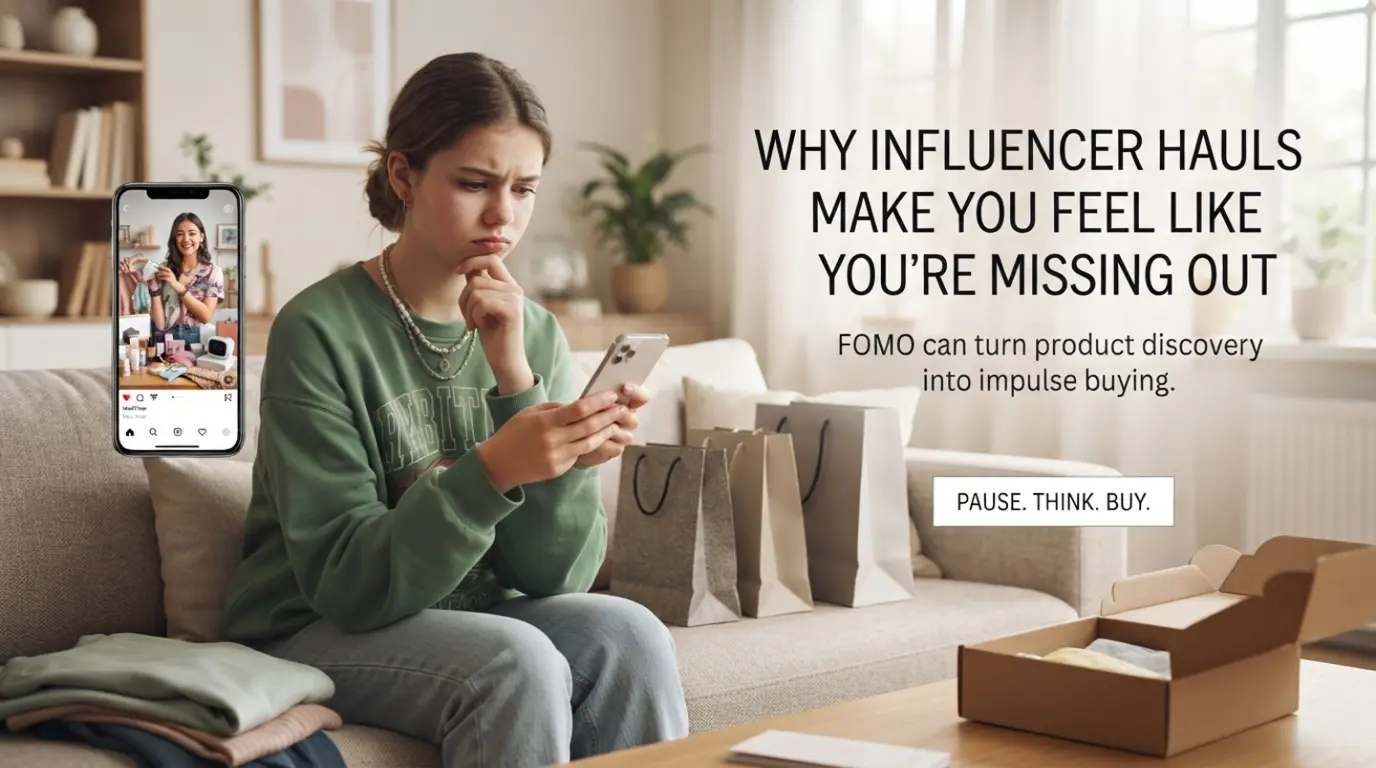
The feeling of missing out, however, does not necessarily mean you are actually missing something you need.
What Is an Influencer Haul?
An influencer haul is content where a creator shows an audience multiple products they recently purchased, received, or plan to use. Hauls can cover almost anything, including clothing, makeup, skincare, electronics, home decor, accessories, fitness products, food, and everyday items.
The format is effective because several products are presented in one piece of content. Instead of encountering one product and making one decision, you might be introduced to ten or more possibilities within a few minutes.
The influencer may explain why they bought each item, demonstrate how it works, show how it looks in their home, or describe how it fits into their daily routine. That context can make products feel more relevant than a simple advertisement might.
Imagine watching a clothing haul without intending to shop. One jacket catches your attention. Then you notice the shoes. Then the bag. Then the accessories. By the end of the video, you have been introduced to an entire collection of products that were not on your shopping list when you opened the app.
You do not have to want everything for the content to influence your shopping behavior. One product can be enough to start the process.
Why Seeing Someone Else Buy Something Can Make You Want It
There is a simple sequence that helps explain why an irrelevant product can suddenly feel desirable:
See the product → compare yourself → perceive popularity → feel FOMO → imagine owning it → feel the urge to buy.
These stages do not happen to everyone, and seeing a product does not automatically lead to an impulse purchase. But each stage can make the next one easier.
See the ProductBefore the video, the product may have been completely irrelevant to you. You may not have known the brand existed or even realized that the product was something people bought.
The influencer gives it attention and context. They explain what it does, show it being used, and place it within a lifestyle that may look appealing. The product has now entered your awareness.
Compare YourselfOnce you see what another person owns or uses, you may begin comparing their lifestyle with your own.
Their wardrobe looks more complete. Their desk looks more organized. Their skincare routine looks more sophisticated. Their kitchen has equipment you do not own.
This does not necessarily mean you consciously want to compete with them. The comparison can be much subtler. You simply start reconsidering what feels normal or what you think you should have.
An item that seemed unnecessary yesterday can begin to look like something people are expected to own.
Perceive PopularityThen you notice that the same product appears elsewhere.
Another creator has it. The comments are full of people asking where to buy it. Someone calls it a “must-have.” You see it again in your feed a few days later.
You may start thinking, “I keep seeing this everywhere.”
Popularity can be useful information. Other people's experiences can help you identify products worth researching. But popularity does not automatically mean that a product is useful for you.
Feel FOMOOnce a product appears popular and desirable, the fear of missing out can enter the picture.
“Maybe I'm missing out.”
The fear may not be about missing a sale. It can be about missing an experience, trend, lifestyle, or opportunity that other people seem to be enjoying.
For a deeper look at this feeling, see You Don't Need It, You're Just Scared Of Missing Out.
Imagine Owning ItThe product then becomes personal.
Instead of watching someone else use the item, you start imagining yourself using it. You picture how the clothes would look on you, how the gadget would fit into your routine, or how the home product could improve your space.
This is where the purchase can begin to feel less like an optional idea and more like a solution to a problem you had not noticed before.
Feel the Urge to BuyOnce the product feels personally relevant, buying can seem like the natural next step.
The original thought was, “What is that?”
Now it becomes, “Where can I get one?”
That shift is important because impulse buying is often less about suddenly needing an object and more about how quickly a desire can move from awareness to action.
The Comparison Effect: When Other People's Purchases Change What Feels Normal
Social media gives us an unusually constant view of what other people wear, own, use, and recommend.
When you repeatedly see similar products and lifestyles, your reference point can change. You may start judging your own possessions against a much more curated stream of other people's purchases.
Consider someone who owns one perfectly good pair of everyday sneakers. They were not thinking about buying another pair.
Then they watch several creators showing new sneakers. They see different colors, brands, styling ideas, and enthusiastic recommendations. After enough exposure, owning one pair may start to feel less like “enough” and more like “I'm missing something.”
The sneakers they already own have not become worse. What changed is the comparison standard.
This can also happen with beauty products, technology, home decor, clothing, and other categories where trends move quickly. Social media can make frequent consumption look ordinary because the viewer is repeatedly exposed to people whose content revolves around new products.
That does not mean every viewer will imitate the behavior. But it can make higher levels of consumption feel more normal than they would otherwise.
Familiarity and Social Proof Can Make a Product Feel More Valuable
Two factors often work together in haul content: repeated exposure and social proof.
The first time you see a product, you may barely notice it. After seeing it several times, you recognize the brand and understand what it does. Eventually, you may feel as though the product is everywhere.
That familiarity matters because unfamiliar products require more mental effort to evaluate. A familiar product is easier to recognize and remember, especially when it keeps appearing in your feed.
Social proof adds another layer. Likes, comments, reviews, recommendations, and phrases such as “everyone is buying this” can signal that a product is popular.
You might think, “If they love it, I probably need it too.”
But popularity is not the same as personal usefulness. An influencer may genuinely love a product while having completely different needs, preferences, budget, or lifestyle from yours.
Other people's enthusiasm can be a reason to investigate a product. It should not automatically become the reason you buy it.
The “I Need This Too” Moment
One of the most interesting parts of social media shopping is how quickly a product can change categories in your mind.
You start with:
“I don't need that.”
Then:
“That actually looks useful.”
Then:
“I could use one of those.”
And eventually:
“I need this.”
The product has not necessarily solved a new problem. What has changed is the story surrounding it.
A haul can show you how an item fits into someone's routine, how it makes their home look, how it improves their appearance, or how much easier it supposedly makes everyday life. You are not simply seeing an object; you are seeing an outcome.
This creates an important distinction: Are you buying the product, or are you buying the lifestyle being presented with it?
A person watching a home-organization haul might not need another set of storage containers. What they may really want is the calm, organized home shown in the video.
Someone watching a fashion haul might not need another jacket. They may be responding to the confidence or identity associated with the outfit.
Someone watching a technology haul might not need another gadget. They may be attracted to the idea of being more productive or having a more sophisticated setup.
Understanding that difference can make impulse purchases much easier to recognize.
Why Haul Videos Can Trigger Multiple Impulse Purchases
A single-product advertisement gives you one product to consider.
A haul can give you many.
A skincare haul might introduce a cleanser, serum, moisturizer, mask, sunscreen, and beauty tool. A fashion haul might feature a jacket, jeans, shoes, bag, and accessories. A technology haul could include headphones, a keyboard, a charging station, and several other gadgets.
Each item creates a new opportunity to think, “I could use that.”
None of the purchases may seem particularly significant on its own. But several small decisions can add up quickly.
This is one reason influencer hauls are especially relevant to social media impulse buying. The content does not necessarily create one large buying decision. Instead, it can create a series of smaller wants in a short period.
You might finish the video with several products saved to a wishlist, several browser tabs open, or several links ready to click.
The emotional momentum of the haul can carry from one product to the next.
Product Discovery vs. FOMO-Driven Impulse Buying
Not every purchase influenced by social media is an impulse purchase.
Sometimes an influencer genuinely introduces you to something useful. You may already have a problem you want to solve, and the content gives you a product worth researching.
The difference is often in what happens next.
With genuine product discovery, you might compare alternatives, check reviews, consider the price, think about how often you would use the product, and decide whether it fits your needs.
With FOMO-driven impulse buying, the process can be more emotional. You encounter the product unexpectedly, notice that other people seem to have it, start wondering whether you are missing out, imagine yourself owning it, and feel pressure to act before the excitement disappears.
The key question is not simply whether an influencer introduced the product.
It is why you want to buy it.
If you would have searched for the product even without seeing the video, that is very different from suddenly wanting it because everyone else appears to have one.
Influencer Marketing and Impulse Buying
Influencer marketing can be a legitimate way for brands to introduce products to relevant audiences. Creators can demonstrate products in realistic settings and explain features that may be difficult to communicate through a traditional advertisement.
At the same time, commercial elements can add another layer of purchase pressure.
Affiliate links make it easy to move from the recommendation to the product page. Discount codes can make the offer feel more attractive. Limited-time promotions can make waiting feel expensive. Sponsored content can combine a product recommendation with the trust and familiarity audiences have built with a creator.
Consider the thought:
“It's only available at this price today.”
That may be a genuine offer. But it can also change the question you are asking yourself.
Instead of “Do I need this?” you start asking, “Can I afford to miss this deal?”
Those are not the same question.
If you want to understand how discounts, scarcity, promotions, and other marketing techniques can encourage unplanned purchases, see Impulse Buying in Marketing: How Brands Encourage Unplanned Purchases.
The goal is not to assume that sponsored content or affiliate links are bad. It is to recognize when commercial urgency is influencing your decision.
Social Media Can Make Buying Almost Frictionless
There is often a natural gap between discovering a product and buying it.
You might see something in a magazine, remember it, visit a store later, compare alternatives, or simply forget about it.
Social media can dramatically shorten that distance.
You see the product, hear why the creator likes it, watch it being used, receive a discount code, tap a link, and arrive at a product page.
The less effort required to buy, the less time there may be between an emotional reaction and an actual purchase.
This is one reason social media impulse buying can be so easy. The platform can combine discovery and shopping within the same environment.
For a closer look at the other half of this process, read Why Online Shopping Makes Impulse Buying So Easy.
The solution is not necessarily to avoid online shopping or social media. Creating your own pause can be enough to change the decision.
Before You Buy Something You Saw in a Haul
You do not have to stop watching haul content to become a more intentional shopper.
Instead, treat the content as a source of ideas rather than an automatic shopping list. If something catches your attention, save it and step away from the video. Give yourself time to consider the purchase outside the emotional environment in which you discovered it.
Before buying, ask yourself:
Did I want this before I saw the video?If the product was completely absent from your thoughts until the video appeared, that is a good reason to pause.
It does not mean you should never buy it. It simply tells you that the desire was created by exposure rather than an existing need.
Would I search for this product if the influencer hadn't shown it?Imagine that you never saw the haul.
Would you have searched for this product yourself? Would you have noticed the problem it supposedly solves?
If the answer is no, investigate why it suddenly feels important.
Do I already own something that does the same job?Before buying something new, look at what you already have.
A new product can feel exciting even when an existing item performs the same function. If the difference is mostly novelty, appearance, or trendiness, waiting may help you decide whether the purchase is genuinely worthwhile.
Am I buying the product or the lifestyle being presented?This is particularly useful with clothing, beauty, home, and technology content.
You may want the organized home, confident appearance, productive routine, or stylish identity represented by the product more than you actually want the product itself.
Would I still want it after waiting a few days?Impulse buying thrives on immediacy.
Give the desire some time. Research the product, compare alternatives, check your budget, and see whether you still want it when the original excitement has faded.
Waiting does not automatically mean saying no. It simply gives you the opportunity to make the decision deliberately.
Am I buying because I need it or because I feel behind?This may be the most important question.
“Everyone has this” is not the same as “I need this.”
“I keep seeing this everywhere” is not the same as “This solves a problem I have.”
“Maybe I'm missing out” is not proof that you are missing something valuable.
And “If they love it, I probably need it too” does not account for the fact that their needs may be completely different from yours.
How to Watch Haul Content Without Automatically Turning Inspiration Into Spending
You can enjoy influencer content without treating every recommendation as a reason to shop.
One practical approach is to separate discovery from decision-making. When you see something interesting, save it instead of buying it immediately. Later, look at the product without the influencer's video, comments, music, discount messaging, or lifestyle presentation influencing the moment.
Then evaluate it on its own.
Research the product. Compare alternatives. Check whether you already own something similar. Think about how often you would realistically use it. Consider whether it fits your budget and whether it solves a genuine problem.
You can also create a personal waiting rule for non-essential purchases. The exact number of days is less important than having a deliberate gap between seeing something and buying it.
If you frequently make small impulse purchases and want to understand their cumulative effect, the Impulse Purchase Calculator can help you look at what those purchases add up to over time.
The Goal Isn't to Stop Being Influenced
It is impossible to completely remove outside influence from shopping decisions.
Recommendations, reviews, advertising, trends, and other people's experiences can all provide useful information. Influencer content can genuinely help you discover products that solve problems you already have.
The goal is not to reject every recommendation.
It is to recognize the difference between:
“This is useful for me.”
and
“I suddenly feel like I need this because everyone else seems to have it.”
That distinction can help you stop impulse shopping without having to stop enjoying social media.
You can discover a product without buying it. You can like a trend without joining it. You can appreciate someone's lifestyle without trying to recreate it through purchases.
Most importantly, you can let the desire sit for a while before deciding what it means.
FAQ
Why do influencer hauls make me want to shop?Influencer hauls expose you to multiple products in a short period and often show those products within an appealing lifestyle context. Comparison, familiarity, social proof, and FOMO can make products feel more desirable, while convenient links and online checkout can make an impulse purchase easier.
Why do influencers cause FOMO?Influencers can show products, trends, experiences, and lifestyles that make viewers feel they are missing something. Repeated exposure to what other people own or enjoy can create the impression that everyone else has discovered something you have not.
Can social media cause impulse buying?Social media can contribute to impulse buying by combining product discovery, emotional triggers, social proof, personalized content, and convenient purchasing options. This does not mean everyone who uses social media will make impulse purchases, but the environment can make unplanned buying easier.
How do influencers influence purchasing decisions?Influencers can influence purchasing decisions by demonstrating products, sharing experiences, creating familiarity with brands, and providing social proof. Sponsored content, affiliate links, discount codes, and limited-time offers can also affect how quickly someone moves from discovering a product to considering a purchase.
How can I stop buying things I see on social media?Create a pause between seeing and buying. Save interesting products instead of purchasing immediately, ask whether you wanted the item before seeing it, check whether you already own something similar, research alternatives, and wait a few days before making non-essential purchases. The goal is not to ignore every recommendation but to make sure the final decision is yours.
Conclusion
Influencer hauls can make shopping feel less like shopping and more like discovering what everyone else already knows about.
You see a product. You notice that other people have it. You encounter it again. You start comparing yourself. It begins to feel popular. Then FOMO enters the picture, and you imagine how the product might fit into your own life.
At that point, buying can feel like the obvious next step.
But the feeling of missing out is not evidence that you are missing something you need.
Sometimes an influencer genuinely introduces you to a useful product. Sometimes you discover something you would eventually have searched for yourself. And sometimes you simply encounter an attractive product at a moment when comparison, familiarity, social proof, and urgency make it feel more important than it really is.
That is why the pause matters.
Before you buy, ask whether you wanted the product before you saw it. Ask whether you would search for it independently. Ask whether you already own something that does the same job. And ask whether you are buying because the product solves a problem or because you feel like you are falling behind.
You do not have to avoid every trend. You do not have to stop watching influencers. You do not have to reject every recommendation.
You simply need enough space between “I want this” and “I'm going to buy this” to decide whether the desire is actually yours.
The feeling that you're missing out doesn't necessarily mean you're missing something you need.