Impulse Shopping in India: Why Small Purchases Add Up
"Learn why small impulse purchases in India can add up over time, from online shopping and food delivery to discounts, festive sales, and quick-commerce."
Impulse Shopping in India: Why Small Purchases Add Up
₹299 for a beauty product. ₹349 for a food delivery add-on. ₹499 for a gadget accessory. ₹399 for something you noticed during a sale.
None of these purchases may feel like a serious financial decision. You might look at the amount and think, “It’s only a few hundred rupees.” That is exactly what can make small impulse purchases so easy to repeat.
The problem with impulse shopping is not always one expensive purchase. Sometimes, it is a series of small purchases that barely register when they happen but become surprisingly meaningful when you look at them together. This can happen anywhere, including India, where online marketplaces, quick-commerce apps, food delivery, digital payments, discounts, festive sales, and mobile shopping make it increasingly convenient to buy something in seconds.
The individual amount may seem harmless, but repeated spending can quietly become a significant monthly expense. So how much are those “just this once” purchases actually costing you? The answer often becomes much easier to see when you stop looking at each purchase separately and start looking at the pattern.
What Is Impulse Shopping?
Impulse shopping is buying something without planning to purchase it beforehand. You may have opened an app to check something specific and ended up buying another product, or gone into a store for one item and returned with several. You might also see a limited-time discount and decide to buy something because the opportunity seems too good to pass up.
An impulse purchase does not necessarily mean the product is useless or that you will regret buying it. Sometimes you genuinely want or need what you bought. The important distinction is that the decision happened spontaneously rather than as part of your original shopping plan.
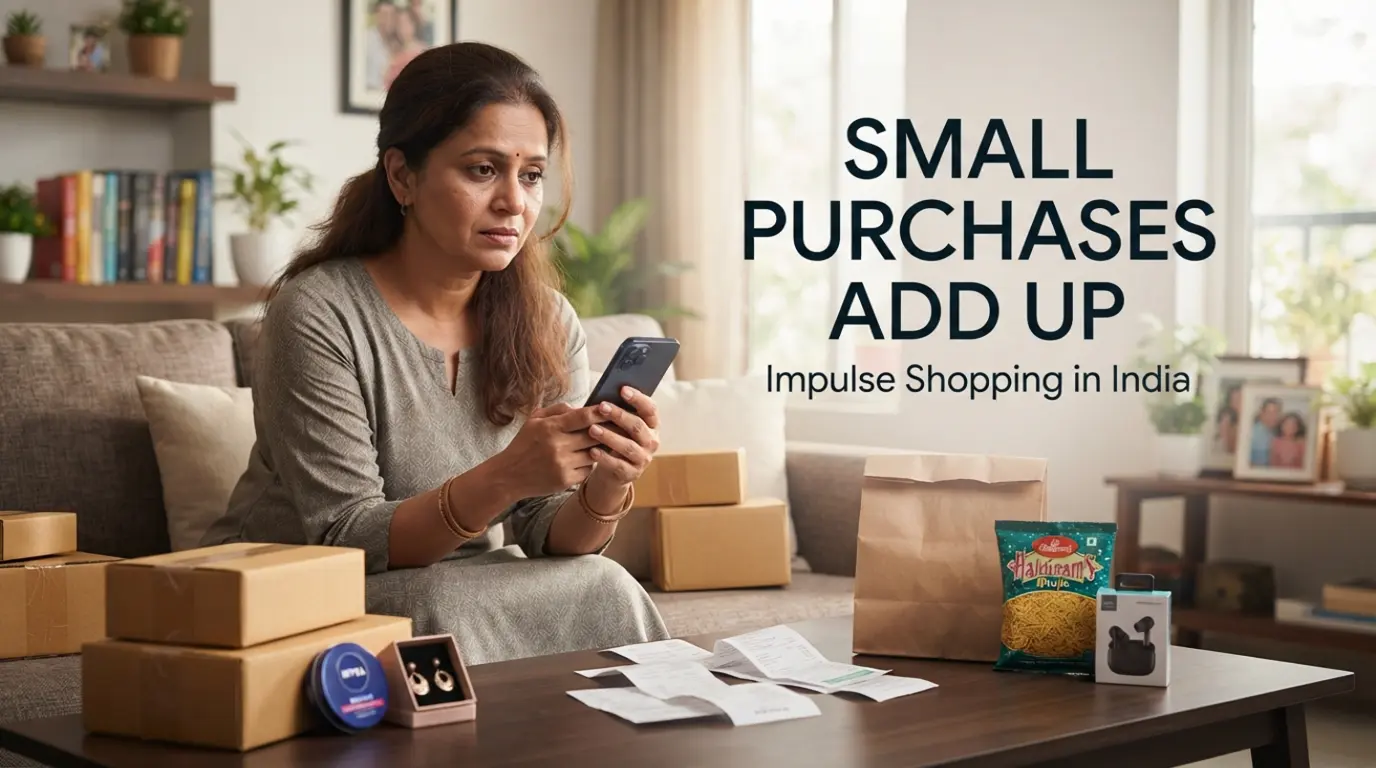
For example, you might plan to order groceries and then add a ₹299 snack because it appears prominently at checkout. You were not necessarily planning to buy it when you opened the app. The purchase happened because something triggered the decision in that moment.
That is what makes impulse shopping worth examining. The product itself may not be the problem; the pattern behind the purchase may be.
For more everyday situations, see Impulse Buying Examples: 10 Everyday Purchases You Don't Plan to Make.
Why Do Small Purchases Feel So Easy to Justify?
A ₹300 purchase usually does not create the same mental resistance as a ₹30,000 purchase. When an amount feels small, it becomes easier to explain the purchase to yourself: “It's only ₹299,” “It's on sale,” “I deserve a little treat,” or “It's just this once.”
None of these statements automatically means the purchase is a bad decision. The problem appears when the same reasoning is used repeatedly. One ₹300 purchase is ₹300, but ten similar purchases are ₹3,000. If those purchases happen regularly, the total can become much larger than the individual transactions make it feel.
This is one reason small purchases adding up is such an important part of understanding impulse spending. Your brain experiences each purchase as a separate decision, while your bank account experiences them as one cumulative total.
The more useful question is therefore not always, “Was ₹400 too much?” It can be, “How often am I spending ₹400 without planning to?”
That shift changes how you see the problem.
How Small Purchases Add Up Over Time
Consider a simple example. Suppose you make an average of three ₹400 impulse purchases every week. That is ₹1,200 per week. Over approximately four weeks, that becomes ₹4,800, and if the same pattern continued for a year, it would amount to ₹57,600.
Your actual spending will obviously vary. Some weeks may involve no impulse purchases, while others may involve more. The example is simply meant to show how quickly relatively small amounts can become meaningful when repeated.
You could have a completely different pattern: ₹250 on an online purchase, ₹350 on food delivery, ₹450 on a fashion item, ₹300 on a beauty product, and ₹500 on a gadget accessory. None of these purchases may feel particularly significant on its own, but together they represent ₹1,850 of unplanned spending.
If you had been asked at the beginning of the month whether you wanted to spend ₹1,850 on unplanned purchases, you might have considered the decision more carefully. Because the spending happened in several separate transactions, however, each purchase may have felt too small to deserve much attention.
This is why looking at the total pattern can be more useful than judging whether each individual purchase was reasonable.
Common Impulse Shopping Triggers in India
Impulse shopping in India is not fundamentally different from impulse shopping elsewhere. People everywhere can be influenced by convenience, promotions, emotions, recommendations, and the immediate appeal of a product. The Indian shopping environment simply has its own combination of situations where spontaneous purchases can occur.
Online MarketplacesLarge online marketplaces make it possible to browse thousands of products without physically going anywhere. You might search for a phone case and discover a cable, stand, charger, headphones, or another accessory. A few taps later, several products can be in your cart.
The convenience is useful, but it also reduces the time between seeing something and buying it. A product that might have required a separate trip to a store can now be purchased while you are sitting at home.
Quick-Commerce OrdersQuick-commerce services make it possible to order everyday items with very little waiting. That convenience can be extremely useful when you genuinely need something urgently, but it can also make small, unplanned purchases easier because there is very little friction involved.
Instead of thinking, “Do I need this enough to go to the store?” the decision can become, “Why not add it to the order?” When the effort required to buy something is almost negligible, the threshold for making a small purchase can become lower.
Food Delivery Add-OnsFood delivery can create another common environment for small impulse purchases. You may start with a meal and then add a dessert, drink, extra side, or snack. Each addition may feel relatively inexpensive, especially when compared with the total cost of a meal.
The concern is not one occasional add-on. It is what happens when these extras become a regular part of multiple orders each week. Small additions can quietly become their own spending category.
Fashion and BeautyA discounted shirt, pair of shoes, skincare product, makeup item, or accessory can be particularly easy to justify. The purchase may be framed as an opportunity: “It's discounted, so I'm saving money.”
But a discount only saves money if you would have bought the item anyway. Spending ₹700 instead of ₹1,000 is not saving ₹300 if you did not need or want the ₹700 purchase in the first place. You still spent ₹700.
Gadgets and AccessoriesSmall technology purchases are another common category. A phone accessory, charging cable, desk gadget, gaming item, or inexpensive electronic product can seem affordable enough to buy without much thought.
Because the price is lower than that of a major device, the purchase may feel insignificant. But several inexpensive gadget purchases can accumulate just like purchases in any other category.
Festive and Seasonal SalesIndia has a strong culture of seasonal and festive shopping, and sales can create a powerful sense of urgency. Whether it is a major online sale, festival-related promotion, end-of-season sale, or special discount event, shoppers may encounter messages suggesting that an offer is available only for a limited time.
That can shift the decision from “Do I want this?” to “Should I buy this before the offer disappears?” Those are very different questions.
For another look at how financial timing can spark unplanned spending, particularly right when money enters your account read Why Payday Triggers Impulse Spending: How to Stop.
Discounts Can Make Impulse Purchases Feel Like Savings
Discounts are particularly effective at changing how we perceive a purchase. Imagine a product originally priced at ₹1,000 being offered for ₹599. The first thought may be, “I'm saving ₹401.”
There is another way to look at it: “I'm spending ₹599.”
If you had no intention of buying the product before seeing the discount, the discount did not create a saving. It created a reason to spend.
This does not mean discounts are bad. A genuine discount can be valuable when it applies to something you already planned to buy. The useful distinction is between a planned purchase that happens to be discounted and an unplanned purchase created by the discount.
Free Delivery Can Encourage "One More Item"
Another subtle trigger is the free-delivery threshold. Suppose your cart is ₹380 and free delivery starts at ₹499. You might start looking for something worth ₹119 or more simply to reach the threshold.
At that point, the question is no longer whether you need another product. It becomes, “What can I add to reach ₹499?”
Adding another item can feel financially sensible because you are avoiding a delivery fee. But if the extra product was not needed, you have still increased your spending.
The same principle can apply to bundled offers, cashback conditions, minimum order values, and other promotions. A small additional purchase may feel justified because of the perceived benefit of the offer.
"Just This Once" Can Become a Spending Pattern
An occasional impulse purchase is not necessarily a problem. You might spontaneously buy something while traveling, treat yourself after a difficult week, or see something you genuinely like and decide to purchase it. The bigger concern is when “just this once” becomes a repeated explanation.
For example, one purchase might happen because it is on sale, another because you have had a stressful week, and another because the amount seems too small to matter. Each purchase has its own explanation, so none of them feels especially concerning at the time.
The pattern becomes visible only when you look at all of them together.
This is the difference between an occasional impulse purchase and a recurring impulse-spending pattern. One is an isolated decision; the other is a behavior that keeps repeating.
Online Shopping Makes Small Purchases Easier to Repeat
Online impulse shopping has one major advantage for the shopper: convenience. You do not necessarily need to travel to a store, wait in line, carry the product home, or even consciously set aside time for shopping.
A product can appear in a social media feed, advertisement, marketplace recommendation, or notification. Because the product is already in front of you and the purchase process is simple, the gap between wanting something and buying it can become very short.
Digital payments can make the final step even more effortless. Once payment information and delivery details are already available, there may be little physical effort involved in completing the transaction.
This does not mean digital payments cause impulse shopping. They simply remove some of the friction that once existed between wanting something and purchasing it.
For a deeper look at this behavior, read Why Online Shopping Makes Impulse Buying So Easy.
How to Find Out How Much Your Impulse Shopping Costs
You do not need to completely change your shopping habits to understand your spending. Start by looking backward at your recent transactions.
Review your bank, card, UPI, wallet, and shopping-app transactions and identify purchases that were unplanned, triggered by a discount, added spontaneously, made because you were bored or browsing, added to reach free delivery, or made because of a limited-time offer.
Once you have identified them, add the amounts together. You may find that individual purchases looked insignificant but the combined number is much larger than expected.
Next, look for repetition. Maybe food delivery appears frequently. Perhaps fashion, beauty, gadgets, or online marketplace purchases are responsible for most of the unplanned spending. The category is useful to identify, but the frequency may be even more revealing.
Finally, project the pattern. If you spent ₹3,000 on impulse purchases last month, multiplying that amount by 12 gives you ₹36,000 as a simple illustration of what that spending pattern could represent over a year. It does not predict your actual future spending, but it makes the recurring cost easier to visualize.
You can also use WaitAndBuy's Impulse Purchase Calculator to estimate your own monthly and yearly impulse spending instead of relying only on an example.
Simple Ways to Pause Before Making Small Purchases
The goal is not to stop yourself from ever buying anything spontaneously. The goal is to create enough space between wanting something and buying it that you can make a deliberate decision.
Use a Short Waiting PeriodWhen something is inexpensive, try waiting before purchasing it. For a small item, that might mean waiting until later in the day. For a more expensive purchase, you might choose to wait a day or longer.
The exact waiting period matters less than creating a pause. If you still want the item after the waiting period, you can make the decision with a little more distance from the initial urge.
Ask Whether You Would Buy It Without the DiscountBefore buying something because of a promotion, ask yourself whether you would still want it at the normal price.
If the answer is no, the promotion may be driving the purchase more than the product itself. This simple question can help separate genuine value from the feeling that you might miss out on a deal.
Check Whether You Already Own Something SimilarThis is particularly useful for clothes, beauty products, accessories, kitchen items, and gadgets. Before buying, ask whether you already own something that performs the same function.
Sometimes a purchase becomes less attractive once you compare it with what you already have. The new item may still be useful, but at least the decision is based on a clearer understanding of what you actually need.
Remove Unnecessary UrgencyLimited-time offers are designed to make waiting feel costly. Sometimes an offer really will expire, but that does not necessarily mean the product deserves an immediate purchase.
If possible, save the item and revisit it later rather than deciding immediately. Giving yourself time can reveal whether you genuinely wanted the product or simply reacted to the urgency around it.
Keep a List Instead of Buying ImmediatelyInstead of treating every urge to buy as a decision that must end in a purchase, create a list of things you are considering. Revisit the list after some time.
You may discover that several things no longer interest you. That is useful information because it shows that the desire to buy was temporary. The pause itself becomes a way to distinguish a passing urge from something you genuinely value.
Small Purchases Are Not Automatically Bad
It is important not to turn this into a rule that every small purchase is irresponsible. Buying a ₹300 coffee, a ₹500 shirt, or a ₹250 snack is not inherently a problem. Money exists to be spent, and occasional treats can be part of a healthy spending plan.
The useful distinction is between intentional spending and unconscious repetition. If you consciously choose to spend ₹500 on something you value, that can be completely reasonable. If you repeatedly spend ₹500 because it feels too small to think about, the pattern deserves more attention.
The objective is not to eliminate small purchases. It is to make sure they are choices rather than habits operating on autopilot.
This is also why the question is not always whether you can afford a particular item. You might be able to afford every individual purchase and still discover that your overall spending does not match your priorities.
A Better Way to Think About Impulse Spending
Instead of asking, “Is this purchase expensive?” try asking, “Is this purchase part of a pattern?”
A ₹300 purchase may be insignificant once. A ₹300 purchase repeated several times every week is different. The same applies to food delivery, clothing, beauty products, gadgets, and other categories where individual purchases can appear affordable.
You do not necessarily need to stop buying these things. You need to become more aware of which purchases you are making, why you are making them, and how often they happen.
That is where intentional spending becomes useful. The goal is not to make every purchase complicated. It is to notice the purchases that happen repeatedly without much thought.
FAQ
What is impulse shopping in India?Impulse shopping in India refers to unplanned purchases made spontaneously rather than as part of an intended shopping decision. It can happen in physical stores or online and may involve food, fashion, beauty, gadgets, groceries, entertainment, or other products.
Why do small purchases add up?Small purchases add up because their individual amounts can feel insignificant, making them easy to repeat. When several unplanned purchases happen each week, their combined monthly and yearly cost can become much larger than expected.
Is impulse buying unique to India?No. Impulse buying is not uniquely Indian. It occurs across different countries and shopping environments. The Indian context simply has its own mix of marketplaces, quick-commerce services, food delivery, festive shopping, digital payments, and promotional events that can create opportunities for spontaneous purchases.
How much can small impulse purchases cost over a year?It depends on how frequently you make them. For example, spending ₹400 three times a week would average about ₹1,200 per week, or roughly ₹4,800 over four weeks. If that pattern continued for 12 months, it would amount to approximately ₹57,600.
How can I tell if I am impulse shopping too often?Review your recent transactions and identify purchases you did not originally plan to make. Add them together and look for recurring patterns. If the same types of unplanned purchases appear repeatedly, you may have a recurring impulse-spending pattern rather than occasional impulse buying.
Do discounts cause impulse purchases?Discounts can encourage impulse purchases by creating a sense of value or urgency. A discount is most useful when it applies to something you already intended to buy. If the discount is the reason you decided to purchase something you did not want beforehand, you are still spending money rather than saving it.
How can I stop impulse shopping online?Start by adding a pause between seeing a product and buying it. You can save items for later, wait before checking out, and ask whether you would still want the product without the discount or promotion. Creating even a short gap between the urge and the purchase can make the decision more deliberate.
How can I calculate my impulse spending?Review your recent transactions, identify purchases that were unplanned, and add them together. You can also use WaitAndBuy's Impulse Purchase Calculator to estimate your monthly and yearly impulse spending and understand how small purchases can accumulate.
Conclusion
Impulse shopping does not always look like a major financial mistake. Sometimes it looks like ₹299, followed by ₹399, then ₹450, and later another ₹500 order because you were close to free delivery. Each purchase can feel too small to matter.
But spending decisions do not exist in isolation. When the same behavior happens repeatedly, the pattern can become much more significant than any individual transaction suggests.
That is the real lesson behind small purchases adding up. You do not necessarily need to stop buying small things. You need to become more aware of which small purchases you are making, why you are making them, and how often they happen.
The next time you are about to make a purchase because “it's only a few hundred rupees,” pause for a moment.
The better question may not be “Can I afford this?” It may be “How many times have I said that this month?”
That small pause is exactly the kind of space WaitAndBuy is designed to help create between the urge to buy and the decision to purchase.