Why Payday Triggers Impulse Spending: How to Stop
"Why do you spend more after payday? Learn how payday can trigger impulse buying and discover practical ways to stop payday overspending without feeling restricted."
Why Payday Triggers Impulse Spending: How to Stop Impulse Shopping
Have you ever been careful with your spending for days, only to get paid and suddenly feel like buying everything you have been thinking about?
A new pair of shoes seems reasonable. Ordering dinner feels deserved. That product sitting in your wishlist suddenly feels like something you can finally afford. Even purchases you ignored before payday can become much harder to resist once your paycheck arrives.
This is one reason payday can become a trigger for impulse spending.
Getting paid changes your bank balance, but it can also change how spending feels. When money has just arrived, you may feel more financially comfortable, less cautious, and more willing to spend on things that are not essential.
The problem is not spending money after payday. Paying bills, buying something you need, enjoying a meal out, or treating yourself can all be perfectly reasonable. The problem begins when the arrival of your paycheck becomes the reason you make purchases you never intended to make.
Understanding why payday spending feels different can help you recognize the urge before it turns into a string of impulse purchases.
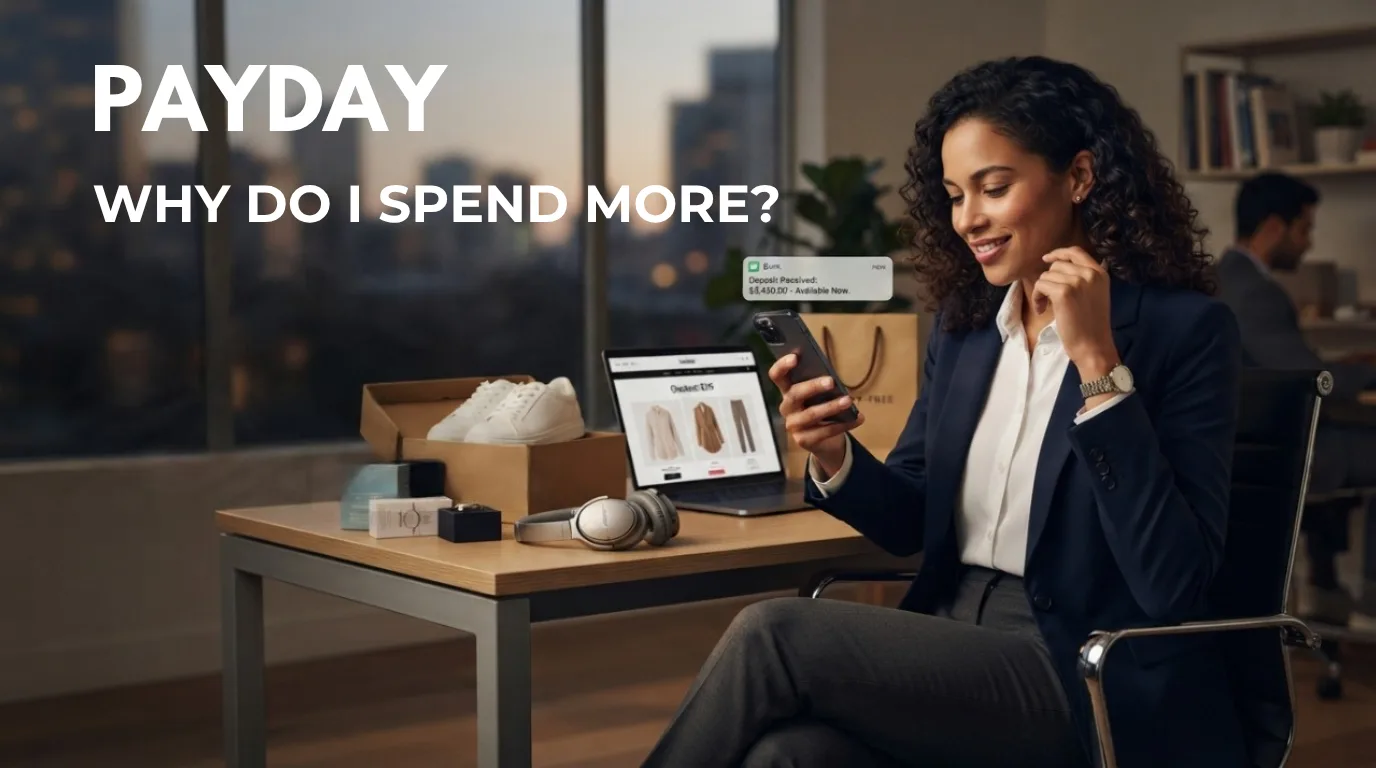
Why Payday Can Change How Spending Feels
Before payday, your available balance may feel limited. You might think twice about ordering something online or decide to wait until later.
Then your paycheck arrives.
Your balance increases, and the same purchase suddenly feels less significant. The psychological resistance that was there a few days earlier may become weaker.
Part of this comes from the immediate feeling of financial breathing room. You have been waiting for money to arrive, and now it is available. That can create a sense of relief and flexibility.
But the money arriving does not necessarily mean you suddenly have more discretionary money than you thought.
Your paycheck may already have several jobs waiting for it bills, groceries, transportation, savings, debt payments, upcoming expenses, and other commitments. The money is available in your account, but much of it may already be spoken for.
That distinction is important because payday spending often begins when available money starts to feel like spending money.
Why Payday Makes You Feel Richer Than You Are
Payday can create a temporary feeling of being financially better off.
Imagine that your paycheck increases your account balance by $2,000. Seeing that number can make you feel as though you suddenly have $2,000 available to use.
But perhaps $1,200 is needed for upcoming expenses, $400 is intended for savings, and only $400 is genuinely available for discretionary spending.
Your financial position has not suddenly become as flexible as the account balance suggests.
This is why payday can influence spending behavior. The new balance is highly visible, while future commitments are easier to overlook.
The result can be a psychological shift from:
“I need to be careful with my money.”
to:
“I have money again.”
That feeling can make impulse purchases easier to justify.
The “I Can Afford It Now” Effect
One of the most common payday thoughts is:
“I can afford it now.”
Technically, you may be able to afford the purchase. But affordability and intentionality are not the same thing.
Suppose you see a $50 product before payday. You decide it is not worth spending the money on and move on.
After payday, you see the same product again. Now $50 seems relatively small compared with your new balance.
The product has not become more useful. Your financial priorities have not necessarily changed. What changed is how risky the purchase feels.
This is why it can be useful to ask a different question:
“If I had not just received my paycheck, would I still be considering this purchase?”
If the answer is no, payday may be influencing the decision more than the product itself.
Mental Accounting and the Way We Treat Payday Money
People often divide their money mentally into different categories.
You may think of one portion of your paycheck as bill money, another as savings, and another as spending money.
This kind of mental accounting can be useful. Giving money different purposes can make it easier to manage your finances.
But those mental categories can also change how spending feels.
For example, once you mentally label part of your paycheck as “fun money,” spending from it can feel almost consequence-free. A purchase may no longer feel like taking money away from something important because it has already been assigned to enjoyment.
The risk comes when the category becomes an excuse rather than a boundary.
You might start with:
“I have $200 budgeted for discretionary spending.”
Then, after a few purchases:
“I have some extra money.”
Eventually:
“I just got paid, so I can buy this.”
The original budget has quietly been replaced by the feeling of having money.
Payday and the Desire to Reward Yourself
Payday can also feel like a reward.
You worked for the money. You waited for the paycheck. You made it through another pay period. When the money arrives, it can feel natural to want to do something enjoyable with it.
That is not necessarily a problem.
Rewarding yourself can be part of healthy spending when it is intentional and fits within your financial priorities.
The problem is when getting paid automatically becomes a reason to treat yourself.
You may not have wanted the item before payday. You may not have planned to buy it. But once the money arrives, the purchase suddenly feels deserved.
This is where payday spending can overlap with emotional spending.
Our article The “Treat Yourself” Trap: When Rewarding Yourself Becomes Overspending explores this idea more deeply.
The goal is not to stop treating yourself. It is to distinguish between:
“I planned to spend money on something enjoyable.”
and:
“I just got paid, so I should buy something enjoyable.”
How Small Payday Purchases Add Up
Payday overspending does not have to involve one expensive shopping spree.
It can happen through a series of small purchases that barely seem important at the time.
You might order food because you feel like celebrating. You buy a shirt you saw online. You pick up a small gadget. You take advantage of a promotion. You add a few things to your cart because your balance looks healthy.
Individually, these purchases may seem harmless.
Together, they can consume a meaningful portion of your discretionary money.
This is one reason it is useful to look at your spending over a month or year instead of judging every purchase separately. A small impulse purchase becomes more significant when the same behavior happens repeatedly.
The Impulse Purchase Calculator can help you see how repeated impulse purchases could add up over time.
The purpose is not to make you feel guilty about small purchases. It is to make the cumulative cost easier to see.
Why Online Shopping Makes Payday Spending Easier
Online shopping removes much of the friction that once existed between wanting something and buying it.
Your payment information may already be saved. Your shipping address may be stored. Your favorite products may be sitting in a wishlist. Shopping apps can send notifications when something goes on sale, while promotional emails can create a sense of urgency.
Then there is one-click or accelerated checkout.
The entire process can take less time than it takes to reconsider the purchase.
This matters after payday because the psychological resistance to spending may already be lower. When you combine a higher account balance with constant access to products, promotions, and convenient checkout, impulse buying becomes extremely easy.
A product you were willing to ignore last week can suddenly become difficult to resist because you now feel that you can afford it.
Common Payday Spending Rationalizations
Payday impulse buying often comes with a familiar explanation.
“I just got paid.”Getting paid is a fact, not necessarily a reason to buy something.
Your paycheck has arrived, but that does not mean every purchase that feels affordable is a purchase worth making.
“I deserve something nice.”You may genuinely deserve something nice.
But ask yourself whether you planned that reward or whether payday created the desire for it.
There is a big difference between intentionally budgeting for something enjoyable and automatically shopping whenever you receive money.
“I'll have plenty left.”This can be especially misleading when you are looking only at your current balance.
Upcoming bills and expenses may not be reflected in the way you are mentally evaluating the purchase.
“It's okay because I can afford it.”Being able to afford something does not mean you have to buy it.
Sometimes the better question is:
“Is this the best use of this money right now?”
That question moves the decision away from immediate affordability and toward intention.
Planned Payday Spending vs. Payday Impulse Spending
Not every purchase made after payday is impulse spending.
A purchase is more likely to be planned spending when you considered it before payday, included it in your budget, and decided that it was something you genuinely wanted or needed.
Payday impulse spending tends to look different:
- You did not plan to buy the item before payday.
- The purchase was triggered by suddenly having money available.
- The amount was not part of your original spending plan.
- You are buying because the purchase feels affordable rather than because it was important to you.
- If payday had not arrived, you probably would have waited.
This distinction matters because the goal is not to eliminate spending.
The goal is to make sure you are deciding what to spend your money on instead of letting payday decide for you.
How Payday Spending Can Create a Cycle
For some people, payday spending becomes a repeating pattern:
Paycheck arrives → spending increases → money feels tight → wait for the next paycheck → paycheck arrives → spending increases again
The first few days after payday can feel comfortable. You have money, so spending feels easy.
As the pay period continues, your balance gradually falls. The purchases that seemed insignificant earlier start to add up. Eventually, money feels tight again.
Then you wait for the next paycheck.
When it arrives, the feeling of financial breathing room returns, and the cycle starts again.
Breaking this pattern does not require extreme restrictions. It can be as simple as creating a pause between receiving money and spending it.
There are several reasons this cycle can happen, from feeling financially freer after payday to using shopping as a reward.
How to Stop Impulse Spending on Payday
Decide what your paycheck needs to do before paydayInstead of waiting until payday to decide how to use your money, think about your priorities beforehand.
Know what needs to cover bills, savings, upcoming expenses, and discretionary spending.
That way, when your paycheck arrives, you already have a plan.
You are less likely to look at your balance and think, “What can I buy?” because you have already decided what the money is supposed to accomplish.
Give yourself room to spendTrying to eliminate all enjoyable spending can make money management feel restrictive.
Instead, create space for spending you genuinely enjoy.
If you have intentionally set aside money for restaurants, entertainment, hobbies, clothes, or other discretionary purchases, you can enjoy those purchases without treating every expense as a failure.
The objective is not to stop spending. It is to stop unplanned spending triggered by the arrival of your paycheck.
Create friction around online shoppingYou can make impulse purchases slightly harder without giving up online shopping altogether.
Consider turning off promotional notifications, removing saved payment details, or moving tempting products into a wishlist instead of checking out immediately.
The goal is simple: create enough friction to give yourself time to reconsider.
Watch your first few days after paydayIf you regularly experience impulse spending after payday, pay attention to what happens during those first few days.
What do you buy?
Where do you shop?
What emotions are you experiencing?
Do you shop more when you feel relieved? Excited? Bored? Reward-seeking?
Sometimes the most useful thing you can discover is not how much you spend, but what triggers the spending.
For example, shopping may sometimes be less about wanting a product and more about wanting something to do. Boredom can become a shopping trigger, making it important to recognize the difference between genuinely wanting something and simply wanting to shop.
Use a waiting period for unplanned purchasesYou do not have to wait before buying everything.
Instead, use a waiting period for purchases you did not plan to make.
A 24-hour pause can be enough to separate the initial urge from the decision.
WaitAndBuy is built around this simple idea: pause before you buy. Saving something you want and giving yourself time to reconsider can turn an automatic reaction into a deliberate choice.
Sometimes you will come back after 24 hours and still want the item.
That's completely fine.
The purpose of the pause is not always to stop the purchase. It is to make sure the purchase is actually your decision.
The Payday Pause
Before making an unplanned purchase after payday, ask yourself:
Did I plan to buy this before payday?
If you had never considered the purchase until your paycheck arrived, that is worth noticing.
Would I still want it next week?
A little time can reveal whether the desire is genuine or temporary.
Is this part of my budget?
If it is not planned, consider whether you are taking money away from another priority.
Am I buying it because I just got paid?
This may be the most important question on the list.
What else could this money be used for?
Thinking about alternatives can make the opportunity cost of an impulse purchase more visible.
Can I wait 24 hours before buying?
If waiting is possible, give yourself that space.
You do not need to answer every question with “no” to decide not to buy something. The purpose of the Payday Pause is simply to create a moment between wanting and buying.
That moment can be enough to make the decision more intentional.
FAQ
Why do I spend more money after payday?You may spend more after payday because receiving your paycheck creates a feeling of greater financial flexibility. Your higher account balance can make discretionary purchases feel less risky, while the relief of getting paid can also encourage reward-based spending.
Why does getting paid make me want to shop?Getting paid can feel like a reward after working and waiting for your paycheck. The new money can make purchases feel more affordable, while online shopping makes it easy to act on that feeling immediately.
How do I stop impulse spending on payday?Plan how you want to use your paycheck before it arrives, separate discretionary money from money needed for other priorities, and use a waiting period for unplanned purchases. A simple 24-hour pause can help you decide whether you genuinely want something or simply feel like shopping because you just got paid.
Why do I feel like I have more money after payday?Your account balance has increased, which can create a feeling of greater financial flexibility. However, some of that money may already be committed to bills, savings, or upcoming expenses. The feeling of having more spending freedom can therefore be greater than your actual discretionary budget.
How can I make my paycheck last longer?Give your paycheck specific jobs before you start spending it. Account for essential expenses, savings, upcoming costs, and discretionary spending. Also pay attention to small impulse purchases immediately after payday because several unplanned purchases can reduce the money available for the rest of the pay period.
Conclusion
Payday gives you money to spend. It does not mean you need to spend it immediately.
That is the key distinction between planned payday spending and payday impulse buying.
When a paycheck arrives, your bank balance changes, but your perception of financial flexibility can change too. Purchases may suddenly feel more affordable. Treats can feel more deserved. Small expenses can seem too insignificant to worry about.
None of this means spending after payday is bad.
You can enjoy your money. You can treat yourself. You can buy something you've been waiting for. You can spend on experiences and things that matter to you.
The important question is whether you are spending because you decided to, or because your paycheck just arrived.
A planned purchase is still a purchase. The difference is that you made the decision before the psychological urgency of payday took over.
So the next time your paycheck arrives and you feel the sudden urge to shop, pause for a moment.
Ask yourself whether you really want the thing or whether you simply like the feeling of having money again.
Getting paid gives you money to spend but it doesn't mean you need to spend it immediately.