Impulse Buying vs. Impulsive Buying: Difference Explained
"Are impulse buying and impulsive buying the same? Learn the difference between impulse purchases, impulsive buying behavior, and compulsive buying."
Impulse Buying vs. Impulsive Buying: What's the Difference?
If you've ever bought something you weren't planning to buy, you may have heard the behavior described as both impulse buying and impulsive buying. But are those terms actually different?
The short answer is not always. In everyday language, “impulse buying” and “impulsive buying” are often used interchangeably. In consumer-behavior research, however, the wording can emphasize slightly different parts of the experience: the sudden urge to buy, the purchase that follows that urge, or a person's tendency to respond to buying opportunities quickly and with little deliberation.
That distinction is worth understanding, but it should not be treated as a strict scientific rule. Researchers have used overlapping definitions of impulse buying for decades. Dennis W. Rook's influential 1987 paper The Buying Impulse, for example, examined the subjective experience of buying impulses and how consumers respond to them. Ronald J. Faber's 2010 overview, Impulsive and Compulsive Buying, discusses impulse buying as a common consumer behavior involving a sudden and powerful urge to buy.
For everyday shoppers, though, the more useful question is often bigger than terminology: Was this simply one unplanned purchase, or is it part of a recurring pattern of buying without stopping to think?
What Is Impulse Buying?
Impulse buying is the act of making a purchase following a sudden urge, usually without having planned to buy that particular item beforehand.
Imagine going into a clothing store because you need a pair of jeans. While browsing, you notice a jacket that looks great. You weren't looking for a jacket, you hadn't planned to spend money on one, and you weren't expecting to buy anything else. But after seeing it, you suddenly want it and decide to purchase it.
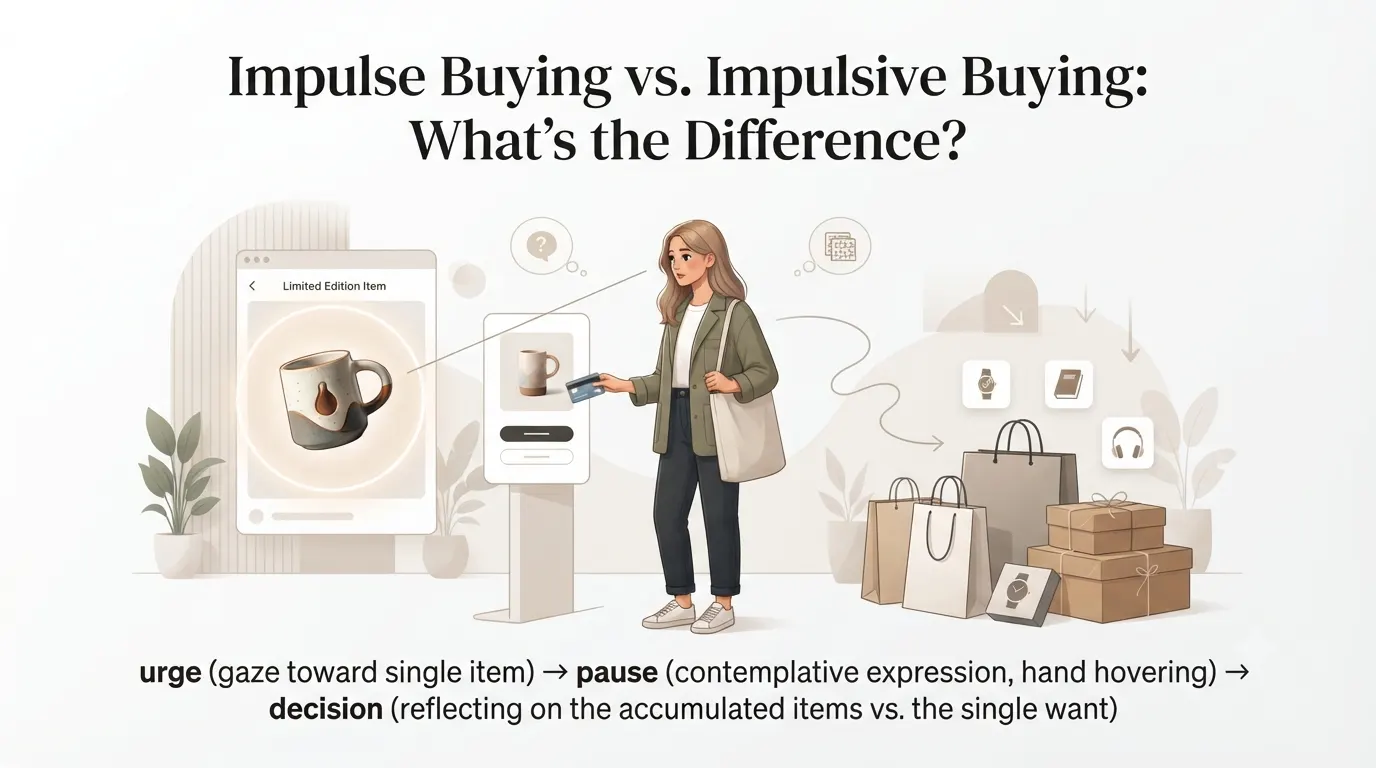
That is a straightforward example of an impulse purchase.
The short answer is not always. In everyday language, “impulse buying” and “impulsive buying” are often used interchangeably. In consumer-behavior research, however, the wording can emphasize slightly different parts of the experience: the sudden urge to buy, the purchase that follows that urge, or a person's tendency to respond to buying opportunities quickly and with little deliberation.
That distinction is worth understanding, but it should not be treated as a strict scientific rule. Researchers have used overlapping definitions of impulse buying for decades. Dennis W. Rook's influential 1987 paper The Buying Impulse, for example, examined the subjective experience of buying impulses and how consumers respond to them. Ronald J. Faber's 2010 overview, Impulsive and Compulsive Buying, discusses impulse buying as a common consumer behavior involving a sudden and powerful urge to buy.
That last point matters. Making an impulse purchase occasionally does not mean that someone has an unhealthy relationship with shopping.
What Does “Impulsive Buying” Mean?
Impulsive buying generally describes buying that happens spontaneously, quickly, or with relatively little deliberation.
The word “impulsive” places more emphasis on the nature of the behavior. It describes acting on an urge rather than spending much time evaluating the decision before acting.
For example, imagine that you regularly browse online stores late at night. When you see something appealing, you often click “Buy Now” almost immediately. You may not compare alternatives, check whether you already own something similar, or think about whether the purchase fits your budget.
That pattern could reasonably be described as impulsive buying behavior.
However, it is important not to turn this into an overly rigid definition. The research literature does not establish a universal rule that “impulse buying” refers only to the purchase while “impulsive buying” always refers to a person's long-term tendency. The terminology overlaps considerably.
In fact, Rook's 1987 discussion of impulse buying explicitly connects the buying impulse with broader ideas about impulsive behavior. Later research has also examined individual differences such as impulse buying tendency alongside situational factors that can contribute to an impulse purchase. The University of Alberta Psychology research material provides further discussion of these concepts.
So the safest way to understand the terminology is to focus on what part of the experience is being described.
Impulse Purchase, Impulse Buying, and Impulsive Buying Behavior
An impulse purchase is the individual transaction. You see something, experience an urge, and buy it even though the purchase wasn't part of your original plan.
Impulse buying is the broader buying process or behavior associated with those spontaneous purchases.
Impulsive buying behavior puts more emphasis on the way someone responds to buying opportunities, particularly when they tend to act quickly or with limited deliberation.
These ideas overlap, which is why the terms are so easily confused. A person can make an impulse purchase without having a persistent tendency toward impulsive shopping.
For example, someone who normally plans their spending carefully might see a book they've wanted for months while passing a bookstore. They hadn't planned to buy it that day, but they decide to purchase it. That could reasonably be described as an impulse purchase.
Another person might repeatedly buy clothes, gadgets, cosmetics, or other products whenever they experience a strong shopping urge. If this happens frequently and with little consideration, describing the pattern as impulsive buying behavior may be more useful.
The important difference is not necessarily the vocabulary. It is the difference between one spontaneous decision and a repeated pattern of reacting to buying urges.
To break down the different ways these spontaneous purchases happen in the real world, read 4 Types of Impulse Buying: Pure, Reminder, Suggestion & Planned.
Can You Make an Impulse Purchase Without Being an Impulsive Buyer?
Yes. One impulse purchase does not automatically tell you that you have an impulsive buying habit.
People make spontaneous purchases for many ordinary reasons. You might walk past a bakery and buy something you weren't planning to eat. You might see a book you've wanted for months and decide to take it home. You might find a small gift that you know someone will appreciate and buy it immediately.
None of those situations, by themselves, establish a broader pattern.
The more useful question is what happens repeatedly.
If you frequently buy things the moment you see them, regularly spend more than intended, often experience buyer's remorse, or find it difficult to walk away from tempting offers, the individual impulse purchases may be part of a larger behavioral pattern.
This is one reason it helps to look beyond the item itself. Instead of asking only, “Why did I buy this?” you can also ask, “Does this keep happening?”
Why Do People Make Impulse Purchases?
There isn't one universal reason people make impulse purchases. Buying decisions can be influenced by the situation, the shopping environment, the product itself, and what someone is experiencing emotionally at the time.
Beatty and Ferrell's 1998 research model examined factors including time available, money available, shopping enjoyment, impulse buying tendency, browsing, emotional responses, and the felt urge to buy. Their work illustrates why impulse buying is better understood as the result of several interacting factors rather than one simple trigger. Their research on impulse buying provides further detail on how these factors interact.
Emotions can influence the urge to buySometimes the shopping decision is connected to how you feel before you buy.
You might browse when you're bored, shop after a stressful day, or feel drawn toward a purchase when you're tired and looking for something enjoyable. That does not mean every emotional purchase is an impulse purchase, but emotions can become part of the context in which an urge to buy develops.
Faber and Christenson's 1996 study, In the Mood to Buy, specifically examined differences in mood states associated with compulsive buyers and other consumers. Faber's later overview also identifies mood states among the individual and situational factors researchers have examined in relation to impulse buying.
The practical takeaway isn't that you should blame every impulse purchase on your mood. Instead, it can be useful to notice whether certain emotional states repeatedly appear before you shop.
WaitAndBuy's story, The Mood Audit That Finally Stopped One Shopper's Impulse Buying, explores this idea through one shopper's experience of paying closer attention to what she was feeling before making purchases. It provides a practical example of how identifying a personal trigger can change the way you approach an urge to buy.
Urgency can make a purchase feel more importantAnother common trigger is urgency.
“Sale ends tonight.” “Only two left.” “Last chance.” “Selling fast.”
Messages like these can change the way a shopping decision feels. Instead of asking whether you actually want the product, you may start thinking about whether you'll miss the opportunity to buy it.
That distinction matters because the product itself hasn't necessarily changed. What has changed is the perceived cost of waiting.
If you would happily walk away from an item when you know it will still be available tomorrow, but suddenly feel that you must buy it when you see “only two left,” urgency may be influencing the decision.
Convenience can remove opportunities to pauseOnline shopping can also make spontaneous purchases easier because the distance between seeing a product and purchasing it can be extremely short.
You can discover an item through a social media post, open the product page, see a recommendation, and complete the transaction within minutes. Saved payment information and simplified checkout can make the process even faster.
Convenience itself isn't a problem. The issue is that a fast purchasing process can leave less natural time for reflection.
Sometimes the most useful intervention is therefore not deciding that you can never buy something spontaneously. It is simply creating a small gap between wanting the item and buying the item.
Impulse Buying and FOMO
FOMO, or fear of missing out, can make that gap particularly difficult to create.
Suppose you see a product you weren't especially interested in. Then you notice that it is described as “limited stock” or “selling fast.” Suddenly, the possibility of losing access to it makes the product feel more desirable.
The decision is no longer only about whether you want the product. It becomes about whether you want to avoid the feeling of missing an opportunity.
WaitAndBuy's story You Don't Need It, You're Just Scared Of Missing Out looks at this pattern through scarcity and urgency messaging.
One useful question in these situations is:
“If this were still available tomorrow, would I want it just as much?”
You don't have to assume that every scarcity message is manipulative or that every purchase influenced by urgency is an impulse purchase. The question is simply whether the urgency is helping you make the decision or preventing you from taking the time to make it.
Is Impulse Buying Always Bad?
No. An impulse purchase is not automatically a bad purchase.
You might spontaneously buy something that you genuinely enjoy, that you can comfortably afford, and that you continue to feel good about owning. The fact that you didn't plan the purchase days in advance does not automatically make it a mistake.
The more useful questions are whether spontaneous purchases fit your financial situation, whether you regularly regret them, and whether you feel capable of walking away when you decide not to buy.
The pattern matters more than the label.
If you occasionally buy something on impulse and it has little negative impact, there may be nothing particularly concerning about that behavior. If you repeatedly spend money you intended to save, accumulate things you don't use, or feel frustrated because you keep making purchases you didn't really want, then the pattern deserves closer attention.
How to Tell What Is Happening With Your Own Shopping
If you're trying to understand whether your purchases are occasional impulses or part of a broader pattern, start by looking at what happens before and after you buy.
Was the purchase planned?Think about what you intended to buy before you encountered the product. If the item appeared unexpectedly and wasn't part of your original shopping plan, the purchase may have been spontaneous.
That doesn't automatically make it harmful. It simply tells you something about how the decision began.
What triggered the urge?Try to identify what made you want the item right then.
It could have been a discount, an attractive display, boredom, stress, curiosity, FOMO, convenience, or simply seeing something you liked.
You don't need to find a single explanation every time. The goal is to notice whether the same situations keep appearing.
How much time did you give yourself?A decision made after several days of consideration is different from one made seconds after seeing an item.
Giving yourself time doesn't guarantee that you'll make the “right” decision. It simply gives you an opportunity to separate a temporary urge from a purchase you genuinely want.
How did you feel afterward?Pay attention to what happens after the purchase.
Do you feel satisfied because you bought something you genuinely wanted? Or do you immediately wonder why you spent the money?
One regretful purchase doesn't establish a pattern, but repeated buyer's remorse can be useful information about how you're making decisions.
Is it a one-off or a pattern?This may be the most important question of all.
One spontaneous purchase is an event. Repeatedly responding to shopping urges without giving yourself time to evaluate them is a pattern.
If you're unsure how often this happens, tracking your purchases can make the pattern easier to see. The Impulse Purchase Calculator can also help you look at how individual impulse purchases can add up over time.
Impulse Buying vs. Compulsive Buying
Impulse buying should also not be confused with compulsive buying.
Ronald J. Faber's 2010 overview makes an important distinction here: impulse buying is a common, ordinary behavior, while compulsive buying involves a much more persistent and difficult-to-control urge and can produce serious negative consequences.
That means an occasional impulse purchase does not automatically indicate a compulsive buying problem.
The difference is better understood in terms of the pattern, control, frequency, motivations, and consequences involved.
Someone might occasionally buy something spontaneously and later decide it wasn't necessary. Another person may repeatedly feel unable to resist buying, experience significant distress around the behavior, and continue despite serious consequences.
Those situations should not be treated as identical simply because both involve an urge to purchase.
The Practical Difference Matters More Than the Label
If you're asking whether “impulse buying” and “impulsive buying” are technically different, the answer is that the distinction is useful but not absolute.
“Impulse buying” commonly refers to buying that occurs in response to a sudden urge or without much prior planning. “Impulsive buying” can emphasize the spontaneous or less-deliberate nature of that behavior. Researchers have used the terminology in overlapping ways, so it is better to explain the context than to pretend there is one universally accepted dividing line. This overlap is also reflected in Faber's overview of impulsive and compulsive buying.
For a shopper, however, another distinction is much more useful: the difference between an individual impulse purchase and a recurring pattern of buying impulsively.
You don't need to label yourself based on one purchase. Instead, look at what repeatedly happens between seeing something and deciding to buy it.
If there is almost no space between the urge and the action, creating that space may be the most useful change you can make.
FAQ
Is impulse buying the same as impulsive buying?They are closely related and are often used interchangeably. “Impulse buying” generally refers to buying in response to a sudden urge or without much prior planning, while “impulsive buying” can emphasize the spontaneous or less-deliberate nature of the behavior. Research terminology overlaps, so the distinction is not an absolute rule. Faber's overview of impulsive and compulsive buying provides further context.
What is an example of an impulse purchase?Buying a pair of shoes because you suddenly see them on sale, even though you went shopping for something else, is a simple example. The key point is that the purchase was not part of your original plan and was made in response to a buying opportunity or urge.
Is impulse buying always bad?No. An occasional spontaneous purchase is not automatically harmful. What matters more is whether the purchase fits your budget, whether you genuinely value the item, whether you regularly regret these purchases, and whether you can comfortably choose not to buy.
What is the difference between impulse buying and compulsive buying?Impulse buying is a common form of spontaneous purchasing. Compulsive buying involves a more persistent and difficult-to-control pattern of buying that can lead to significant negative consequences. Ronald J. Faber's overview of impulsive and compulsive buying specifically distinguishes ordinary impulsive buying from compulsive buying.
Can someone make an impulse purchase without being an impulsive buyer?Yes. Someone can make an occasional unplanned purchase without having a broader tendency toward impulsive shopping. To understand whether there is a pattern, look at how frequently it happens, how much control you feel you have, and what consequences follow.
Why do I keep making impulse purchases?There can be several reasons, including emotional states, shopping environments, promotions, urgency, convenience, and personal buying tendencies. Rather than assuming there is one universal cause, look for the situations that repeatedly appear before your own purchases.
How can I stop impulsive buying?Start by increasing the amount of time between the urge and the purchase. Save the item, leave the store or website, and return to the decision later. You can also ask whether you need the item, whether you own something similar, whether you would still want it without the discount, and whether you're responding to the product itself or to an emotion such as urgency or FOMO.
Conclusion
So, impulse buying and impulsive buying are closely related, but they are not necessarily two completely separate behaviors.
In everyday language, the terms are often interchangeable. In consumer-behavior research, the wording can be used to emphasize different parts of the experience: the buying impulse, the purchase that follows it, or the tendency to act spontaneously and with limited deliberation. Researchers have used overlapping definitions, so the distinction should be treated as useful context rather than a rigid rule. Faber's overview of impulsive and compulsive buying provides further context on these overlapping concepts.
For most shoppers, the more important question isn't which label applies. It's whether an unexpected purchase was simply a one-time decision or part of a recurring pattern.
That is where a pause becomes useful.
When you notice something you want, you don't have to immediately decide whether you should buy it. Give yourself some time. Come back to the item when the excitement, urgency, or fear of missing out has had a chance to settle.
Sometimes you'll still want it.
And sometimes you'll realize that you wanted the feeling of buying it more than you wanted the product itself.