Festive Sale FOMO: Do You Really Need That Deal?
"Festive sales create FOMO and urgency that can trigger impulse buying. Learn why discounts don't always save money and how to shop smarter."
Festive Sale FOMO: Do You Really Need That Deal?
Festive sales are designed to make shopping feel urgent. A product is suddenly 40% off. A banner says the offer ends tonight. A countdown timer keeps ticking. Another message tells you that thousands of people are viewing the same product.
And suddenly, something you had never planned to buy starts feeling like an opportunity you might regret missing.
That is the power of festive sale FOMO, or the fear of missing out. The pressure isn't always about wanting the product. Sometimes, it is about not wanting to miss the deal.
But there is an important difference between getting a good price and saving money.
A deal is only a saving if you actually needed the thing.
If you spend $70 on something you never intended to buy just because it was discounted from $100, you did not save $30. You spent $70.
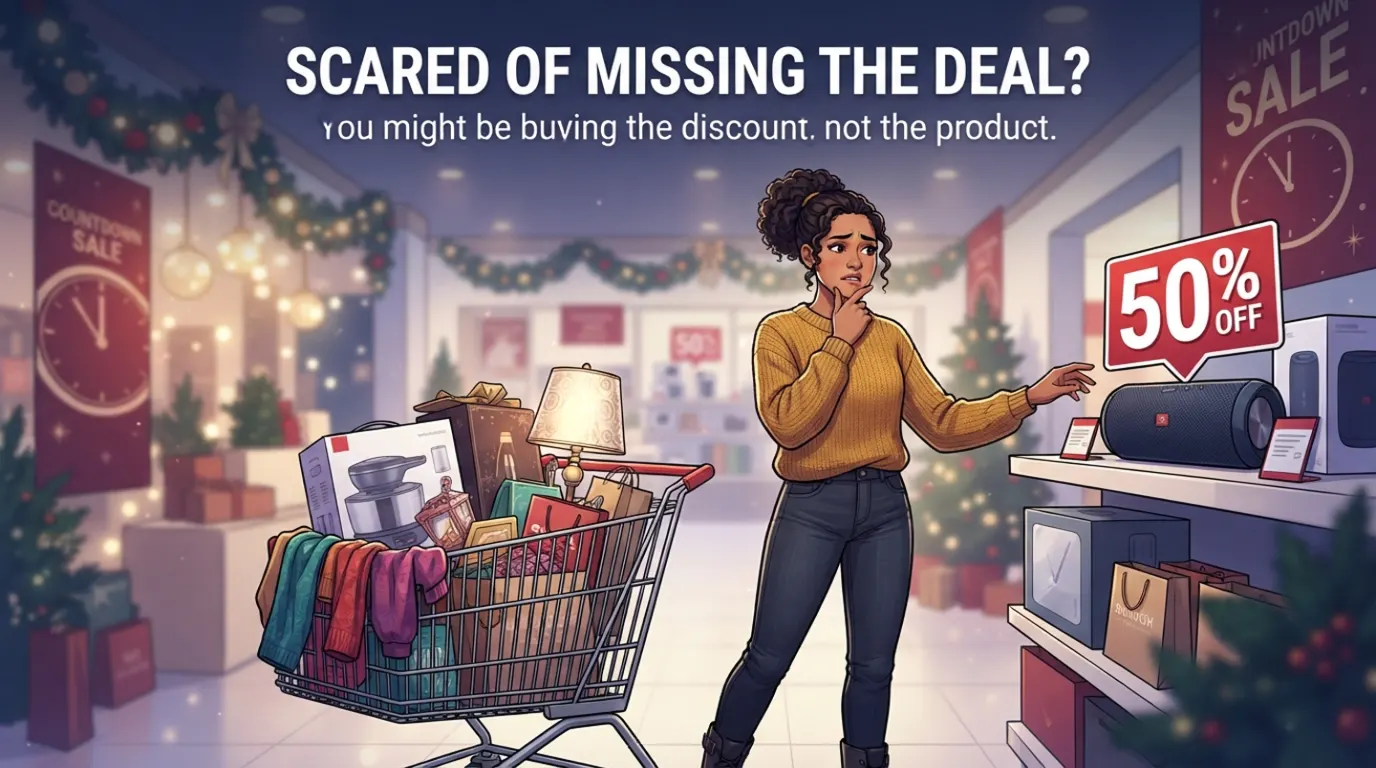
Why Festive Sales Create So Much FOMO
Festive sales combine several psychological triggers at the same time. There is the excitement of the occasion, the promise of a better price, limited-time offers, special discounts, and the feeling that everyone else is shopping too.
During major shopping periods, retailers often present deals as events rather than ordinary promotions. This changes how we think about purchases. Instead of asking, "Do I need this?" we may start asking, "How much can I save?"
That small change in the question can have a big effect on what ends up in the shopping cart.
A product that seemed unnecessary yesterday can suddenly look like a missed opportunity if you don't buy it today.
The Discount Can Become the Reason to Buy
Normally, the product comes first and the price comes second.
You need a new pair of shoes, so you look for shoes. You need a phone, so you compare phones. You need a kitchen appliance, so you check available options.
During a festive sale, the order can get reversed.
You see the discount first, and the product becomes secondary.
A message saying "50% OFF" can make you pay attention to something you would never have searched for otherwise. Once you see the discount, your brain starts looking for reasons why buying it makes sense.
Maybe you could use it someday. Maybe the price won't be this low again. Maybe you should buy it now because it is a great deal. Maybe you would regret missing the offer.
The discount has quietly changed from a benefit of buying into the reason for buying.
"What If I Miss This Deal?"
This is where FOMO becomes especially powerful.
A normal purchase can be postponed. But a limited-time deal creates the impression that waiting has a cost.
If you don't buy now, the offer might disappear. The price might go up. Someone else might buy the last available item. You might never see the same discount again.
That possibility can create pressure even when there is no real need for the product. If you're buying mainly because you're afraid the opportunity will disappear, you may be experiencing the same kind of FOMO explored in You Don't Need It, You're Just Scared Of Missing Out.
You are no longer deciding whether to buy something you need. You are deciding whether you are willing to let a deal go.
A Cheap Product Can Still Be an Unnecessary Expense
Price and value are not the same thing.
Something costing less than usual does not automatically make it valuable to you.
Imagine you see a jacket marked down from $120 to $70. The discount looks attractive. But if you already have several jackets and were not looking for another one, the $70 is still an expense.
The same applies to electronics, beauty products, home decor, clothes, subscriptions, accessories, and almost anything else sold during a festive promotion.
A lower price can reduce the cost of an item. It cannot automatically create a need for that item.
The "I Saved Money" Trap
One of the easiest ways to justify an impulse purchase is to think about the amount you supposedly saved rather than the amount you actually spent.
If something was originally $100 and you paid $60, it is tempting to think, "I saved $40." But your bank account does not receive $40. It loses $60.
The $40 is only a saving if you were already going to buy the item and the discount reduced what you would have spent.
This is why comparing the sale price with the original price can sometimes distract you from the more important question: "Would I have bought this at all if there were no discount?"
If the answer is no, the discount may not be saving you money. It may simply be making an unnecessary purchase feel easier to justify.
Why "Buy Now" Feels Better Than "Wait"
Festive sales often encourage immediate decisions. The offer is available now, the timer is running now, and the discount is available now. Waiting can feel like giving something up.
But waiting can be useful because it separates the excitement of the promotion from the actual usefulness of the product.
When the urgency disappears, your decision may become clearer. You might realize you already own something similar. You might remember that you have barely used a similar purchase. You might notice that the product was never part of your original plans.
Or you might still decide that you genuinely want and need it.
That is the point of waiting. It doesn't automatically mean saying no. It gives you enough distance to make a better yes-or-no decision.
Ask Yourself These Questions Before Buying a Festive Deal
Before you buy something simply because it is on sale, stop and ask yourself a few questions.
Did I plan to buy this before I saw the sale?
This is one of the most useful questions.
If the product was already on your shopping list, the sale could be genuinely useful. If you discovered the product only because of the promotion, take a closer look at why you suddenly want it.
Would I buy it at the current price if there were no countdown timer?
Remove the urgency from the decision.
Imagine the exact same product at the same sale price, but without a message saying "Only 2 hours left."
Would you still want it?
If the answer changes, the urgency may be influencing your decision more than the product itself.
Do I already own something that does the same job?
Festive sales can make small differences between products feel more important than they really are.
Before buying another version, check what you already own. The cheapest item is still expensive if it spends most of its life unused.
Where will I use it?
Try to think beyond the excitement of opening the package.
Where will the product actually be used? How often? Do you have space for it? Does it solve a real problem?
A specific answer is usually more useful than "I might need it someday."
Am I buying the product or the feeling of getting a deal?
Sometimes the excitement comes from the purchase itself.
Finding a discount can feel like winning. Getting something for less than its listed price can create a sense of achievement.
But the satisfaction of finding a deal can disappear quickly if the product turns out to be unnecessary.
A Better Way to Look at Festive Sales
You don't have to avoid festive sales completely.
The goal is not to reject every discount. It is to make sure the discount is helping a purchase you already wanted rather than creating a purchase you never needed.
A simple approach is to make your shopping list before you start browsing the sale. Write down what you actually need, then decide what you are willing to spend on those items.
When the sale begins, look for those products first. If you discover something outside the list, don't automatically add it to the cart. Give yourself permission to wait.
This is also where the idea behind WaitAndBuy fits naturally. Instead of making an immediate decision while the discount and countdown are influencing you, you can pause, save the item, and come back to it later with a clearer head. The goal isn't to tell you what to buy. It is to give you space to decide whether you actually want it.
This changes the role of the sale. Instead of asking, "What can I buy because it is cheap?" you ask, "What can I buy that I already need at a better price?"
That is a much safer way to shop.
Not Every Missed Deal Is a Missed Opportunity
One of the hardest parts of avoiding impulse purchases is accepting that you will sometimes miss a good deal.
The product might genuinely become more expensive later. Another shopper might get it at a better price. The promotion might end before you decide.
That can feel uncomfortable, especially when you are used to acting quickly during sales.
But missing an unnecessary purchase is not the same as missing an opportunity.
If you didn't need the product, keeping your money can be the better outcome. There will always be another sale, another promotion, another product, and another opportunity to buy something.
You don't have to take every deal simply because it is available today.
The 10-Second Festive Sale Gut Check
If you are already at checkout and don't have time to think through every question, use one simple test:
"If this wasn't on sale, would I still be looking for it?"
If the answer is yes, the discount may be helping you buy something you genuinely need.
If the answer is no, pause before completing the purchase. You may be reacting to the fear of losing the deal rather than responding to a real need.
This same question works during Black Friday, Cyber Monday, holiday sales, and other limited-time promotions. The season changes, but the decision remains the same: are you buying the product because you need it, or because the opportunity to get it cheaply feels too good to ignore?
FAQ
What is festive sale FOMO?
Festive sale FOMO is the fear of missing out on a limited-time discount or shopping opportunity. It can make people feel pressured to buy quickly, even when they did not originally need or plan to buy the product.
Why do sales make me want to buy things I don't need?
Sales can make purchases feel more valuable because of discounts, urgency, limited-time offers, and the fear that the opportunity will disappear. These factors can shift your attention from whether you need the product to how much you might be saving.
Does buying something on sale actually save money?
Only if you genuinely needed the item and would have bought it anyway. If the discount causes you to spend money on something you never planned to purchase, you have still spent money rather than saved it.
How can I avoid impulse buying during festive sales?
Create a shopping list before browsing the sale, set a spending limit, and pause before buying anything that wasn't already planned. Ask whether you would still want the product without the urgency or discount.
Should I buy something just because the discount is very high?
No. The size of the discount does not determine whether the purchase is useful. A large discount on something you don't need can still be an unnecessary expense.
How do I know if I actually need something during a sale?
Ask whether you planned to buy it before seeing the sale, whether you already own something similar, how often you will use it, and whether it solves a specific problem. If you cannot identify a clear need, waiting may be worthwhile.
Conclusion
Festive sales can be genuinely useful when they help you buy something you already need for less.
The problem starts when the discount becomes the reason you buy.
A product being 30%, 50%, or even 70% off does not make the purchase free. If you never needed it, the money is still leaving your account.
So before adding that tempting festive deal to your cart, pause and ask yourself one simple question:
"If this wasn't on sale, would I still want it?"
If the answer is no, you may not be afraid of missing the product. You may simply be afraid of missing the deal.
That is exactly the kind of moment when a pause can help. Whether you simply step away from the checkout or use a tool like WaitAndBuy to save the item and reconsider it later, the goal is the same: give yourself enough time to decide before the urgency decides for you.
A deal is only a saving if you actually needed the thing.
And sometimes, the smartest deal is the one you decide not to take.