Diwali Shopping: Why Discounts Make It So Easy to Overspend
"Diwali discounts can make you spend more than planned. Learn how festive online sales influence buying decisions and how to avoid overspending."
Diwali Shopping: Why Discounts Make It So Easy to Overspend
You may have been waiting for months to buy something you actually need. Maybe it is a new phone, laptop, television, appliance, pair of shoes, or something for your home. You have compared prices, read reviews, and decided that you will finally buy it during the Diwali season when you expect better deals.
Then the festive sales begin.
You open a shopping app to check the price of the thing you wanted. Within minutes, you are looking at clothes, headphones, home décor, kitchen products, beauty products, gifts, and dozens of other offers. Most of them were never part of your plan, but now they are cheaper, and "I don't need this" can quickly turn into "But this is a really good deal."
That is where Diwali shopping can start going in a completely different direction.
The problem isn't that discounts are bad. A discount can genuinely help you spend less when you are buying something you already needed and planned for. The problem starts when the sale changes what you intended to buy.
A discount isn't saving money if you weren't planning to buy the item in the first place.
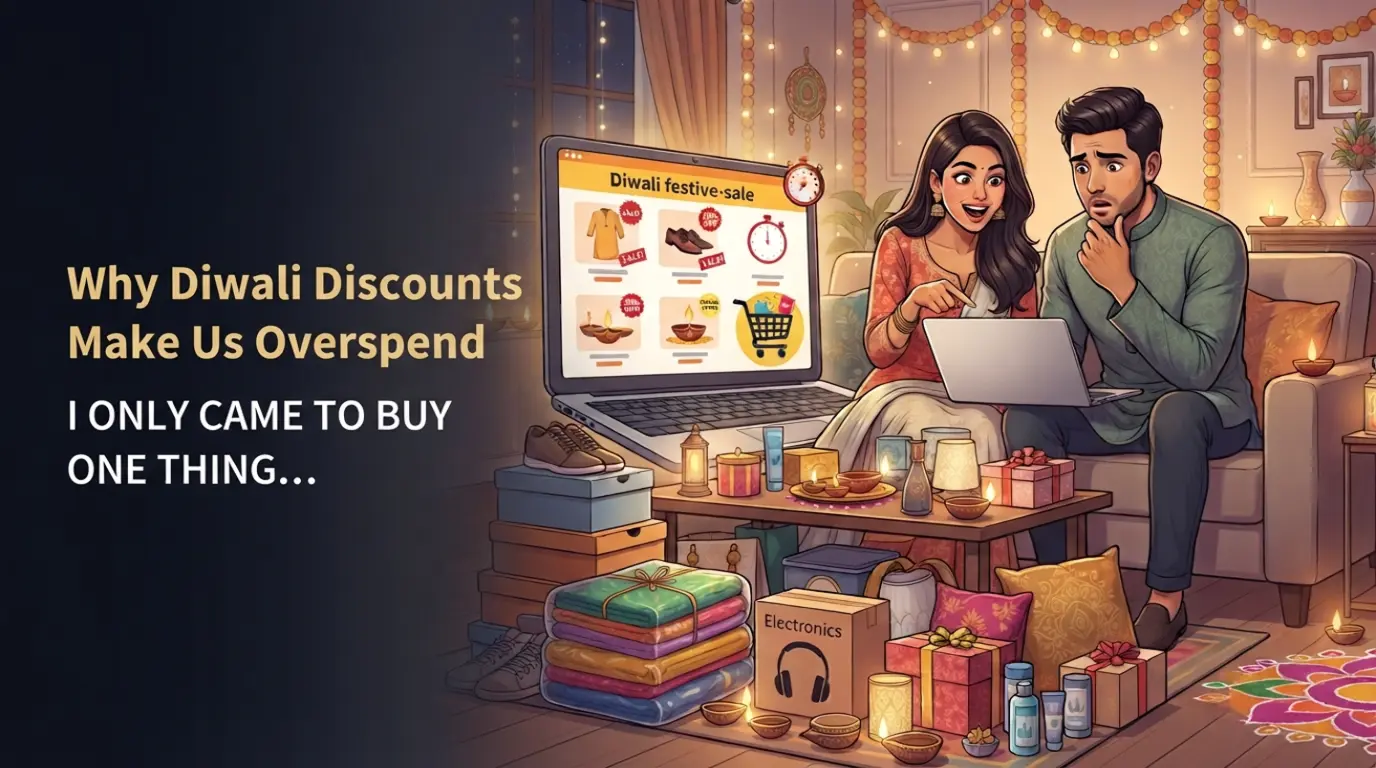
You Waited Months to Buy One Thing. So Why Are You Buying Something Else?
There is a strange thing that happens during major festive sales. You may spend months waiting for the right time to buy one particular product. You compare prices, read reviews, and decide that you will finally purchase it during the Diwali sale.
Then the sale arrives, and your attention moves somewhere else.
You see a pair of headphones at a lower price than usual. Then you notice a shirt with a large discount. A kitchen product you never searched for appears to be a great deal. Another product comes with an additional bank offer.
None of these purchases was part of your original plan. But because you are already in "shopping mode," adding one more item feels easier.
The original reason for opening the app was to buy one thing. The sale has quietly turned it into an opportunity to buy many things.
Why Online Diwali Sales Are So Hard to Ignore
Festive shopping in India is no longer limited to visiting a market or walking through a shopping mall. A large part of Diwali shopping now happens online, and festive sale events can keep shoppers engaged for days or even weeks.
The experience is built around constant opportunities to buy. You may see countdowns for deals, limited-time offers, notifications about price drops, coupons, bank discounts, or messages suggesting that only a few products are left.
Even when you are not actively shopping, your phone can remind you that a sale is happening.
This creates a very different shopping environment from normal browsing. Instead of deciding what you need and then looking for it, you can end up browsing first and deciding what you want after seeing the deals.
That difference matters.
When the sale becomes the starting point, the products can start creating the demand.
The Discount Can Change the Question in Your Head
Imagine you see something priced at ₹1,000 and now available for ₹650.
The first thought may be:
"I'm saving ₹350."
But there is another question that is more important:
"Would I have spent ₹650 on this if I had not seen the discount?"
If the answer is no, then the discount hasn't really helped you save ₹350. It has convinced you to spend ₹650.
This is one reason discounts can be so powerful. They make you compare the sale price with the original price instead of comparing the purchase with your actual needs.
The product looks cheaper. The purchase feels smarter. But the money is still leaving your account.
When "It's Cheap" Becomes a Reason to Buy
One of the easiest ways to overspend during a Diwali sale is to use the price itself as the reason for buying.
You might think, "It's only ₹499," or "It's only ₹999." You may tell yourself that you are getting 40% off, that you will probably need the item eventually, or that you may not get the same price again.
Each thought can make the purchase feel reasonable.
But several "small" purchases can quickly become a large expense.
A ₹700 clothing purchase, ₹900 home product, ₹1,200 gift, ₹1,500 electronic accessory, and ₹800 décor purchase already add up to ₹5,100.
The individual purchases may not feel significant. The total is.
This is why looking at each deal separately can be misleading. Your budget doesn't care whether the money was spent across five different categories. It only sees the total amount you spent.
How One Planned Purchase Can Become Five Unplanned Purchases
Suppose you have planned to spend ₹20,000 during Diwali. You have a specific product in mind and have already decided that it is worth buying.
Then you start browsing.
You find a few discounted clothes, add some gifts because they are cheaper than usual, see a home product you had never considered, and notice an electronic accessory with a special offer.
By the time you reach checkout, the original purchase is still there, but it is now surrounded by several other products.
This is where festive shopping can quietly expand across categories. One extra outfit, a few additional gifts, some décor, a beauty product, or an electronic accessory may each seem manageable. But when you add them together, the original shopping budget can disappear surprisingly quickly.
The dangerous part is that none of the individual decisions necessarily feels like a major mistake. You can justify each one separately:
"I got a good discount."
"I was going to need this someday."
"It's useful."
"It's for Diwali."
"It's cheaper now."
But your original ₹20,000 plan has slowly changed.
The sale didn't just reduce the price of something you wanted. It increased the number of things you wanted.
The Fear of Missing a Festive Deal
There is another powerful reason people keep buying during festive sales: the fear that the opportunity will disappear.
A countdown can make a normal purchase feel urgent. A limited-time offer can make waiting feel risky. A message about limited availability can make you feel that someone else might buy the product before you do.
You may know that you didn't need the product yesterday, but suddenly it feels important because the price might change tomorrow.
This is where festive-sale FOMO comes in. We explore this more in Festive Sale FOMO: Do You Really Need That Deal?
The important thing to remember is that missing a discount is not the same as losing money.
If you don't buy a ₹2,000 product discounted to ₹1,500, you haven't lost ₹500.
You have kept ₹1,500.
That sounds obvious when written down, but discounts can make us think about the money we could save instead of the money we are actually spending.
Bank Discounts Can Make the Final Price Look Even Better
Festive online sales can also combine several offers.
You might see a product with a sale price and then notice an additional discount for using a particular payment method or card.
The final price can look dramatically better than the original price.
That can be useful if the product was already on your shopping list.
But if the additional discount becomes the reason you decide to buy the product, the same problem appears again.
You are not necessarily saving money. You are spending money because the opportunity to save made the purchase more attractive.
There is nothing wrong with using a legitimate discount. The important thing is deciding whether you wanted the product before discovering the discount.
How to Stop a Diwali Sale From Taking Over Your Shopping
You don't need to avoid festive sales completely. Instead, go into them with a plan.
Make Your Shopping List Before the Sale
Decide what you actually want before you start browsing.
If you need a new phone, write it down. If you need clothes for a specific event, decide how many. If you have gifts to buy, make the list before opening the shopping app.
This gives you something to compare the sale against.
Without a list, every attractive deal can become a potential purchase.
Separate Planned Purchases From Sale Discoveries
This is one of the simplest ways to identify impulse purchases.
When you see something interesting, ask:
"Was this already on my list?"
If yes, compare the price and decide.
If no, don't immediately add it to your cart. Give yourself time to think about it.
The fact that you discovered something during a sale doesn't automatically make it part of your Diwali shopping needs.
Set a Total Budget
Category budgets are useful, but a total budget is even more important.
If you planned to spend ₹20,000, keep that number visible while shopping.
Don't let every category create its own excuse for going over.
The question shouldn't only be:
"Can I afford another ₹800?"
It should be:
"Do I still have ₹800 available in my total Diwali budget?"
That small change in thinking can make additional purchases much easier to recognize.
Pause Before Buying an Unplanned Deal
If something wasn't on your list, don't make the decision immediately.
Close the product page. Remove it from the cart or save it for later. Come back after some time.
Sometimes the excitement disappears once you are no longer looking at the discount. You may realize that you already have something similar, or that you only wanted it because the price looked attractive.
That pause is often enough to turn an impulse into a decision.
This is exactly the kind of pause WaitAndBuy is built around: saving something instead of buying it immediately and giving yourself time to decide whether you genuinely want it or simply reacted to the deal.
Ask One Question Before Checkout
Before buying an unexpected sale item, ask:
"Was I looking for this before I saw the discount?"
If you were already looking for it, the discount may be useful.
If you weren't, pause.
You don't have to prove that you don't need the product. You simply need to give yourself enough time to decide whether the product belongs in your shopping plan at all.
When a Diwali Discount Is Actually a Good Deal
Not every discount is a trap.
If you have been waiting for a product for months, researched it, decided that you need it, and set aside money for it, getting it at a lower price during a Diwali sale can genuinely be a good decision.
The important difference is what came first.
Did you want the product and then discover the discount?
Or did you discover the discount and then decide you wanted the product?
Those two situations can look almost identical at checkout.
But financially, they are very different.
A sale should ideally reduce the cost of a planned purchase, not create a new purchase.
A Better Way to Shop Diwali Sales
You don't have to treat every festive sale as something you should avoid.
Instead, treat the sale as a place to find better prices for things you have already decided to buy.
Make your list first. Set your budget. Know what you actually need. Then look for the deals.
When something unexpected catches your attention, pause before buying it.
The goal isn't to become someone who never takes advantage of discounts. The goal is to make sure the discount is working for you, rather than your desire to get a discount working for the seller.
FAQ
Why do Diwali sales make people overspend?
Diwali sales combine discounts, urgency, limited-time promotions, notifications, and multiple shopping categories. These can encourage people to focus on finding deals rather than sticking to what they originally planned to buy.
Why do I buy things I didn't plan to buy during sales?
A large discount can make an unplanned purchase feel financially sensible. Once you are already shopping, adding another discounted item can also feel like a small decision, even when several such purchases eventually add up.
Is buying something on discount actually saving money?
Not necessarily. If you already planned to buy the product, a discount can reduce your spending. If you only bought it because it was discounted, you have still spent money that you may not have planned to spend.
How can I control online shopping during Diwali?
Create your shopping list and total budget before the sale begins. During the sale, separate products you planned to buy from products you discovered because of the promotion. Give yourself time before buying unplanned items.
Should I buy something immediately if the festive deal may expire?
Not automatically. A deal expiring doesn't mean you have lost money. If the product wasn't important before you saw the offer, consider whether the urgency is coming from your need for the product or from the sale itself.
What is the best question to ask before buying a discounted product?
Ask yourself: "Was I looking for this before I saw the discount?" If you weren't, pause and reconsider the purchase.
Conclusion
Diwali sales can be a great opportunity to buy something you genuinely need at a better price.
But they can also turn one planned purchase into several unplanned ones.
You may spend months waiting for the right time to buy a phone, appliance, clothing, or another product. Then a festive sale surrounds you with hundreds of other deals, and suddenly those deals become more interesting than the thing you were actually waiting for.
That is when it helps to step back.
A product being cheaper doesn't automatically make it necessary. A countdown doesn't automatically make it urgent. And a discount doesn't automatically mean you saved money.
Before adding that next festive deal to your cart, ask yourself one simple question:
"Was I going to buy this before I saw the discount?"
If the answer is no, maybe the best Diwali deal is the one you pause on.