Why Countdown Timers Trigger Impulse Buying During Flash Sales
"Why are flash sales hard to resist? Learn how countdown timers trigger FOMO and impulse buying, plus 6 ways to avoid rushed purchases."
Why Countdown Timers Make Flash Sales So Hard to Resist
You find a product you like while browsing an online store. The price looks good, but you are not entirely sure you need it. Then you notice a countdown timer: Sale ends in 09:42.
Suddenly, the decision feels different. You are no longer simply deciding whether the product is worth buying. You are deciding whether to buy it before the opportunity disappears.
That small change can make a difference. A countdown timer introduces a deadline into an otherwise ordinary shopping decision, encouraging you to act before you have fully considered the purchase. When it appears alongside a limited-time discount, a low-stock warning, or a message about an expiring offer, the pressure can become even stronger.
This is one reason flash sales can be difficult to resist, even when you were not planning to buy anything in the first place.
Understanding why countdown timers work can help you recognize when urgency is influencing your judgment. More importantly, it can help you develop a simple habit: pause long enough to decide whether the purchase makes sense for you, rather than letting a clock make the decision for you.
How Countdown Timers Change the Way You Shop
Countdown timers can make flash sales harder to resist by creating urgency and increasing the perceived risk of missing a deal. When a ticking clock appears beside a discounted price, shoppers may focus more on securing the offer than on whether they actually need the product.
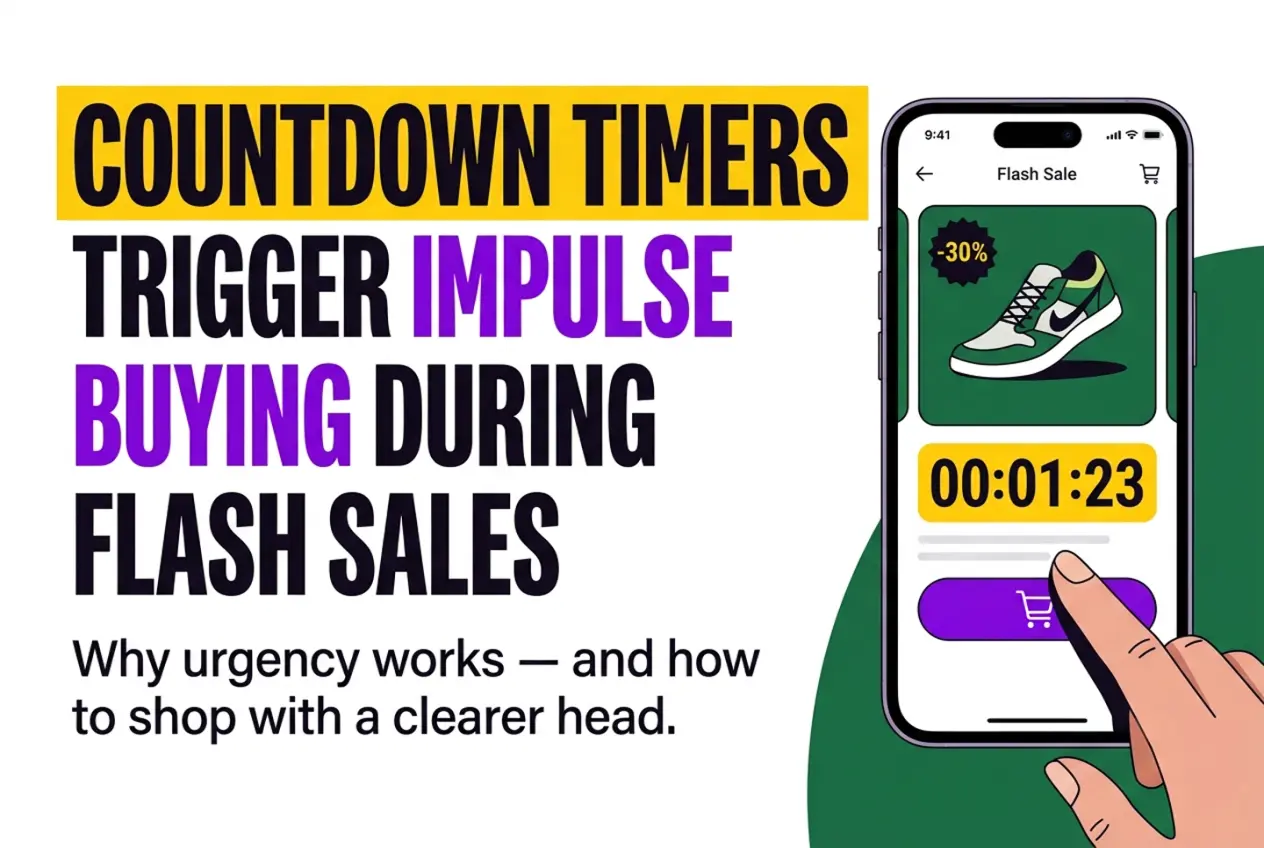
A countdown timer does more than display how much time remains in a sale. It changes the context in which you evaluate a product.
Without a timer, you might compare prices, read reviews, check your budget, and decide whether the item is worth owning. With a timer counting down, those same steps can start to feel like delays that could cost you a deal.
The product has not necessarily become more valuable. Your available time to make a decision simply appears to have decreased.
This creates a subtle shift in priorities. Instead of asking, "Do I actually want or need this?", you may begin asking, "What if I miss this price?" The possibility of losing an opportunity starts competing with the practical reasons for buying or not buying.
That is the central appeal of a countdown timer for a retailer: it gives shoppers a reason to make a decision now instead of later.
The difference between a discount and a deadline
A discount gives you a financial reason to consider a purchase. A deadline gives you a reason to hurry.
When the two appear together, they can reinforce each other. You see a reduced price and then learn that the price may disappear soon. The discount makes the offer attractive, while the deadline makes postponing the decision feel risky.
Consider a pair of headphones priced at $48 and temporarily offered for $34. You might reasonably want to compare the headphones with other models before spending $34. But if a timer says the offer ends in ten minutes, you may feel compelled to buy immediately.
The important question is not simply whether $34 is a good price. It is whether these headphones are worth $34 to you, given your needs, budget, and existing purchases.
A lower price can make a worthwhile purchase better value. It cannot automatically turn an unnecessary purchase into a sensible one.
The Psychology Behind Countdown Timers
Countdown timers can influence shopping decisions through several psychological mechanisms, including urgency, fear of missing out, perceived scarcity, and anticipated regret. Recognizing these triggers can help you separate the appeal of an offer from the actual value of the product.
1. Urgency reduces the time available for reflection
The trigger: A visible deadline makes a decision feel time-sensitive.
As the remaining time shrinks, it becomes easier to focus on completing the purchase and harder to give equal attention to questions that require thought. You might skip checking whether a product is compatible with something you own, overlook delivery charges, or decide not to compare alternatives.
Even when you have enough time to think, the timer can make a careful decision feel unnecessarily slow. This is why urgency matters: it can change not only how quickly you act but also which details you consider before acting.
What to do: Establish your own minimum decision process. For a small purchase, that might mean checking your budget and whether you already own something similar. For an expensive purchase, it could mean reviewing specifications, return conditions, and competing offers. If the timer does not leave enough time for these checks, step back rather than rush.
2. Fear of missing out makes the offer feel more important
The trigger: You worry that you will lose an opportunity that may not return.
Fear of missing out, commonly called FOMO, is the concern that you will miss something desirable or later regret not acting in time. Flash sales can trigger this feeling through messages such as "Last chance," "Offer ends soon," or "Only a few minutes left."
You may start imagining how frustrating it would be to see the same product at its original price tomorrow. That imagined regret can feel more immediate than the future benefit of keeping your money.
But missing a discount and missing something you genuinely need are two different things. If you did not want the product before seeing the sale, the end of the offer does not automatically create a need for it.
What to do: Ask yourself, If this product were not discounted, would I still be considering buying it today? Your answer can help separate genuine interest from the fear of losing an offer.
3. Perceived scarcity increases the appeal of an opportunity
The trigger: The product or offer appears to be available only for a limited time or in limited quantities.
Scarcity refers to the perception that something is difficult to obtain or may soon become unavailable. A flash sale may combine a countdown with a low-stock message or a claim that the offer is exclusive. Together, these signals can make the opportunity seem unusually valuable.
The key word is perceived. A countdown shows that a timer is running, but it does not by itself establish that the product is rare, that demand is unusually high, or that the same price will never return.
Scarcity can be genuine. A retailer may have a real promotion with a fixed end time or limited inventory. However, even genuine scarcity does not tell you whether the product is useful to you or affordable.
What to do: Distinguish the availability of the offer from the value of the purchase. A product can be difficult to obtain and still be the wrong choice for your needs.
4. The possibility of regret pushes decisions toward action
The trigger: You imagine regretting a missed deal more strongly than regretting an unnecessary purchase.
People can experience regret about actions they take and opportunities they fail to pursue. A countdown timer can make the second possibility feel especially powerful. You may worry that you will regret not buying the product once the discount disappears.
However, purchasing can create a different kind of regret. You might later realize that you did not need the item, could have found a better option, or spent money that was intended for something more important.
The timer makes one possible regret highly visible while leaving the other less obvious.
What to do: Consider both sides. Ask yourself what you might regret about buying the item and what you might regret about passing on it. If the main downside of waiting is simply that you may miss a discount, that may be a manageable trade-off.
5. Immediate rewards can overshadow long-term value
The trigger: Securing the discount feels rewarding right now, while the benefits of not spending are less visible.
In a flash sale, the immediate reward is the feeling of securing a discount before it expires. The benefits of not buying, meanwhile, are less dramatic. You keep the money, avoid adding another item to your home, or preserve your budget for a more important purchase.
This imbalance can encourage short-term thinking. The excitement of getting a deal becomes the main consideration, while the longer-term consequences receive less attention.
What to do: Make those future consequences visible. Before checking out, consider where the money would otherwise go, how often you would use the product, and whether owning it would solve a real problem.
Why Flash Sales Are More Tempting Than Ordinary Discounts
Flash sales combine a price reduction with a deadline, making the offer feel more urgent than an ordinary discount. That combination can shift attention away from the product's usefulness and toward the opportunity to save money before time runs out.
The combination of a lower price, a deadline, and a sense of possible loss can make the offer feel more significant than the product itself.
These psychological triggers are also why flash sales can trigger impulse buying, turning an attractive discount into a purchase you may not have planned.
The deal can become the product
Imagine that you open a shopping app looking for a phone charger. While browsing, you notice a discounted smartwatch with a timer showing that the deal expires shortly.
You had not planned to buy a smartwatch. You may not have researched which model suits you, and you may already own a watch that meets your needs. Yet the discount attracts your attention, and the countdown makes the decision feel urgent.
At this point, the question has subtly changed. You are no longer evaluating whether a smartwatch belongs in your life. You are evaluating whether you should take advantage of a deal.
This is a common trap in discount-driven shopping, the perceived opportunity becomes the reason for buying, rather than the usefulness of the item.
A genuine bargain should be judged by the value it provides relative to its cost, not simply by the size of the discount displayed on the screen.
The original price can dominate your judgment
Suppose a store lists a backpack at $60 and offers it for $36 during a timed sale. The $24 difference looks attractive, particularly when a countdown suggests that the offer is about to disappear.
But the saving exists only if you were going to buy the backpack in the first place and the listed comparison price is meaningful. If you do not need a backpack, spending $36 is still an expense.
It is useful to evaluate the actual amount you will pay, not just the amount the retailer says you will save. Also consider whether comparable products are available at similar prices elsewhere.
A discount is a feature of the transaction. It is not proof that the transaction benefits you.
Repeated exposure can make urgency feel normal
Online shoppers may encounter countdown timers across shopping websites, mobile apps, email promotions, and advertisements. Over time, repeated exposure to limited-time messages can make urgent offers a familiar part of shopping.
That familiarity does not mean every offer is misleading. It does mean that shoppers can become accustomed to making decisions under pressure without consciously recognizing the pressure itself.
Developing a consistent buying rule helps. For example, you might decide that any unplanned purchase above a chosen amount requires a pause, regardless of the size of the discount or the time remaining.
A rule you establish before seeing the offer is less likely to be shaped by the excitement of the moment.
Are Countdown Timers Always Misleading?
No. Some countdown timers communicate genuine promotional deadlines, such as a scheduled sale that ends at a specified time. Others may use changing or recurring countdowns to create a continuing sense of urgency. The timer alone does not establish whether a retailer is being deceptive.
The more useful approach is to evaluate the offer independently of its presentation.
Ask yourself three questions:
- Is the deadline clear? Can you understand what ends when the timer reaches zero, a discount, a promotion, or product availability?
- Is the price competitive? Have you checked the final price, including shipping and other charges, against reasonable alternatives?
- Would I want this without the countdown? Is the purchase connected to a real need or a considered preference?
If the answers are unclear, you do not have to resolve them under pressure. You can leave the page, check the details, and return if the purchase still makes sense. If the offer disappears, you have lost a particular opportunity, not necessarily something you needed.
How to Make a Calmer Buying Decision During a Flash Sale
The simplest way to resist countdown-timer pressure is to create a deliberate pause between seeing an offer and paying for it. A short decision routine helps you check your needs, budget, and alternatives before urgency takes over.
1. Pause before clicking Buy
Take a moment before acting. When a countdown triggers the urge to purchase, interrupt the automatic response. Close the checkout window, put down your phone, or move to another tab for a moment.
The purpose is not to make every purchase difficult. It is to create enough distance to notice whether you are interested in the product or simply reacting to the timer.
Even a brief pause can give you an opportunity to reconsider the decision instead of following the momentum from product page to checkout.
2. Return to your original reason for shopping
Check whether the purchase fits your original plan. Ask yourself what brought you to the store in the first place. Were you looking for a specific product because something you own stopped working? Were you researching a planned purchase? Or were you browsing without a particular need?
If the item was not part of your original plan, treat it as an unplanned purchase and evaluate it separately. You can still choose to buy it, but the decision should be based on its usefulness and affordability rather than the fact that it appeared at an attractive moment.
3. Calculate the real cost
Focus on what you will spend, not just what you will save. Look beyond the displayed discount. Check the final checkout price, delivery fees, taxes where applicable, and any accessories you may need. Consider whether the purchase would require using credit or reducing money available for essentials or existing commitments.
For example, saving $18 on a product that costs $54 may seem worthwhile. But if the product is unnecessary and that $54 would be more useful toward an upcoming bill, the discount does not make the purchase financially beneficial.
The right question is not simply how much you save. It is whether what you receive is worth what you spend.
4. Use a waiting period for unplanned purchases
Give the urge time to settle. For items you did not intend to buy, introduce a waiting period before making a decision. The length can depend on the cost and importance of the purchase.
A low-cost item might need a short pause and a budget check. A costly electronic device, a piece of furniture, or a fashion purchase that you are unsure about may deserve a day or several days of consideration.
You may worry that waiting means losing the sale. That is possible. But a waiting period also helps you discover whether the desire remains after the urgency fades.
If you still want the product later, you can research alternatives and decide whether the price is fair. If you forget about it or no longer want it, the pause has helped you avoid spending money on a temporary impulse.
5. Compare the offer with alternatives
Do the checks that matter before committing. Before buying, check whether another retailer offers the same product at a comparable price. Read relevant reviews, verify specifications, and look at return and warranty conditions.
This matters because a countdown can make comparison shopping feel like a waste of time. Yet the time spent checking an offer may prevent you from paying more than necessary or buying a product that does not suit your needs.
If the deadline leaves insufficient time for reasonable checks, consider that a reason to pass on the offer. A good buying decision should not depend on ignoring information you need.
6. Decide your rules before the next sale
Set boundaries before the pressure starts. It is easier to make a deliberate decision when you have already decided how you will respond to urgency.
Your personal rules might include:
- Buy only products that meet a need or a clearly defined preference.
- Set a spending limit for unplanned purchases.
- Wait before buying items above a chosen price.
- Compare the final price with at least one credible alternative for significant purchases.
- Never treat a countdown alone as a reason to buy.
These rules are not about eliminating enjoyment from shopping. They help you distinguish purchases you genuinely want from purchases driven mainly by pressure.
How WaitAndBuy Can Help You Resist Countdown-Timer Pressure
Sometimes, recognizing an impulse is not enough to change what you do next. You may understand that a timer is creating urgency and still feel tempted to complete the purchase.
That is where a deliberate pause can help.
WaitAndBuy is designed around a simple idea: instead of buying an item the moment you want it, save it, wait, and decide later. The goal is to create space between wanting something and spending money on it.
When a flash sale catches your attention, you can use a similar approach:
- Save the product. Keep a record of what caught your attention instead of immediately checking out.
- Give yourself time. Let the pressure of the countdown pass before evaluating the purchase.
- Reconsider the reason. Ask whether you need the item, whether it fits your budget, and whether you would want it without the discount.
- Make a deliberate choice. Buy it if it still makes sense, or skip it if the interest has faded.
You may not be able to preserve every limited-time price. But you can preserve control over your spending decisions.
The purpose of waiting is not to convince yourself that every purchase is unnecessary. It is to ensure that the purchases you make reflect your priorities rather than the urgency of a sales message.
Frequently Asked Questions
Are countdown timers on websites real?
Some countdown timers reflect genuine promotional deadlines, while others may reset or recur to maintain a sense of urgency. A timer alone does not prove that a deal is genuine, exclusive, or about to disappear permanently. Check the offer's terms and compare the final price before buying.
Why do limited-time offers cause impulse buying?
Limited-time offers can encourage impulse buying by making shoppers feel they have little time to decide. The deadline may intensify fear of missing out and shift attention away from practical questions about need, budget, and product value.
How can I stop impulse shopping during flash sales?
Pause before checking out, review why you want the product, and check whether it fits your budget. Saving the item for later with a tool such as WaitAndBuy can create space between the initial urge to buy and the final decision.
Why do countdown timers make discounts seem more attractive?
A countdown timer makes the offer feel temporary. When combined with a discount, it can make the possibility of losing the deal more prominent than the actual cost or usefulness of the product.
Should I buy something before a countdown timer expires?
Buy only if the product meets a genuine need or preference, fits your budget, and represents good value after reasonable checks. A deadline alone is not a good reason to purchase something. Missing a discount may be preferable to spending money on an item you do not need.
Does waiting before buying help reduce buyer's remorse?
Waiting can give you time to evaluate your reasons for buying, consider alternatives, and assess affordability. It cannot guarantee that you will never regret a purchase, but it can help you make decisions that better reflect your priorities.
Conclusion
Countdown timers make flash sales difficult to resist because they turn a shopping decision into a race against time. Urgency, fear of missing out, perceived scarcity, and the possibility of regret can all make an offer feel more important than it would under ordinary circumstances.
But a ticking clock cannot tell you whether a product is useful, affordable, or worth owning. A discount can reduce the price without creating a genuine need, and a deadline can make a decision feel urgent without making it important.
The next time you see a flash-sale countdown, pause and ask yourself whether you would still want the item if the timer were not there. Check the real cost, consider your alternatives, and give yourself permission to walk away.
You do not have to beat the countdown. You just have to make a decision you will feel good about after it ends.