5 Ways Black Friday FOMO Triggers Emotional Spending
"Black Friday FOMO can turn good deals into impulse purchases. Learn how scarcity, countdowns, discounts, and social pressure trigger emotional spending."
5 Ways Black Friday FOMO Triggers Emotional Spending
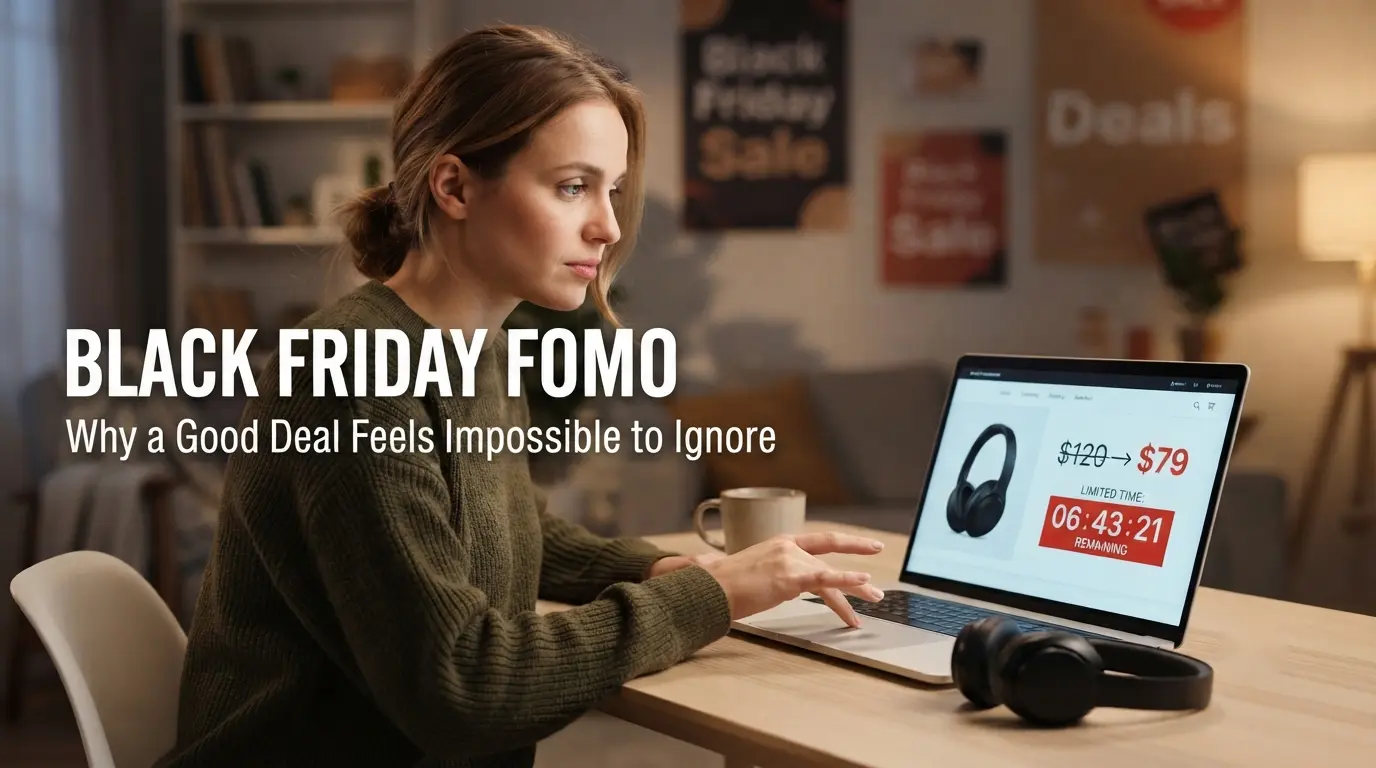
You weren't planning to buy it. Maybe you had seen the product before and decided it wasn't worth the money. Then Black Friday arrives, the price drops from $120 to $79, a countdown appears on the screen, and suddenly waiting feels like a bad decision.
The product hasn't changed. You haven't suddenly needed it more. What changed is the feeling around the purchase.
Black Friday is built around urgency. Limited-time discounts, countdown timers, low-stock messages, “Black Friday only” prices, and constant deal coverage can make shoppers feel that waiting means losing money. Instead of asking, “Do I really want this?” you may start asking, “What if I never get this price again?”
That shift is where FOMO can turn into emotional spending and, eventually, an impulse purchase. And when the excitement wears off, that purchase can leave you wondering why you bought it in the first place, the familiar feeling of buyer's remorse.
Here are five ways Black Friday FOMO can make a good deal feel impossible to ignore.
1. FOMO Makes Waiting Feel Like Losing Money
A $50 discount sounds like an opportunity. But during Black Friday, it can also feel like something you are about to lose.
Imagine you've been considering a $200 coffee maker for several months. You haven't bought it because you weren't sure you needed it. Then you see it for $129 on Black Friday. Instead of thinking about whether you actually want the coffee maker, your attention shifts toward the $71 you're supposedly “saving.”
That is an important psychological change. You are no longer evaluating the purchase on its own. You're comparing buying now with the possibility of missing the deal.
The fear of missing out can make the discount feel more important than the product itself. You may not have wanted to spend $129 yesterday, but today the thought of paying $200 later or missing the $71 savings, can create pressure to act.
This is one reason emotional spending can feel completely rational in the moment. You're not thinking, “I'm making an impulse purchase.” You're thinking, “I'd be stupid to pass this up.”
2. Countdown Timers Make Decisions Feel Urgent
Black Friday deals often come with a clock. “Ends tonight.” “Only 3 hours left.” “Deal expires at midnight.”
A countdown doesn't tell you whether you need the product. It tells you how long you have to decide.
When there is no deadline, you can close the browser, think about the purchase, compare alternatives, check your budget, or simply forget about it. A countdown creates the opposite feeling. The longer you wait, the more you may feel that you're giving up an opportunity.
This can turn a normal shopping decision into an urgent one.
You might have spent two weeks thinking about whether you need a new laptop, but suddenly feel that you have only 47 minutes to decide because the Black Friday price expires. The product deserves the same amount of thought whether the clock says 47 minutes or 47 days.
A useful question is: Would I still be considering this purchase if there were no countdown?
If the answer changes simply because a timer appeared, the urgency may be coming from the promotion rather than the product.
3. Scarcity Can Make Something Feel More Valuable
“Only a few left.”
“Almost sold out.”
“Limited quantity.”
Scarcity can make a product feel more important because the opportunity to buy it appears temporary. When something seems difficult to get, walking away can feel risky.
But scarcity doesn't change what the product can actually do for you.
A $300 television with five units left is still the same television it was when there were 500 units available. A pair of sneakers doesn't become more useful because your size might sell out.
This is where FOMO and impulse buying can overlap. The fear isn't necessarily that you need the item. The fear is that you won't be able to get it later.
If you want to explore this idea further, see “You Don't Need It, You're Just Scared of Missing Out,” our guide to how FOMO and scarcity can turn wants into impulse purchases.
That distinction is worth paying attention to. If the main reason you want something is that it might disappear, take a step back and ask whether you wanted it before it became scarce.
4. The “Best Price” Can Become More Important Than the Purchase
One of the strongest Black Friday pressures is the belief that you are seeing a price you shouldn't miss.
Maybe the headphones are $89 instead of $149. Maybe the television is $499 instead of $699. Maybe a jacket you've looked at is 40% off.
A discount can be genuinely valuable. But getting a great price doesn't automatically make buying the product a good decision.
Consider two purchases.
You spend $80 on something you've wanted for months and will use regularly. You researched it, planned for it, and would have eventually bought it anyway. The discount makes the purchase better.
Now consider spending $80 on something you never intended to buy simply because it was marked down from $140. You saved $60 compared with the original price, but you still spent $80.
This is one of the easiest ways emotional spending can disguise itself as saving.
The real question isn't just how much you're saving. It's whether the purchase itself makes sense for you.
5. Everyone Else Buying Can Make You Feel Like You Should Buy Too
Black Friday isn't just a shopping event. It's a constant stream of shopping signals.
Your inbox fills with deal alerts. Social media is full of recommendations. Friends share what they bought. Websites publish lists of the “best” deals. Videos show people opening their Black Friday purchases. Retailers highlight products that other shoppers are supposedly rushing to buy.
Eventually, buying can start to feel like the normal thing to do.
This creates a subtle form of social pressure. If everyone seems to be taking advantage of Black Friday, sitting out can feel like you're missing an opportunity.
But someone else's purchase doesn't tell you whether something belongs in your budget, your home, or your life.
A product can be a great deal for someone else and still be an unnecessary impulse purchase for you.
This is especially important when shopping becomes emotional. You aren't necessarily buying because the product solves a problem. You may be buying because participating feels good, getting the deal feels rewarding, or missing out feels uncomfortable.
The Question That Can Stop a Black Friday Impulse Purchase
When you feel that sudden need to buy, separate the product from the promotion.
Ask yourself:
“Do I genuinely want this, or am I afraid of missing the deal?”
Think about what made you notice the product in the first place. Had you already been looking for it, or did the discount create the desire?
If you have wanted the product for months, researched it, planned for the expense, and it solves a problem you already had, that's very different from discovering something today and feeling that you have to buy it before midnight.
The goal isn't to avoid every Black Friday sale. A good deal on something you genuinely need or have already planned to purchase can be a smart decision. The goal is to avoid letting the sale make the decision for you.
How to Pause Before You Buy
You don't need to completely stop shopping during Black Friday to avoid impulse spending. You simply need to create enough distance between the emotional reaction and the purchase.
Before checking out, ask yourself what originally made you want the item. Was it something you were already looking for, or did the sale introduce the desire? Then look at the actual cost, not just the discount. A product discounted from $150 to $90 still costs $90. If that $90 wasn't part of your spending plan, the discount doesn't change that.
When you can, give yourself permission to wait. Take a screenshot, save the product, or put it on a list instead of immediately checking out. Creating a pause gives you the opportunity to decide based on what you actually want rather than how urgently the sale makes you feel.
That's the idea behind WaitAndBuy: creating a little space between seeing something you want and deciding whether you actually want to buy it. Even a short pause can help you move from an emotional reaction to a more intentional decision.
That pause is at the heart of intentional spending: you don't have to decide simply because someone else created a deadline.
FAQ
Why does Black Friday cause impulse buying?Black Friday combines discounts with urgency, scarcity, countdowns, and social pressure. These signals can make shoppers focus on avoiding a missed opportunity rather than deciding whether they actually need the product.
What is emotional spending?Emotional spending is spending money in response to feelings such as excitement, stress, boredom, anxiety, or fear of missing out rather than making a purchase based primarily on a considered need or plan.
How does FOMO affect shopping?FOMO can create a fear that you will miss a product, opportunity, or price. During Black Friday, this can make waiting feel costly and increase the pressure to buy immediately.
How can I stop impulse shopping on Black Friday?Create a pause before purchasing. Ask whether you wanted the product before seeing the sale, whether the purchase fits your budget, and whether you would still want it after the urgency disappears.
Is buying something on sale still impulse buying?Yes. A discount doesn't determine whether a purchase is impulsive. If you buy something primarily because the sale creates urgency or excitement, rather than because you had already decided you wanted or needed it, it can still be an impulse purchase.
How do I know if I actually want something or just don't want to miss the deal?Ask yourself what originally attracted you to the product. If you wanted it before the Black Friday promotion appeared, the desire may be genuine. If the disappearing discount is what makes the purchase feel urgent, FOMO may be driving the decision.
Conclusion
Black Friday can make waiting feel expensive. A discount can turn into a countdown, a countdown can create urgency, and urgency can make a product you merely wanted feel like something you have to buy right now.
The most useful question isn't always, “Is this a good deal?”
It's “Am I buying this because I want it, or because I don't want to miss out?”
That distinction can help separate genuine purchases from emotional spending and impulse buying. You don't have to ignore every Black Friday sale. You just need to make sure you're buying because the product makes sense for you, not because the fear of missing out made waiting feel impossible.
If you're trying to build that habit beyond Black Friday, WaitAndBuy is built around exactly that idea: pause, think, and then decide.