Black Friday Buying Checklist: 7 Questions Before You Buy
"Not every Black Friday deal is a good purchase. Use these 7 questions to spot impulse buys, avoid FOMO, and decide whether a deal is really worth it."
Black Friday Buying Checklist: 7 Questions to Ask Before You Buy
Black Friday has a way of making an ordinary purchase feel urgent.
A pair of headphones you weren't looking for suddenly drops from $180 to $99. A jacket you've never seen before is marked down by 50%. A retailer tells you there are only a few left, and a countdown clock suggests you don't have much time to decide. Before you know it, you're no longer asking whether you need the product. You're asking whether you can afford to miss the deal.
That's where Black Friday gets tricky.
The question isn't always whether you're getting a good price. You might be. The harder question is whether you're making a good purchase.
A $100 item marked down to $60 is still a $60 purchase. If you needed it, planned to buy it, and will use it regularly, the discount could be genuinely valuable. But if you never needed the item in the first place, the 40% discount hasn't saved you $40. It has convinced you to spend $60.
A discount can lower the price, but it doesn't automatically create a need.
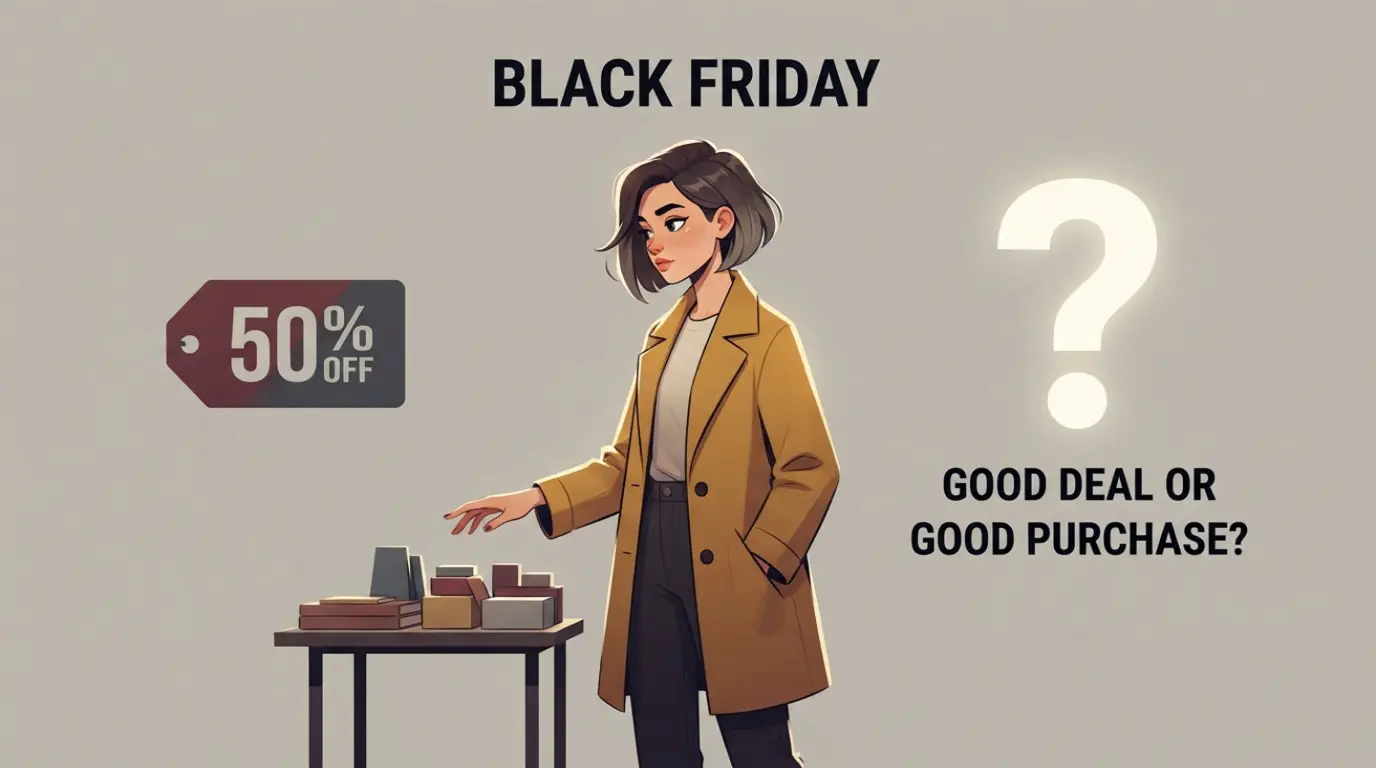
Before you click "Buy Now" this Black Friday, run the purchase through these seven questions. They are designed to create just enough distance between seeing the deal and making the decision.
Good Deal vs. Good Purchase: They're Not the Same Thing
It's easy to confuse these two ideas because Black Friday puts them side by side.
A good deal is about the offer. The price is lower than usual, the discount is attractive, or you're getting more value for your money.
A good purchase is about the decision. The item fits a genuine need or want, makes sense for your budget, and is something you're likely to use.
Consider a $200 office chair reduced to $120. That's potentially a good deal. But if you already have a comfortable chair and weren't planning to replace it, buying the discounted chair may not be a good purchase.
Now consider the opposite situation. Your current laptop is unreliable, you were already planning to replace it, and you've researched the model you want. When that laptop goes on sale during Black Friday, the discount may simply make a planned purchase cheaper.
The distinction is straightforward:
A good deal asks, "Is the price attractive?"
A good purchase asks, "Should I buy this at all?"
The seven questions below are designed to help answer that second question.
The 7-Question Black Friday Buying Checklist
1. Would I Buy This If It Were Not on Sale?
This is one of the quickest ways to separate genuine interest from discount-driven temptation.
Think back to before you saw the sale. Was this product already on your list? Had you been comparing models? Were you waiting for the price to drop? Or did you discover it because a retailer put "50% OFF" in front of you?
That difference matters.
Suppose you're shopping for a winter coat because your current one is worn out. You've been looking for one for several weeks, narrowed your options down to three, and one of them happens to be discounted on Black Friday. The sale is helping you make a decision you were already considering.
Now compare that with browsing an electronics sale and discovering a portable projector for $79. You weren't looking for a projector, don't have a particular use for one, and hadn't thought about buying one before today. The discount created the desire.
You don't have to pretend the sale doesn't make the product more appealing. The point is to ask whether the product would still matter to you without the sale attached to it.
If the discount disappeared and your interest disappeared with it, that's a good reason to pause.
2. What Problem Does This Purchase Solve?
"Because it's a great deal" isn't a problem the product solves.
Try finishing this sentence: "I'm buying this because I need it to ______."
A useful answer might be that you're replacing your broken headphones, buying something suitable for work, or replacing shoes you wear every day. A less convincing answer might be that you might use the item, it could come in handy, or you've always thought about owning one.
Those answers don't automatically mean you shouldn't buy. Wanting something is a perfectly valid reason to spend money. But when you're surrounded by hundreds of Black Friday offers, vague reasons make it easier to justify purchases you wouldn't normally make.
Consider a kitchen appliance advertised as a "must-have." If you cook every day and the appliance would replace something you already use poorly, it may solve a real problem. If you rarely cook and already have several appliances sitting unused, the problem may actually be that the sale has given you a reason to buy something.
The more clearly you can explain what the purchase is for, the easier it becomes to decide whether it belongs in your budget.
3. Do I Already Own Something That Does the Same Job?
Black Friday is particularly good at making replacements feel necessary when they're really just upgrades.
You may already own three pairs of sneakers and still find yourself considering a fourth because this particular pair is 40% off. You may already have a working television, coffee maker, backpack, smartwatch, or set of headphones, yet suddenly your existing one feels outdated because a newer version is on sale.
Before buying, look at what you already own. Ask whether the new item provides something meaningfully different or simply gives you a newer version of something that already works.
Replacing a laptop that struggles with your daily work is different from replacing a laptop that works perfectly well because the newer model has a slightly better screen. Replacing worn-out running shoes is different from buying another pair because the color looks good and the discount is unusually large.
The goal isn't to avoid upgrades. Sometimes an upgrade is worth paying for. The goal is to make sure you're buying a solution rather than duplicating something you already have.
If you already own something that does the job, ask what the new purchase does that the old one cannot. If you don't have a good answer, consider putting the item back on your list rather than immediately putting it in your cart.
4. How Often Will I Actually Use It?
A low price can make an expensive purchase feel small.
A $30 gadget doesn't sound like much during a Black Friday shopping spree. But if you use it twice, the discount didn't turn it into a useful purchase. It simply made the purchase easier to justify.
Think about the life of the item after the excitement of Black Friday disappears. Where will you use it? How often? What will it replace? Will it become part of your routine, or will it end up in a drawer, closet, or storage box?
Imagine buying a $120 espresso machine because it's marked down to $70. If you already make coffee every morning and genuinely want to change how you make it, you may get plenty of use from it. But if you rarely drink coffee at home, the machine could spend most of its life taking up counter space.
You don't need an exact calculation to answer this question. Picture yourself using the item 30 days from now, after the Black Friday excitement is gone. If you can clearly see it becoming part of your life, that's useful information. If you struggle to imagine when you'll actually use it, that's useful information too.
5. What Will This Purchase Really Cost Me?
The price on the product page isn't always the full cost of buying something.
There may be accessories, subscriptions, replacement parts, delivery charges, installation costs, maintenance, or other purchases you'll need later. A discounted printer might look inexpensive until you realize you'll need ink. A gaming device may require additional games or accessories. A fitness product may come with a subscription.
There's another cost that's easy to overlook: the money you could spend elsewhere.
If you spend $150 on three things you didn't plan to buy, that $150 is no longer available for something you actually needed. The question isn't simply "Can I afford this?" It's also "Is this where I want this money to go?"
This becomes particularly important when Black Friday shopping turns into a series of small purchases. One item doesn't feel significant, then another one appears, followed by another. By the end of the day, the individual discounts may look impressive while the total spending tells a very different story.
Before checking out, look at the entire cart rather than each discount separately. The total is what leaves your bank account.
6. Am I Buying This Because I Want It or Because I Might Miss the Deal?
This is where urgency can distort a perfectly reasonable decision.
Black Friday creates a strong sense that waiting means losing. A countdown timer, limited-stock message, "today only" promotion, or large discount can make you feel that a decision has to be made immediately.
But urgency doesn't tell you whether the product is right for you. It tells you that the offer may not last.
Ask yourself: "If this deal disappeared tomorrow, would I regret not owning the product, or would I regret missing the discount?"
Those are two different feelings.
If you've wanted a particular camera for months and finally find it at a price you can afford, missing the deal might genuinely bother you because you've already decided the camera is valuable to you.
But if you're looking at a random kitchen gadget and thinking, "I should probably buy it because it's 60% off," the fear may not be about losing the product. It may be about losing the opportunity to get something cheaply.
If you want to understand more about why Black Friday urgency can feel so difficult to resist, our guide to 5 Ways Black Friday FOMO Triggers Emotional Spending looks at the psychological triggers behind that pressure and how they can influence spending decisions.
The important thing is to recognize when the fear of missing a deal has become more powerful than your actual reason for wanting the product.
7. If I Wait 24 Hours, Will I Still Want It?
The final question is deliberately simple: Can this purchase survive a little time?
Waiting doesn't mean you can never buy the item. It means you're giving yourself an opportunity to see whether the desire remains once the immediate excitement fades.
You might come back the next day and realize you already have something similar. You might discover that you don't actually know where you'd use the product. You might notice that you're more excited about the discount than the item itself.
Or you might come back and think, "Yes, I still want this, I've thought about how I'll use it, and it fits my budget." That's a useful answer too.
The purpose of waiting isn't to turn every purchase into a "no." It's to turn an automatic yes into a deliberate decision.
If you're unsure, save the item instead of immediately buying it. Take a screenshot, add it to a wishlist, or use a tool such as WaitAndBuy to record what you wanted and revisit the decision after a waiting period.
The goal is to give the future version of yourself a chance to have a say.
The 7-Question Black Friday Test
Before you check out, run through the list one more time:
- Would I buy this if it were not on sale?
- What problem does this purchase solve?
- Do I already own something that does the same job?
- How often will I actually use it?
- What will this purchase really cost me?
- Am I buying it because I want it, or because I might miss the deal?
- If I wait 24 hours, will I still want it?
You don't need seven perfect answers to justify every purchase. Instead, look for patterns.
If you have a clear need, know how you'll use the item, don't already own an adequate replacement, understand the total cost, and would still want it without the Black Friday pressure, you may have found a genuinely worthwhile purchase.
If most of your answers revolve around the discount, urgency, or fear of missing out, that's a good reason to step away from the checkout page.
Good Deal, Good Purchase: A Real-World Example
Imagine two shoppers see the same $300 headphones discounted to $179.
Shopper A has been researching headphones for months. Their current pair is broken, they use headphones every day for work, and this is one of the models they were considering. The Black Friday price gives them a chance to buy something they already needed for less.
That's a good deal and potentially a good purchase.
Shopper B already owns two working pairs of headphones. They weren't looking for another pair until they saw the 40% discount. They don't have a specific use for the new pair, but the original $300 price makes $179 feel like an opportunity that shouldn't be missed.
That's a good deal that may not be a good purchase.
The product is identical. The discount is identical. What changes is the decision behind the purchase.
That's why the most important Black Friday question isn't "How much am I saving?" It's "Would I want this if there were no sale?"
What to Do When You Can't Decide
Not every purchase will produce a clear yes or no.
Sometimes you genuinely want something, but you're unsure whether you should buy it now. That's when a pause becomes useful.
Instead of forcing yourself to decide while the sale is in front of you, save the item and give yourself a waiting period. Write down the item, price, store, and reason you want it. Then come back to it later.
WaitAndBuy is built around exactly this idea: pause before you buy. You can save an item instead of purchasing it immediately, then return to the decision after your chosen waiting period. When you revisit it, you can decide whether to buy it, skip it, or wait longer.
That small change in timing changes the question. Instead of asking, "Should I buy this right now?" you're asking, "After thinking about it, do I still want this?"
Sometimes the answer will be yes. Sometimes it will be no. Both are useful outcomes when the decision was intentional.
FAQ
What should I ask myself before buying something on Black Friday?Start by asking whether you would buy the item if it weren't on sale. Then consider whether you need it, whether you already own something similar, how often you'll use it, the total cost, whether urgency is influencing you, and whether you'd still want it after waiting.
How do I know if a Black Friday deal is actually worth it?A Black Friday deal is more likely to be worthwhile when the item solves a real need, fits your budget, and is something you would have considered buying without the discount. A large percentage discount alone doesn't make an unnecessary purchase worthwhile.
What is the difference between a good deal and a good purchase?A good deal means you're getting an attractive price or value. A good purchase means the item itself makes sense for you. Something can be heavily discounted and still be a poor purchase if you don't need or use it.
Should I wait before buying something on Black Friday?If the purchase isn't urgent, waiting can help you separate genuine interest from the excitement of a limited-time sale. A 24-hour pause can be especially useful for unplanned purchases.
Why do Black Friday discounts make me want to buy things I don't need?Discounts can shift your attention from whether you need an item to how much money you could save. Limited-time offers and scarcity messages can add pressure, making an unnecessary purchase feel like an opportunity you might regret losing.
How can I avoid impulse buying on Black Friday?Create a list of things you genuinely need before shopping, set a spending limit, and use a checklist before buying unplanned items. Most importantly, give yourself permission to pause instead of treating every discount as an opportunity you must take.
Is buying something on sale the same as saving money?No. You save money when you spend less on something you intended to buy. If you spend money on something you didn't need simply because it was discounted, you've spent money rather than saved it.
Conclusion
Black Friday is designed to make the price feel like the most important part of the decision.
But price is only one part of a purchase.
A $200 item marked down to $100 isn't automatically a $100 saving. If you didn't need the item, it's a new $100 expense. On the other hand, if you were already planning to buy it, you've potentially found an opportunity to spend less on something you genuinely wanted or needed.
That's the difference between chasing deals and making good purchases.
Before you click "Buy Now," run through the seven questions. Ask what the product solves, whether you already own something similar, how often you'll use it, what it will really cost, and whether the urgency is coming from you or from the sale.
And if you're still unsure, wait.
The best Black Friday purchase isn't necessarily the one with the biggest discount. It's the one you'll still be glad you bought after the sale is over.