4 Types of Impulse Buying: What They Mean
"Discover the 4 types of impulse buying, with simple examples that explain why we make unplanned purchases."
4 Types of Impulse Buying: Pure, Reminder, Suggestion & Planned
Impulse buying is often described simply as buying something you did not plan to buy. But not every impulse purchase happens for the same reason. The trigger behind the purchase can be very different, even when the final result looks the same: you leave the store or close your browser with something you had not originally intended to buy.
Sometimes you see something completely unexpected and buy it because it feels exciting or different. Sometimes a product reminds you that you are running low on something at home. Sometimes you discover a product you have never considered before and suddenly convince yourself that you need it. And sometimes you go shopping expecting that you might make an additional purchase if the right discount, coupon, or promotion appears.
These different situations are captured in a classic consumer-behavior framework associated with Hawkins Stern. In his 1962 article, The Significance of Impulse Buying Today, Stern described four types of impulse buying: pure impulse buying, reminder impulse buying, suggestion impulse buying, and planned impulse buying.
Understanding these four types makes impulse shopping easier to recognize because it moves beyond simply asking whether a purchase was planned. It helps explain why an unplanned purchase happened in the first place and what caused the decision to happen at that particular moment.
It is also worth keeping the framework in context. These four categories are a classic way of understanding impulse purchases, not the only classification used in consumer research. Later researchers have used different definitions and approaches to impulse buying, so terminology and boundaries can vary somewhat.
What Are the 4 Types of Impulse Buying?
The four classic types of impulse buying are pure impulse buying, reminder impulse buying, suggestion impulse buying, and planned impulse buying. They describe different situations that can lead someone to make a purchase they had not fully specified in advance.
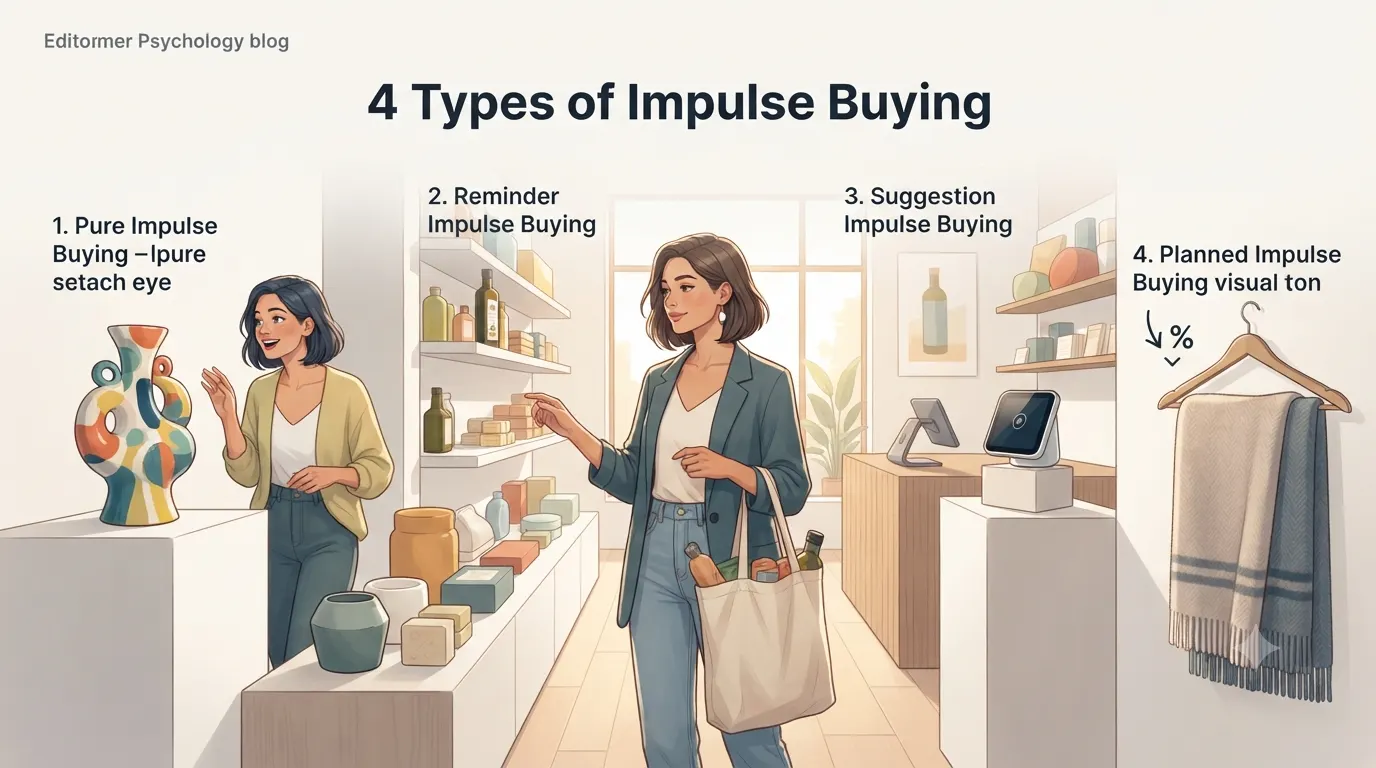
Pure impulse buying happens when a purchase breaks the shopper's normal buying pattern, often because something feels novel, exciting, or unusual. Reminder impulse buying happens when seeing a product reminds the shopper of an existing need. Suggestion impulse buying happens when encountering a product creates a new perceived need or desire. Planned impulse buying happens when a shopper expects that they may make an additional purchase if a suitable promotion, discount, coupon, or other opportunity appears.
The easiest way to distinguish the four types is to focus on the trigger. If novelty or a desire to break from your usual shopping pattern causes the purchase, it is pure impulse buying. If seeing the product reminds you of something you already need, it is reminder impulse buying. If the product introduces a new idea and makes you feel that you need or want it, it is suggestion impulse buying. If you are open to buying something extra when the right deal appears, it is planned impulse buying.
1. Pure Impulse BuyingPure impulse buying is the form most closely associated with the idea of breaking from your normal shopping behavior. It happens when a shopper encounters something unexpected and makes a purchase primarily because it feels novel, exciting, unusual, or appealing in the moment.
The important point is that the purchase stands apart from what the shopper would normally buy. You were not simply reminded of something you needed, and you were not necessarily looking for a particular solution. Instead, something about the product or situation creates an unexpected desire to buy.
For example, imagine someone who normally buys practical clothing and avoids bold styles. While walking through a store, they notice a brightly colored jacket that is completely different from anything they normally wear. They like how unusual it feels and decide to buy it despite having no intention of shopping for another jacket. The novelty of the purchase is part of what makes it a pure impulse purchase.
The same thing can happen online. You might browse an online marketplace without looking for anything specific and come across a quirky gadget that makes you curious or excited. After a few minutes of browsing the product page, you decide to buy it even though it was not something you had previously considered.
A similar situation can happen with home products. You might visit a store looking for storage boxes and unexpectedly notice an unusual decorative object near another display. You have never thought about buying one before, but you like it immediately and decide to take it home.
Pure impulse buying can therefore be summarized as an unexpected break from your usual buying pattern. The internal reaction is often something like, “I wasn't looking for this, but I really want it.”
2. Reminder Impulse BuyingReminder impulse buying happens when seeing a product reminds you of an existing need. The important difference from pure impulse buying is that the need was already there before you encountered the product. You simply were not actively thinking about it when you started shopping.
A familiar product, store display, advertisement, recommendation, or online listing can bring that need back into your attention. Once you remember it, you decide to make the purchase even though it was not part of your original shopping plan.
For example, you might visit a supermarket to buy vegetables and snacks. When you walk past the laundry detergent aisle, you remember that the bottle at home is nearly empty. You had not planned to buy detergent during that particular trip, but seeing it reminds you that you need more, so you add it to your cart.
The same pattern can happen while shopping online. You might visit an online store because you need a phone case. While browsing, you notice your usual shampoo in a recommendation or product section. You remember that the bottle at home is almost empty and add it to your order.
A physical store can trigger the same response with everyday toiletries. You might walk into a pharmacy to buy medicine and see toothpaste on a nearby shelf. Seeing it reminds you that the tube at home is nearly finished, so you decide to replace it.
The important distinction is that the product did not create the need. The need already existed. Seeing the product simply brought it back to your attention and prompted you to act.
3. Suggestion Impulse BuyingSuggestion impulse buying is different because the product creates the perceived need or desire when you encounter it. You see something you had not previously considered buying, and its features, appearance, demonstration, presentation, or apparent usefulness make you think that it would be valuable to have.
In other words, you are not remembering an existing need. The encounter itself introduces the idea.
This can happen particularly easily while shopping online. Product recommendations, demonstrations, reviews, short-form shopping videos, and product comparisons can introduce shoppers to items they were not previously considering. Once you see what the product does, you may start imagining how it could make your own life easier.
For example, you might have never heard of a compact vegetable chopper. While browsing an online store, you see a video showing how quickly it prepares vegetables. You suddenly start thinking that cooking would be easier with one and add it to your cart, even though you had not been looking for a vegetable chopper.
The same thing can happen in a physical cosmetics store. You may walk in without a specific beauty product in mind, and a salesperson demonstrates a new skincare product you have never used. The demonstration makes you think the product could solve a problem you had not previously considered, and you decide to buy it.
Social media can create a similar situation. You might be scrolling through a shopping video and see a small device designed to organize charging cables. You had never thought about buying one, but after seeing how it works, you begin imagining how useful it would be on your desk and decide that you need one.
The distinction from reminder impulse buying is important: with reminder impulse buying, you remember an existing need; with suggestion impulse buying, the encounter creates a new perceived need or desire.
4. Planned Impulse BuyingPlanned impulse buying sounds contradictory at first. If a purchase is planned, how can it also be an impulse purchase?
The distinction becomes clearer when you separate planning to buy a specific product from planning to take advantage of an opportunity. Planned impulse buying does not necessarily mean that the shopper has already chosen exactly what they will purchase. Instead, the shopper may enter a shopping situation expecting that they could make an additional purchase if the right condition appears.
That condition might be a discount, coupon, sale, special offer, or another favorable buying opportunity. The shopper is prepared to buy, but the exact product or purchase is not necessarily fully specified beforehand.
For example, someone might decide to look for a good pair of shoes during a sale. They do not have one particular pair in mind, but they know they are willing to buy if they find something suitable at an attractive price. When they encounter the right pair at a significant discount, they make the purchase.
Online shopping can create the same situation. You might already be placing an order for several household products when you notice that spending slightly more unlocks a discount. You add another item that you were interested in but had not specifically planned to purchase because the promotion changes the calculation.
A physical clothing store can create another example. You might visit during a seasonal promotion with the intention of buying something if you find a good deal. You see a shirt marked down significantly and decide to buy it even though that specific shirt was never on your shopping list.
This is why planned impulse buying is not necessarily as contradictory as it first sounds. The opportunity may be anticipated, while the specific purchase remains open-ended. You are not necessarily planning to buy a particular item; you are planning to remain receptive to an attractive buying opportunity.
Promotions, discounts, scarcity messages, and urgency can all act as external triggers in these situations. When a promotion makes you feel that you need to act immediately, it is useful to distinguish between a genuine opportunity and pressure to buy. WaitAndBuy explores this dynamic in FOMO & Scarcity Marketing: The Impulse Buying Trap.
If you want a quick visual overview of the psychology behind impulse purchases, see Impulse Buying: 12 Powerful Shorts About Why We Buy.
The Easiest Way to Tell the Four Types Apart
The four types can seem similar because they can all result in a purchase that was not fully planned in advance. The difference is the reason the product became a purchase in the first place.
With pure impulse buying, something feels different or exciting enough to break your normal buying pattern. With reminder impulse buying, you see something and remember that you already need it. With suggestion impulse buying, the product introduces a new possibility and creates a perceived need or desire. With planned impulse buying, you are already open to making an additional purchase if the right promotion or opportunity appears.
Looking at the trigger can therefore make the categories much easier to understand. If you ask yourself, “What changed between the moment I started shopping and the moment I decided to buy this?” the answer will often point toward one of the four types.
This distinction can also be useful when reviewing your own spending. Instead of simply labeling every unexpected purchase as an impulse purchase, you can look for the specific trigger behind it. That gives you a more useful picture of your shopping behavior.
Planned Purchases vs. Unplanned Purchases vs. Impulse Purchases
Planned purchases, unplanned purchases, and impulse purchases are related, but they are not necessarily interchangeable terms. The fact that something was not on your shopping list does not automatically tell you why you bought it.
A planned purchase is something you decide to buy before the shopping situation occurs. You might put it on a shopping list, research different options, compare prices, set aside money, or decide on a particular product in advance. If your washing machine stops working and you spend several days researching replacement models before ordering one, for example, that is a planned purchase.
An unplanned purchase is simply something you did not intend to buy before the shopping situation. That does not automatically mean the purchase involved a strong impulse. You might notice that you forgot something important and decide to buy it, or discover that an item you genuinely need is available at a convenient price.
An impulse purchase, by contrast, generally involves a spontaneous buying decision made close to the point of purchase. The classic Hawkins Stern framework provides four ways of understanding different impulse-buying situations based on what triggered that spontaneous decision.
This is why unplanned and impulse purchases should not always be treated as exact synonyms. A purchase can be unplanned without being a strong impulse, while an impulse purchase can involve different motivations ranging from novelty to reminders to promotions.
Why These Types Matter When You Look at Your Own Spending
Understanding the types of impulse buying becomes more useful when you apply the framework to your own shopping patterns.
Imagine looking through your recent purchases and noticing several clothing items. One purchase happened because you saw a jacket that was completely different from what you normally wear. Another happened because you remembered that some of your everyday clothes were wearing out. A third happened because you discovered a new style online and suddenly wanted to try it. A fourth happened because a store was running a major sale.
All four purchases could be considered impulse purchases, but the reasons behind them are different. Recognizing those differences can help you understand which situations tend to make you spend unexpectedly.
The best way to create a pause may also depend on the trigger. If novelty is the problem, ask whether you still want the item after the excitement fades. If reminders frequently turn into purchases, check whether you actually need the replacement. If new products repeatedly create new “needs,” give yourself time to decide whether the product solves a genuine problem. If discounts drive your spending, ask whether you would still want the item at its regular price.
Clothing is a particularly relatable example because a single purchase may feel inexpensive while repeated purchases can add up. If you find yourself repeatedly buying clothes because they are cheap or heavily discounted, WaitAndBuy's story Cheap Clothes & Impulse Buying looks at why low prices can make spontaneous purchases easier to justify.
A Simple Pause Before an Impulse Purchase
You do not have to eliminate every impulse purchase. The more useful goal is to recognize the moment when an impulse appears and create enough distance to decide whether the purchase actually makes sense.
Before checking out, consider what triggered the desire. Were you already looking for the product, or did you only notice it because it appeared in front of you? Did seeing it remind you of something you genuinely need? Did the product create a new desire that you had not considered before? Or is the main reason you want it the fact that it is currently discounted or available as part of a promotion?
It can also help to ask whether you would still want the item without the discount, whether you already own something similar, and whether you would make the same decision after waiting a day or two. You do not necessarily need a complicated system. Even a short pause can create enough distance between the initial impulse and the final decision.
If you regularly wonder where your impulse spending goes, WaitAndBuy's Impulse Purchase Calculator can help you look at the cost of those purchases over time rather than judging each purchase individually.
FAQ
What are the 4 types of impulse buying?The four classic types associated with Hawkins Stern are pure impulse buying, reminder impulse buying, suggestion impulse buying, and planned impulse buying. They describe different situations and triggers that can lead to an impulse purchase.
What is pure impulse buying?Pure impulse buying occurs when a shopper breaks their normal buying pattern and makes an unexpected purchase because of novelty, excitement, or the desire for something different.
What is reminder impulse buying?Reminder impulse buying occurs when seeing a product reminds you of an existing need. For example, seeing toothpaste while shopping may remind you that the tube at home is almost empty.
What is suggestion impulse buying?Suggestion impulse buying occurs when encountering a product creates a perceived need or desire that the shopper had not previously considered. The product itself introduces the idea that it could be useful or desirable.
What is planned impulse buying?Planned impulse buying occurs when a shopper is prepared to make an additional purchase if a suitable condition appears, such as a discount, coupon, sale, or special promotion. The general opportunity may be anticipated even though the exact purchase is not fully specified in advance.
Is impulse buying the same as an unplanned purchase?Not necessarily. An unplanned purchase is simply something you did not intend to buy beforehand, while an impulse purchase involves a spontaneous buying decision made close to the point of purchase. Some unplanned purchases are practical or deliberate once the need becomes apparent, so unplanned and impulse purchases should not always be treated as exact synonyms.
Conclusion
The four types of impulse buying show that spontaneous purchases are not all triggered in the same way. Pure impulse buying breaks your normal shopping pattern. Reminder impulse buying brings an existing need back to mind. Suggestion impulse buying creates a new perceived need when you encounter a product. Planned impulse buying involves being open to an additional purchase when the right deal or opportunity appears.
The Hawkins Stern framework remains a useful classic consumer-behavior lens for understanding these differences, although later research has used other definitions and classifications of impulse buying. That means the four categories are best treated as a useful framework rather than a rigid rule for labeling every spontaneous purchase.
The next time you make an unexpected purchase, try identifying the trigger before judging the decision. Was it novelty, a reminder, a newly created desire, or a tempting opportunity? Understanding why you wanted something can be the first step toward deciding whether you actually want to buy it.