Why Do We Buy So Many Halloween Decorations?
"Why do we keep buying Halloween decorations when we already have enough? Explore the psychology behind seasonal shopping, novelty, scarcity, and overbuying."
Why Do We Buy So Many Halloween Decorations?
You open a storage bin in the garage and find plastic pumpkins, fake cobwebs, skeletons, orange lights, signs, candles, ghosts, and decorations you barely remember buying. Some of them may have been used only a few times. Others may have been sitting there for years.
Then Halloween arrives again, and you find yourself looking at a new collection of decorations in the store. There is a different kind of skeleton, a pumpkin that looks more interesting than the ones you already own, or a new sign that would look perfect near the front door. You already have plenty of Halloween decorations, but the new ones still feel tempting.
Why does this happen? Why do we repeatedly buy seasonal decorations when the decorations we already own are perfectly usable?
The answer has less to do with pumpkins and skeletons than it does with the psychology of seasonal shopping. Halloween combines novelty, emotion, scarcity, social expectations, and easy-to-justify purchases in a way that can make buying something new feel more appealing than using what we already have.
Halloween Turns Shopping Into Part of the Experience
For many people, Halloween is more than a single day on the calendar. The season builds gradually as stores put out decorations, neighborhoods begin to change, parties are planned, and people start thinking about costumes and events. Shopping becomes part of that build-up, which means the act of browsing can feel like part of the celebration itself.
That changes the question we ask when we see something we like. Ordinary shopping often begins with a practical need: What do I need to replace? What am I running out of? What problem do I need to solve? Halloween shopping can begin with a very different thought: What would be fun? What would look good this year? What would make the house feel more festive?
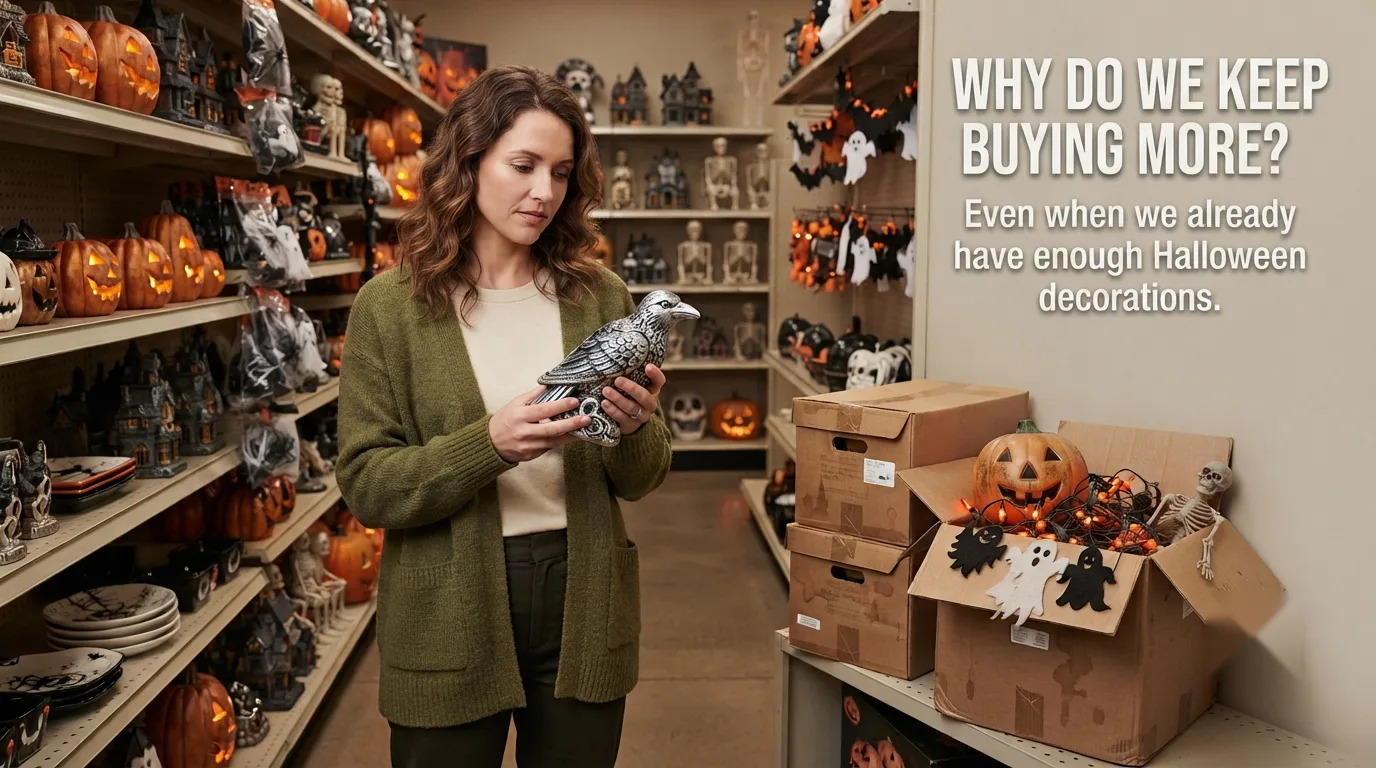
A decoration does not have to solve a practical problem to feel worthwhile. It can provide atmosphere, nostalgia, excitement, or a sense of participation in the season. That makes it easier to justify a purchase even when there is no real gap in what we already own.
In other words, you may not be buying another plastic pumpkin because you need another plastic pumpkin. You may be buying the feeling associated with having something new for Halloween.
Why This Year's Decorations Can Feel Different
One of the strongest attractions of seasonal shopping is novelty. The decorations sitting in your storage box may still be perfectly good, but they have become familiar. A new Halloween collection, on the other hand, gives you something you have not seen before.
That can create the feeling that this year's Halloween should look different from last year's. Perhaps you used traditional pumpkins before and now want something darker or more elaborate. Maybe your decorations have been the same for several years and you feel ready for a change. Or perhaps you simply saw something that fits your current taste better than what you already own.
There is nothing inherently wrong with wanting to change your decorations. The interesting part is how easily a desire for variety can become a reason to keep adding rather than replacing. Instead of choosing which old decorations no longer belong and making room for something new, we often keep everything and add another item to the collection.
The result is predictable over time: each year's new decorations become part of next year's existing collection, while the desire for something different starts the cycle again.
Why “Just One More” Is So Easy
Halloween decorations are particularly good at encouraging small purchases because many individual items do not feel expensive. A small pumpkin, a decorative sign, a string of lights, or a tabletop decoration can seem like such a minor expense that it hardly feels necessary to think about the purchase.
The problem is that we tend to evaluate these decisions one at a time. One inexpensive decoration does not feel significant. Neither does the next one. But several small decisions can eventually produce a surprisingly large collection without there ever being a moment when you consciously decided to spend a large amount of money on Halloween decorations.
This is one reason seasonal overbuying can be difficult to notice while it is happening. Each purchase can have its own justification: this one is different, that one would look good outside, and this other one is inexpensive enough to take home. The accumulation only becomes obvious later, when you are packing everything away or trying to find space for another storage box.
The individual purchase may be small. The habit is not.
A single inexpensive decoration may not seem significant, but several “just one more” purchases can add up over time. The WaitAndBuy Impulse Purchase Cost Calculator can help you see what those small impulse purchases could cost when you look at the bigger picture.
Seasonal Scarcity Makes Waiting Feel Risky
Halloween also creates a natural sense of urgency because the shopping season is temporary. Seasonal displays appear for a limited period, and particular designs may not be available once the season has passed. That can make a product feel more valuable simply because you know the opportunity to buy it will not last forever.
Scarcity is known to influence consumer behavior. Research examining scarcity promotions has found that limited-time and limited-quantity cues can increase arousal and contribute to impulse purchasing, although the strength of the effect varies depending on the situation and the product.
Halloween does not necessarily need an aggressive “buy now” message to create this feeling. The calendar itself creates the deadline. If you see something you like in October, waiting until November may mean waiting until next Halloween.
That changes the way we think about the decision. With an ordinary purchase, waiting can feel sensible because the item will probably still be available later. With a seasonal decoration, waiting can feel like taking a risk. Even when the decoration is something you did not need five minutes earlier, the possibility of losing the opportunity can make it feel harder to walk away.
You May Not Remember What You Already Own
There is also a surprisingly practical reason Halloween shopping can lead to overbuying: many seasonal decorations are invisible for most of the year.
Your Halloween decorations may be packed into boxes in a garage, attic, closet, basement, or storage room. By the time October arrives, you may have only a vague memory of what is actually inside those containers. Meanwhile, the store is presenting you with a highly visible collection of new possibilities.
That creates an information problem. The new decoration is directly in front of you, while the decorations you already own exist somewhere in your memory. You may genuinely think you need something similar simply because you cannot immediately remember what you have.
Opening your storage boxes before going shopping can therefore change the decision. Instead of thinking, “I don't have anything like this,” you might discover that you already have three decorations that serve almost exactly the same purpose. The purchase then becomes a choice between what you actually need and what happens to be exciting right now.
Sometimes the simplest way to reduce seasonal overbuying is to make your existing collection visible before the new collection gets your attention.
Social Expectations Can Make “Enough” Feel Like “Not Enough”
Halloween decorations can also become part of how people present their homes. If friends, neighbors, family members, or social media accounts around you are decorating, those examples can gradually influence your idea of what a Halloween setup should look like.
The expectation does not have to be explicit. Nobody has to tell you that you need more decorations. You simply see decorated houses, elaborate displays, themed rooms, and increasingly creative ideas, and your own setup may start to look less impressive by comparison.
Research on social norms and consumer decision-making suggests that perceptions of what other people do or approve of can influence consumer behavior.
That does not mean people decorate only to impress others. Halloween decorating can be genuinely enjoyable and creative. The important point is that social expectations can quietly change the definition of “enough.” A few decorations may have felt perfectly adequate before you saw what everyone else was doing. Afterwards, the same collection can suddenly feel incomplete.
Once that happens, buying another decoration can feel less like adding an unnecessary object and more like catching up with an expectation you never consciously chose.
Shopping Can Feel Better Than Owning
Perhaps the most interesting part of Halloween overbuying is that the emotional reward can happen before the decoration is ever used.
There is anticipation when you walk through the seasonal aisle. There is the satisfaction of finding something you like, imagining where it will go, and bringing something new home. The purchase itself can become part of the Halloween experience.
That creates an important distinction between wanting to buy something and wanting to own it. You may genuinely like a decoration, but the strongest feeling might be connected to discovering it and taking it home. Once the excitement of the purchase disappears, the object has to become part of your actual life. In the case of a seasonal decoration, that can mean spending only a few weeks on display before returning to storage for another year.
This does not make the purchase automatically wasteful. Some objects are worth owning because they create enjoyment during a special occasion. But it does make the decision more interesting. The question is no longer simply whether you like the decoration. It is whether you like it enough to own, store, unpack, display, and store again when the season is over.
How a Seasonal Shopping Habit Becomes Accumulation
One Halloween decoration rarely looks like a problem. The accumulation happens because the old decorations usually stay.
You buy a few things this year, then add a few more next year. Perhaps you change your decorating style, but instead of replacing the older pieces, you keep them because they might be useful later. After several years, your storage boxes contain multiple versions of the same basic categories: pumpkins, lights, signs, figures, table decorations, and outdoor pieces.
The number of decorations you own is therefore determined less by how many you need for one Halloween and more by how many purchases you have made across several Halloweens.
This is why seasonal shopping can quietly turn into accumulation. The need does not necessarily increase, but the collection does.
A useful question before buying another decoration is not simply, “Do I like this?” It is, “Do I like this enough to store it for another year?”
That question brings the future back into a decision that is usually dominated by the excitement of the present.
What to Ask Before Buying Another Halloween Decoration
You do not have to stop buying Halloween decorations to avoid overbuying them. The more useful goal is to create a little distance between seeing something you like and deciding that you need to own it.
Before making another seasonal purchase, consider a few questions:
- Do I already own something that serves the same purpose?
- Do I remember what I have in storage at home?
- Would I still want this if it were available all year?
- Am I replacing something, or simply adding another item?
- Do I like the decoration itself, or mainly the excitement of finding something new?
- Where will I store it after Halloween?
- How often am I realistically going to use it?
- If I leave it behind today, will I still be thinking about it later?
These questions are not meant to turn Halloween shopping into a complicated decision-making exercise. They simply slow the process down enough to separate a lasting preference from a temporary impulse.
That distinction can be useful because the strongest desire to buy something is not always the same as the strongest desire to own it.
Do You Want the Decoration, or the Feeling of Buying Something New?
Halloween makes seasonal overbuying easy to understand because several different forces arrive at the same time. New decorations create novelty, the limited season creates urgency, other people's displays can influence expectations, and existing decorations are often hidden away where we cannot easily remember them.
But underneath all of those influences is a simpler question: What are you actually responding to when you want to buy?
Sometimes you genuinely want the decoration and will enjoy using it. Sometimes you are replacing something that no longer works or no longer fits your style. But sometimes what feels like a desire for the object is really a desire for novelty, discovery, or the excitement of buying something new.
Giving yourself a pause before purchasing can make that difference easier to see. You might still decide to buy the decoration. The important part is that the decision comes from you rather than from the urgency of the moment.
That is the basic idea behind WaitAndBuy as well: creating a little space between seeing something you want and deciding whether you actually want to buy it. The goal is not to make every purchase a “no,” but to make sure the purchase is a decision rather than an automatic reaction.
FAQ
Why do people buy so many Halloween decorations?People can buy more Halloween decorations than they need because seasonal shopping combines novelty, emotion, scarcity, social influence, and easy-to-justify small purchases. New collections can make existing decorations feel less exciting, while the temporary nature of the season can create a sense of urgency.
Why do I want new Halloween decorations when I already have enough?You may be responding to more than the decoration itself. New seasonal items can provide excitement, variety, and the feeling of making this year's Halloween different from previous years. Sometimes the desire for novelty is stronger than the practical need for another decoration.
Why do Halloween decorations feel like they need to be different every year?New seasonal designs can make familiar decorations feel less exciting. Seeing new themes and styles may create the impression that your Halloween setup should change every year, even when the decorations you already own are still perfectly usable.
Why does “just one more” lead to so many Halloween decorations?Small purchases are easy to justify individually, especially when each item seems inexpensive. The problem is that several small purchases can accumulate over multiple years without ever feeling like one major spending decision.
Does scarcity make people buy Halloween decorations?Scarcity can create urgency and influence purchasing decisions. Research on scarcity has found that limited-time and limited-quantity cues can increase arousal and purchase intentions, although their effects depend on the circumstances and product.
Why do I forget what Halloween decorations I already have?Seasonal decorations are often stored for most of the year, so they are out of sight when new products appear in stores. This can make new decorations more mentally available than the items already sitting in storage.
How can I stop buying too many Halloween decorations?Start by looking at what you already own before shopping. Then pause before buying and ask whether the item fills a genuine need, replaces something you already have, or simply feels exciting because it is new. Thinking about where you will store and use it can also make the decision more realistic.
Should I stop buying Halloween decorations altogether?Not necessarily. There is nothing wrong with buying decorations you genuinely enjoy. The goal is to become more intentional about the purchases you make so that you are buying because you want the item and expect to use it, rather than because the seasonal shopping environment made the purchase feel urgent.
For a closer look at the specific psychological triggers and repetitive spending habits behind seasonal clutter, read 8 Reasons You Keep Buying More Halloween Decorations.
Conclusion
The reason we buy so many Halloween decorations is not simply that we love Halloween. It is that Halloween creates a particularly effective environment for wanting something new.
The seasonal displays give us novelty. The short shopping window creates urgency. Other people's decorations can influence what feels like enough. And because our existing decorations spend most of the year in storage, it is surprisingly easy to forget just how much we already own.
Recognizing these patterns does not mean you have to stop decorating, stop shopping, or reuse the same decorations forever. It simply gives you another way to look at the moment when you reach for one more item.
Before buying it, ask yourself one question:
Do I actually want this, or do I just want the feeling of buying something new?
Sometimes you will still buy it. But when you can tell the difference between wanting the object and wanting the excitement of the purchase, you are much more likely to end up with decorations you actually value rather than a storage box that keeps getting fuller every Halloween.