Shopping Addiction: Why You Can't Stop Buying
"Why can't you stop buying things you don't need? Learn what causes shopping addiction, how compulsive buying keeps the cycle going, and how to break it."
When Shopping Stops Feeling Like a Choice
Shopping can start innocently enough.
You see something interesting, browse for a few minutes, find a good deal, and decide to buy it. Nothing unusual about that.
The problem starts when shopping becomes something you do automatically whenever you're bored, stressed, restless, lonely, or looking for a quick lift. You may not even be looking for anything specific. You open an app, scroll for a while, find something interesting, and suddenly you're checking out.
Then comes the familiar thought: Why did I buy this?
One purchase doesn't necessarily mean there's a problem. But when the same pattern keeps repeating despite regret, clutter, financial pressure, or promises to stop, it may be worth looking at the behavior more closely.
What Is Shopping Addiction?
Shopping addiction is a commonly used term for a pattern of repeated, difficult-to-control buying. It is also sometimes discussed as compulsive buying or compulsive buying behavior.
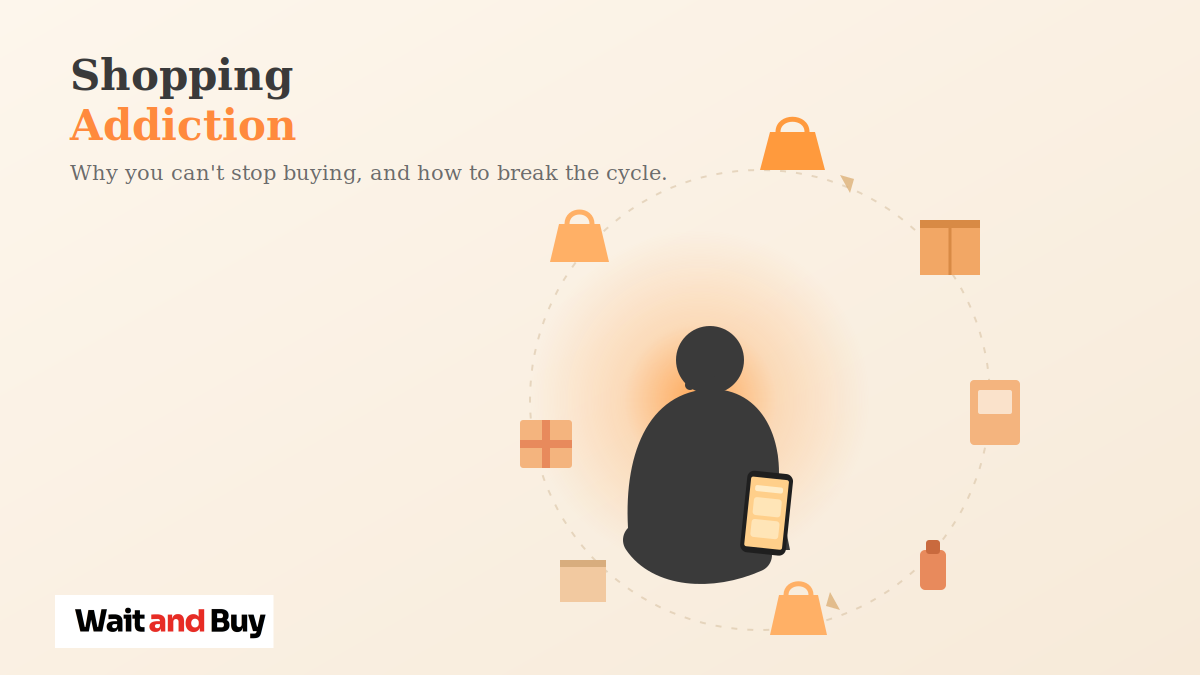
The important distinction is between an occasional impulse purchase and a persistent pattern that feels difficult to control.
Someone struggling with compulsive shopping may spend more time browsing than they intended, repeatedly buy things they don't need, hide purchases, feel guilty afterward, or continue shopping even when they know it is creating problems.
The product isn't always the main attraction.
Sometimes the anticipation of finding something, getting a bargain, completing the purchase, or imagining how the new item will improve life becomes the rewarding part.
That can turn shopping from an occasional activity into a repeating emotional cycle.
What Are the Signs of Shopping Addiction?
There isn't one single behavior that proves someone has a shopping addiction. The bigger issue is the overall pattern and whether shopping is becoming difficult to control.
Some warning signs can include:
- Frequently buying things you didn't plan to purchase
- Spending more time shopping or browsing than you intended
- Shopping mainly when you're stressed, bored, or upset
- Feeling a strong urge to buy something even when you know you shouldn't
- Experiencing guilt or regret after purchases
- Accumulating things you rarely use
- Making promises to stop and repeatedly breaking them
- Hiding purchases or minimizing how much you've spent
- Continuing to shop despite financial, relationship, or emotional consequences
Having one of these experiences occasionally doesn't automatically mean you have an addiction. What matters is whether the behavior is persistent, difficult to control, and causing meaningful problems in your life.
Why Do Bargains Make Impulse Buying Feel Responsible?
One of the easiest ways to rationalize an unnecessary purchase is to find a discount.
Imagine seeing something originally priced at $100 for $40.
Your first thought might not be, "Do I need this?"
It might be, "I'm saving $60."
That small change in thinking can make an impulse purchase feel financially responsible.
Second-hand marketplaces can create the same effect. A rare item, limited availability, or unusually low price can make passing on the purchase feel like losing an opportunity.
But a discount doesn't turn an unnecessary purchase into a necessary one.
If you spend $40 on something you never needed, you haven't saved $60. You spent $40.
That's why one useful question to ask before buying a bargain is:
Would I still want this if it were full price?
If the answer is no, the discount may be driving the decision more than the item itself.
Why Does Late-Night Shopping Make Impulse Buying Worse?
Late-night browsing has its own set of risks.
When you're tired, it can become harder to slow down and think through the consequences of a purchase. At the same time, online stores are always available. There is no closing time forcing you to walk away.
You can lie in bed, open a shopping app, and move from one product to another without any natural stopping point.
A few minutes of browsing can turn into an hour.
For someone who already uses shopping as entertainment or emotional relief, late-night browsing can become a predictable trigger. The quiet environment, fatigue, boredom, and constant stream of products create an easy path from "I'm just looking" to "I might as well buy it."
The solution isn't necessarily to eliminate online shopping.
It's to recognize when you're most vulnerable to making decisions you may not make during the day.
Is Compulsive Shopping the Same as Impulse Buying?
Not exactly.
Impulse buying is a purchase made spontaneously, often without planning or much consideration. It can happen to almost anyone.
Compulsive shopping is a broader and more persistent pattern in which a person may feel driven to shop repeatedly despite negative consequences.
The two can overlap, but they aren't the same thing.
To unpack those underlying emotional triggers and spot your personal habits, read Journaling for Shopping Addiction: Can Writing Down Your Urges Help Stop Impulse Buying?.