Overconsumption & Shopping Addiction: Why We Keep Buying
"Why do we keep buying things we don't need? Learn how overconsumption and shopping habits fuel the cycle and how to break it."
When More Starts Feeling Like Less
The bathroom shelf looked impressive at first. There were products for dry skin, products for glowing skin, products for relaxing after work, and products that promised to make an ordinary shower feel like a spa experience. The problem was that most of them were barely being used.
Every few weeks, another product appeared. A new moisturizer looked promising. A body wash was trending. Someone online had discovered an "essential" oil that apparently belonged in everyone's routine. None of these purchases felt unreasonable on their own, and that was exactly the problem. One bottle didn't seem excessive, and neither did another. When each purchase was inexpensive and each product promised a slightly better version of everyday life, there was always a reason to buy one more.
Eventually, the shelf stopped looking like self-care and started looking like a reminder of how often buying had replaced actually using what was already there.
How Social Media Turns Everyday Products Into "Must-Haves"
Social media can make ordinary products feel essential. A simple skincare routine can look incomplete when every video shows ten steps. A basic shower can suddenly seem inadequate when creators showcase shelves full of specialized products.
The constant exposure creates a subtle shift in expectations. Instead of asking "do I need this," it becomes easier to start asking "what am I missing." That shift can turn everyday consumption into a never-ending search for the next product, upgrade, or routine. Because the products involved are often relatively inexpensive, the spending tends to stay invisible for a long time.
Why Do We Keep Buying Things We Don't Need?
Overconsumption rarely starts with the intention to accumulate too much. It usually starts with a small promise: this might work better, this could make the routine easier, it's worth trying while it's on sale, or everyone else already seems to be using it.
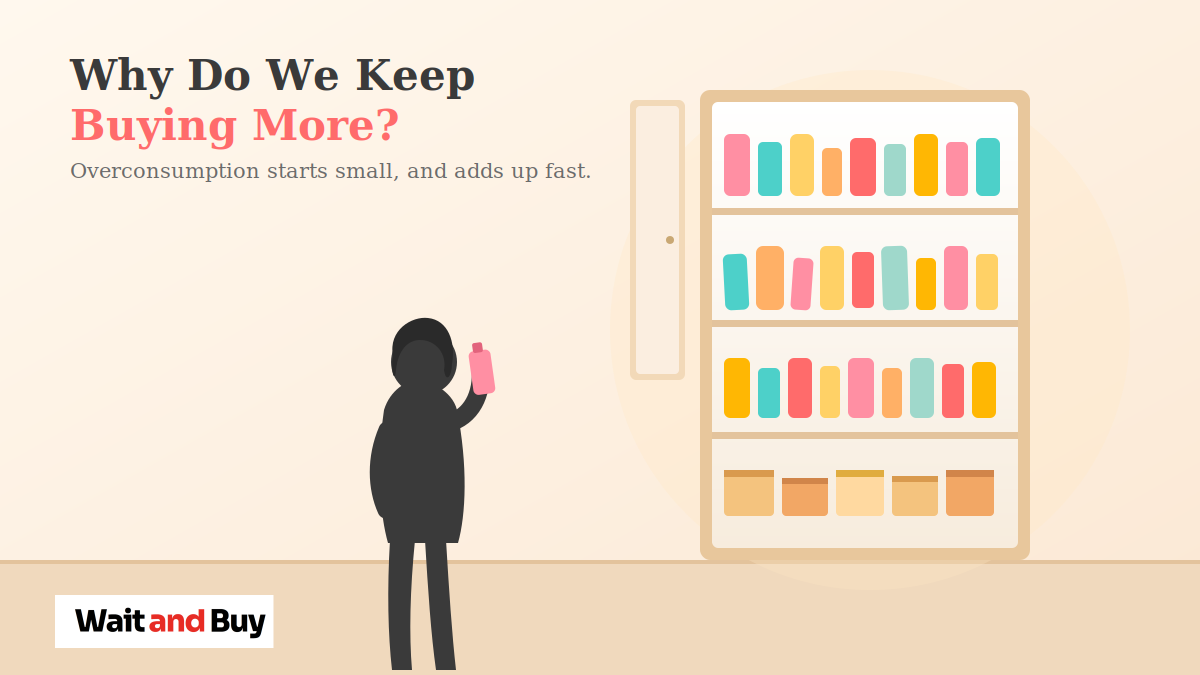
Each purchase provides a little excitement and a sense that something is being improved. But when the same pattern repeats often enough, buying stops being about solving a problem and becomes more about responding to the urge to buy in the first place. That shift is exactly where impulse buying settles in as a habit rather than an occasional decision.
When Does Shopping Become a Problem?
Buying something occasionally because you enjoy it isn't automatically a problem. The warning signs have more to do with the pattern surrounding the purchases than any single one of them.
It's worth paying attention if you regularly buy products faster than you can use them, keep backups of things you already have plenty of, purchase something mainly because you saw it repeatedly on social media, feel guilty or embarrassed about how much you've accumulated, spend money meant for other priorities on non-essential purchases, or keep buying even after realizing that past purchases never actually solved the problem they were supposed to fix. The individual purchase may look harmless enough on its own. The repeated pattern is what actually matters.
Why Decluttering Doesn't Always Solve Overconsumption
Getting rid of unused products can feel like a fresh start, but there's an important question worth asking afterward: what caused the shelf to get crowded in the first place? If the answer is social media, boredom, stress, sales, or the feeling of missing out on something, simply clearing out the products doesn't remove the actual trigger behind them. An empty shelf can turn back into a full one surprisingly fast.
That's why reducing overconsumption isn't only about owning less. It's also about changing what happens before the purchase, not just cleaning up after it.
For a unique perspective on how changing your physical space and confronting physical accumulation can break the cycle of buying things you don't need, read How Moving Homes Cured My Impulse Buying Habit.
How Can You Stop Buying Things You Don't Need?
You don't necessarily need to stop shopping completely. What helps more is slowing the decision down. Before buying something, it's worth asking whether you actually need it, whether you'll use it regularly, and whether you already own something that does the same job.
The most useful question of all might be whether you'd still want the item if you couldn't buy it right this moment. That single question creates something impulse buying doesn't like: time.
Can a Pause Help With Impulse Buying?
A pause creates distance between seeing something you want and deciding to buy it. Instead of purchasing immediately, saving the item and stepping away gives the moment room to settle. The excitement might still be there later, and if it is, the purchase may genuinely be something worth having. But often the urgency quietly disappears once time has passed, and when that happens, no willpower was needed at all. The gap did the work on its own.
A Simpler Way to Pause Before Buying
This is the idea behind WaitAndBuy. When you see something you want, you take a photo instead of buying it right away, save the item and its details, and come back to it later. If it still feels worth it, you can go ahead and buy it.
The goal isn't to tell you that you shouldn't shop. It's to give you a moment between wanting something and buying it. Sometimes consuming less doesn't require more discipline. It just requires giving yourself enough time to decide.